Rice paper — "banh trang" — is one of those ingredients that seems simple until you start paying attention to how many versions exist and how differently each one behaves in the kitchen or on the street. Swap the wrong type into a recipe and the whole thing falls apart, literally.
What Banh Trang Actually Is
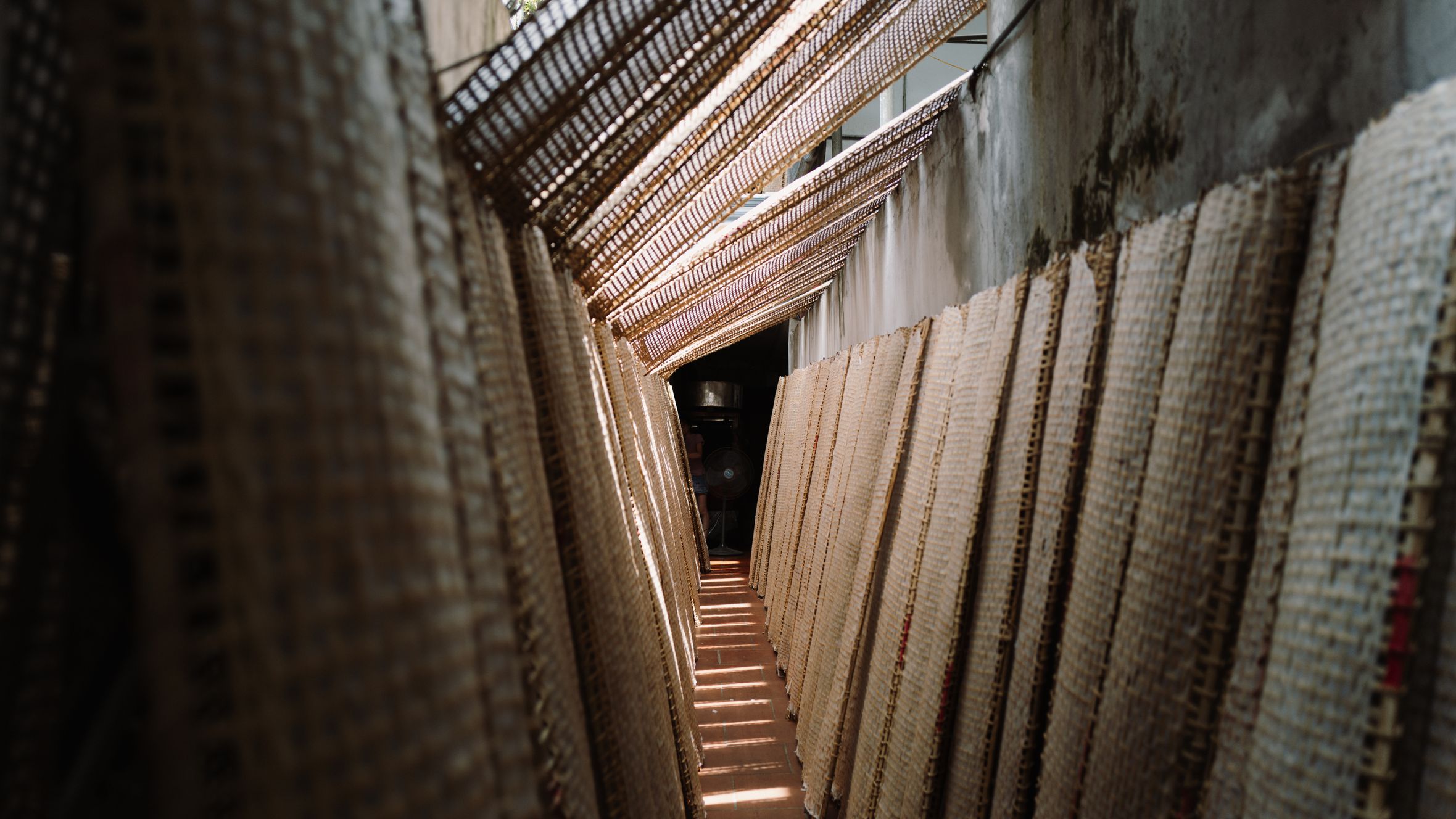
At its core, banh trang is a dried sheet made from a batter of rice flour, water, and salt, spread thin on a cloth stretched over a steaming pot, then sun-dried on bamboo racks. That basic method is consistent across Vietnam (베트남 / 越南 / ベトナム). What changes — and changes significantly — is the rice variety used, the thickness of the pour, whether tapioca starch is added for stretch, and how long the sheets dry. Those variables produce discs that behave completely differently at the table.
Banh Trang Tay Ninh — The Southern Standard
If you have ever eaten "goi cuon" (fresh spring rolls) in Saigon or anywhere in the south, you have almost certainly used a Tay Ninh sheet. Tay Ninh province, about 100 km northwest of Saigon, has been the dominant producer for the south for generations. The sheets are thin, semi-transparent when held to light, and have a clean, slightly neutral flavor with just a whisper of salt. They hydrate quickly — ten to fifteen seconds submerged in room-temperature water is usually enough — and they are pliable without tearing if you handle them with a light touch.
The thinness is the point. Goi cuon (고이꾸온 / 越南春卷 / ゴイクオン) depends on seeing the shrimp and herbs through the wrapper. A thick, opaque sheet kills the visual and changes the texture ratio. Tay Ninh sheets are also the wrapper of choice for "cha gio" (fried spring rolls) in the south, though here a slightly thicker variant is preferred so the roll does not blow out in hot oil.
In Tay Ninh town itself, you will find banh trang sold by weight at the market for around 30,000–50,000 VND per half-kilo, and vendors sell them seasoned with dried shrimp, scallion oil, or chili as a street snack eaten dry or barely moistened — a local habit that rarely travels north.
Banh Trang Phoi Suong — The Central Specialty
"Banh trang phoi suong" translates roughly as dew-dried rice paper, and the name describes the process: sheets are taken out in the early morning and left to absorb the moisture in the air before sunrise, which gives them a softness and slight tackiness that oven-dried or fully sun-dried sheets do not have. This variety is most associated with Hoi An and the broader Quang Nam region.
The texture is the key difference. Banh trang phoi suong does not need to be dipped in water at all — it is already soft enough to roll immediately. In Hoi An, it is the standard wrapper for "cao lau" accompaniments and appears constantly at tables where you are building your own rolls from a spread of herbs, pork, and vegetables. It has a slightly thicker body than the Tay Ninh sheet and a more pronounced rice flavor.
In Da Nang and Hue, similar dew-softened sheets appear alongside "banh xeo" (sizzling crepes), where diners tear off pieces of the crepe and roll them inside the rice paper with lettuce and herbs. The rice paper here is not a container — it is a structural element that softens and merges with everything inside it.

Photo by Pragyan Bezbaruah on Pexels
Banh Trang Nuong — Grilled Rice Paper
This one has escaped its Dalat origins and spread to every major city, but it is worth understanding where it started. "Banh trang nuong" — grilled rice paper topped with egg, scallion oil, dried shrimp, and various toppings — was for years primarily a Da Lat street snack, associated with the city's cooler evenings and its high-school and university crowd who would gather around charcoal grills after dark.
The sheets used for nuong are thicker than goi cuon wrappers — they need to hold toppings and survive direct heat without cracking. In Da Lat, a single sheet runs 15,000–25,000 VND depending on toppings. In Hanoi and Saigon, the same format now appears as "pizza banh trang" with cheese and processed meat additions, which is its own thing entirely.
Banh Trang Xich Lo — A Northern Snack Format
Less known outside the north, banh trang xich lo is a thicker, chewier disc typically sold as a snack, either plain or seasoned. The name references the cyclo (xich lo) vendors who once sold them from bicycle carts around Hanoi's streets. The sheets are often eaten with a dipping sauce made from fermented shrimp paste, lime, and chili, or pressed around grilled meat.
The texture is noticeably more substantial than southern varieties — closer to a chewy rice cracker than a delicate wrapper. They do not hydrate into soft rolls. They are meant to be bitten into, providing a snap and chew that the southern thin sheets cannot replicate.

Photo by FOX ^.ᆽ.^= ∫ on Pexels
How to Tell Them Apart at the Market
At any large market — Dong Xuan in Hanoi or Ben Thanh in Saigon — you will find multiple varieties stacked together. A few quick signals: thin, near-transparent sheets are Tay Ninh-style and best for fresh rolls. Slightly thicker, off-white sheets with a matte surface are better for frying. Pre-softened sheets that stick slightly when stacked are phoi suong types, usually from central producers. Thick, rigid discs with a rougher surface are your grilling and snacking sheets.
Vendors know exactly what each type does. Ask what you are cooking and they will hand you the right one — and probably be mildly surprised that you asked.
Practical Notes
Banh trang keeps well in a sealed bag in a cool, dry place for several months, which makes it worth buying regionally when you are traveling — a pack of genuine Tay Ninh sheets from the source costs a fraction of what import shops in Hanoi charge. If you are buying for goi cuon specifically, size matters: 22 cm diameter sheets are standard for single-serving rolls, while 28 cm sheets give more room for stuffing.
Last updated · May 29, 2026 · independently researched, never sponsored.




