Hue has a reputation for obsessing over its own food, and "banh ep" is a good example of why that reputation is earned. It's a snack so tied to this city that you'll struggle to find a credible version of it anywhere else in Vietnam (베트남 / 越南 / ベトナム) — and the imitations that do exist mostly miss the point.
What Banh Ep Actually Is
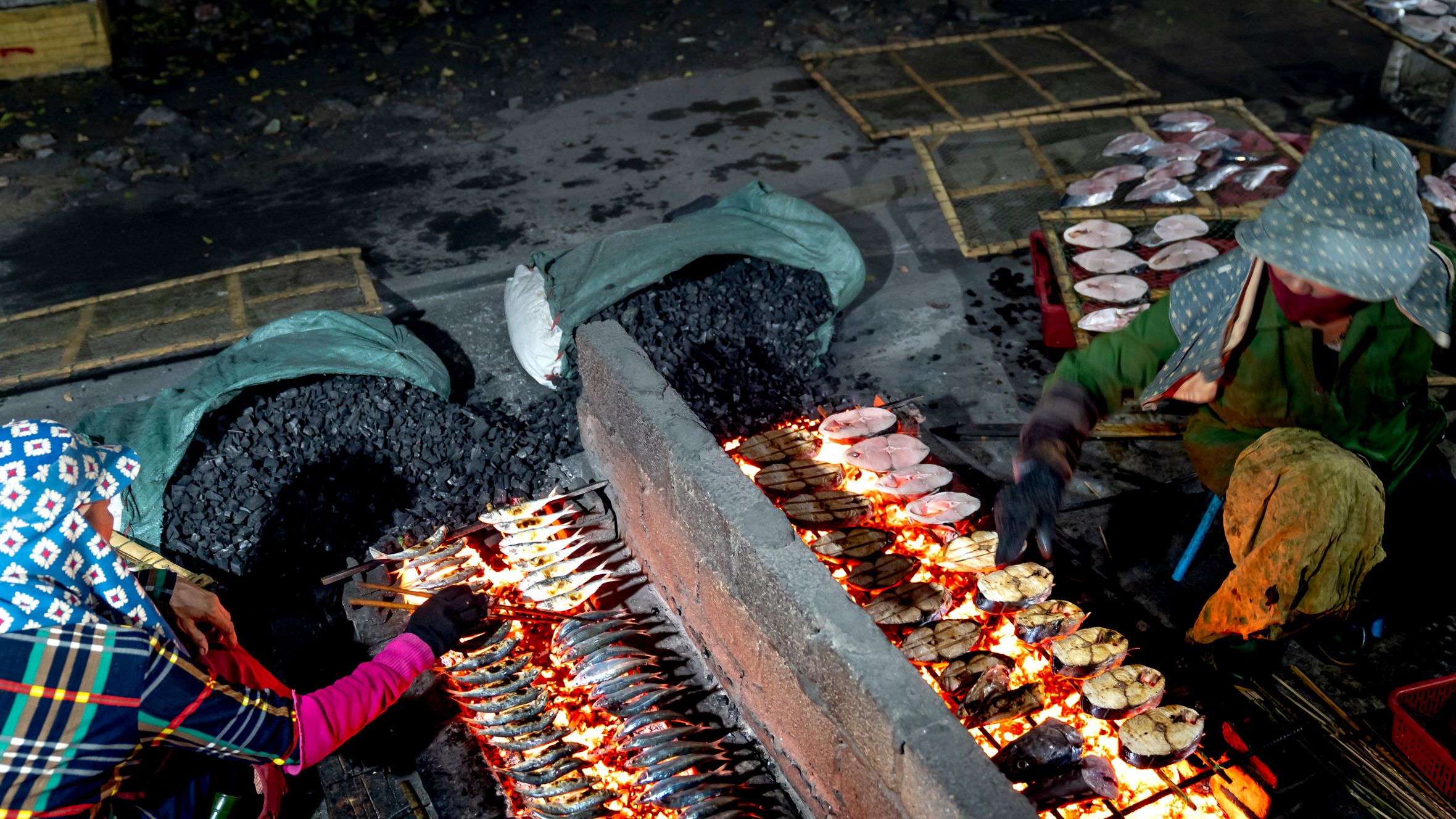
The name translates roughly as "pressed cake." A vendor takes a thin, round disc of dried tapioca — slightly translucent, about the size of a small saucer — and lays it on a hinged iron press sitting over a charcoal brazier. A raw quail egg gets cracked on top, sometimes joined by a strip of "bo kho" (dried spiced beef) or a few shrimp. The iron clamps shut. Thirty seconds later, you have a hot, crisped disc with a just-set egg cooked into its surface and a faint char on the underside.
The vendor hands it to you with a small pair of scissors to snip it into pieces, a smear of chili sauce, and sometimes a wedge of green mango or a pinch of fresh herbs. You eat it standing up, or perched on a plastic stool the size of a shoebox, while the next one is already pressing.
The texture is the whole game: brittle at the edges, slightly chewy toward the center where the egg has set, with a smokiness from the charcoal that a gas burner simply cannot replicate.
Where to Find It in Hue
The densest cluster of banh ep carts is along Nguyen Binh Khiem Street, particularly in the stretch near the school zone that fills up after 3:30 p.m. when students pour out. This is not a coincidence — banh ep is student food, afternoon food, cheap food. Most vendors here run from around 3 p.m. to 7 or 8 p.m., or until they sell out.
A single banh ep runs 5,000–8,000 VND depending on toppings. Quail egg only is the cheapest; add dried beef and you're at the top of that range. It's normal to eat three or four in a sitting — at that price, you should.
Another reliable spot is the cluster of vendors near Truong Tien Bridge on the south bank of the Perfume River, which tends to stay open slightly later into the evening and draws a more mixed crowd of locals and visitors.
If you're staying near the Hue (후에 / 顺化 / フエ) Imperial Citadel, ask guesthouse staff where the closest school-zone cart is — there are neighborhood vendors scattered across the city that don't show up on any map.

Photo by Th2city Santana on Pexels
How It Compares to the Rest of Vietnam
This is where things get interesting. Banh ep exists in name in a few other cities — you'll occasionally see signs for it in Da Nang or even Hanoi — but the product is usually different enough to be a different snack entirely.
In Da Nang, vendors sometimes press rice paper rather than tapioca, which gives a crispier but thinner result without the chew. The toppings lean sweeter. In Saigon, street-food stalls occasionally offer something marketed as banh ep, but the discs are often pre-made commercial tapioca chips pressed to order — the result is snappier and more uniform, missing the slight irregularity of hand-formed discs.
None of this is a criticism of those cities' street food — Saigon's "com tam" and Hue's "bun bo Hue" are both world-class on their own terms. But banh ep is one of those snacks that is genuinely place-specific in a way that matters. The charcoal heat, the freshly cracked quail egg, the particular thickness of Hue's tapioca disc — these aren't marketing claims. They're the actual variables.
Hue's food culture runs deep in this direction. The city that gave Vietnam "banh cuon" filled with pork and wood ear mushroom, that takes its "banh mi" fillings more seriously than most, that produces a version of "mi quang" with turmeric noodles distinct from the Quang Nam original — this is a place where small distinctions between dishes are taken seriously by the people making and eating them.
Banh ep fits that pattern. It's not the flashiest thing you'll eat in Hue. It costs less than a cup of coffee. But it's the kind of snack that reminds you why specificity matters in food.

Photo by Pew Nguyen on Pexels
Practical Notes
Go in the afternoon, not after dinner — most carts are winding down by 8 p.m. and the best ones sell out earlier. Bring small bills; vendors rarely have change for 100,000 VND notes. If you're visiting Hue as part of a longer central Vietnam trip, the afternoon banh ep run pairs well with a slow walk back along the Perfume River before the evening gets going.
Last updated · May 29, 2026 · independently researched, never sponsored.