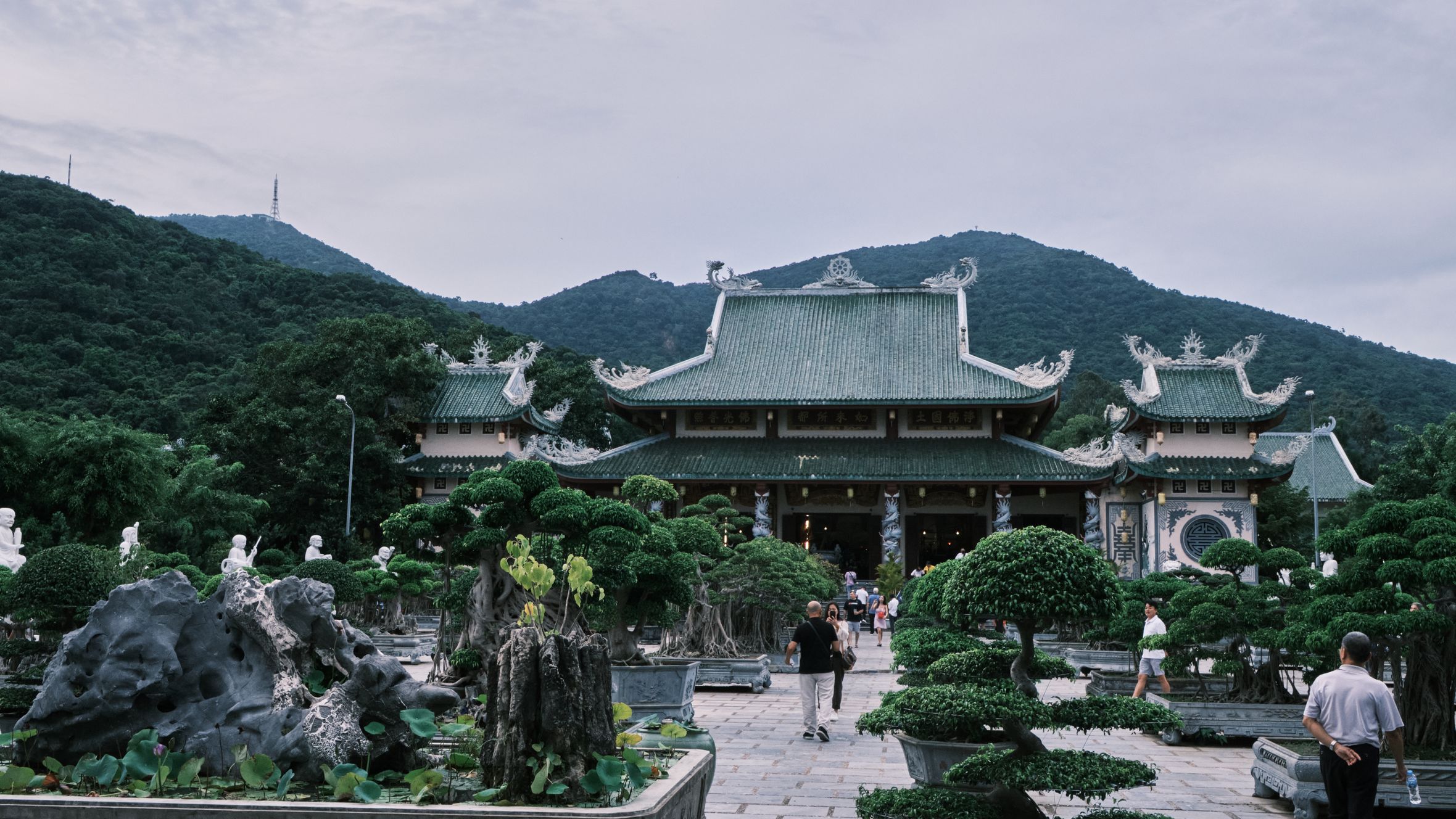
What it is
About 8 km southeast of Da Lat's city center, Chua Linh Phuoc sits on Trai Mat's main road — a Buddhist pagoda where nearly every surface is covered in pieces of broken bottles, ceramic plates, and beer-can fragments. Locals call it "Chua Ve Chai" (the bottle pagoda), and while that nickname sounds kitschy, the place is genuinely impressive in scale and craft.
The pagoda was built in 1952 and has been continuously expanded and decorated since. Artisans embed shards of glass and pottery into cement to create dragons, Buddhas, and ornamental panels across the grounds. The main hall, the 49-meter Linh Thap tower, the courtyard dragon — all of it mosaic. It's folk art on an architectural scale, the kind of obsessive, decades-long project that doesn't really exist anywhere else in Vietnam (베트남 / 越南 / ベトナム).
Why travelers go
Chua Linh Phuoc isn't a quiet meditation temple. It's loud, colorful, and a little overwhelming — which is exactly why it works as a destination. The detail rewards slow looking. You'll spot Heineken bottles worked into a dragon's spine, rice bowls forming lotus petals, and shattered teacups turned into roof tiles. It's the kind of place where you keep noticing new things the longer you stay.
The Linh Thap tower holds a 1.5-meter-tall bell, reportedly among the largest in Vietnam. Inside the main hall, a 5-meter-high golden Buddha sits behind an elaborate mosaic altar. Out back, a 49-meter-long dragon made from over 12,000 glass bottles wraps through the courtyard.
Photographers love it. Kids love it. Even people who don't care about pagodas tend to spend longer here than they expected.
Best time to visit
Da Lat (달랏 / 大叻 / ダラット)'s weather is mild year-round — that's the whole point of the place — but aim for November through March when rain is least likely. Mornings are cool (15-18°C), and the light is good for photos before 10 AM.
Avoid Vietnamese public holidays, especially Tet and summer weekends (June-August), when domestic tourists flood Da Lat and Trai Mat gets packed. A weekday morning in December is about as peaceful as it gets.

Photo by Tuan Vy on Pexels
How to get there
From central Da Lat, you have a few options:
Taxi or Grab
The most straightforward. A Grab car from the Da Lat Market area to Chua Linh Phuoc costs around 80,000-120,000 VND one way. Takes about 20 minutes depending on traffic.
Da Lat railway
This is the scenic option and half the fun. The restored Da Lat Railway Station runs a heritage train to Trai Mat — a 7 km ride through pine forests and flower farms. Trains depart when they fill a carriage (usually around 30 passengers), roughly every hour or two between 8 AM and 4 PM. Tickets cost 150,000 VND return. The pagoda is a 5-minute walk from Trai Mat station. If you're already planning to see the old French-era railway station, this makes a natural pairing.
Motorbike
Rent a semi-auto in Da Lat for 120,000-150,000 VND/day and ride out on the road toward Trai Mat. Parking at the pagoda is free.
What to do
Walk the Linh Thap tower. The 7-story tower is the tallest structure on the grounds. Climb to the upper levels for views over Trai Mat and the surrounding hills. Each floor has mosaic panels depicting Buddhist stories — the craft gets more intricate as you go up.
Study the courtyard dragon. The 49-meter dragon sculpture is built from over 12,000 recycled beer bottles. Walk its full length and look at how the glass colors create texture — greens from Saigon beer bottles, browns from La Rue, clear glass for teeth and eyes. It's remarkably cohesive for something made of garbage.
Sit in the main hall. The interior is calmer than the exterior suggests. The mosaic work here is finer — smaller pieces, more deliberate patterns. Look at the ceiling panels and the altar surround. If a ceremony happens to be underway, stay quietly at the back. The acoustics are surprisingly good.
Check the side buildings. Most visitors stick to the main hall and tower, but the smaller buildings flanking the courtyard have their own mosaic work and Buddhist statues. The craftsmanship in these quieter corners is often more detailed because fewer hands worked on them.
Catch the train back. If you came by rail, time your visit so you're not rushing. An hour to ninety minutes at the pagoda is comfortable. The return train ride feels different — you notice the vegetable farms and greenhouses you missed on the way out.
Where to eat nearby
Trai Mat itself is a small town, but there are a few local spots worth knowing.
Look for "banh canh" stalls near Trai Mat market — the thick tapioca noodle soup is a Central Highlands staple, usually served with pork knuckle or crab for 35,000-50,000 VND. There's a reliable one on the main road about 200 meters before the pagoda entrance.
If you head back to Da Lat proper, the city has no shortage of food. "Banh mi" carts near the central market are solid, and the night market area around Nguyen Thi Minh Khai street has decent "com tam" and "bun bo Hue" for 40,000-60,000 VND. For something more Da Lat-specific, look for "banh can" — small savory rice cakes cooked in clay molds, topped with quail egg and scallion, dipped in fish sauce. About 30,000 VND for a plate.

Photo by Ngân Dương on Pexels
Where to stay
Most people visit Chua Linh Phuoc as a half-day trip from Da Lat, so stay in the city center.
- Budget: Hostels and guesthouses around the market area run 150,000-300,000 VND/night. Basic but functional.
- Mid-range: Hotels on Phan Dinh Phung or Bui Thi Xuan streets offer clean rooms with breakfast for 500,000-900,000 VND/night.
- Comfortable: Boutique stays and hilltop resorts outside the center range from 1,200,000-3,000,000 VND/night. Worth it if you want quiet and views.
Practical tips
- Dress code: It's an active place of worship. Cover your shoulders and knees. Shoes off inside the main hall.
- Entry fee: Free, though donation boxes are placed throughout. Contributing is appreciated — it funds ongoing restoration.
- Time needed: 60-90 minutes is enough to see everything without rushing.
- Bring a zoom lens if you're into photography. The mosaic details are best captured close up, and the tower is worth shooting from across the courtyard.
- Combine with Trai Mat village. Walk the 10 minutes past the pagoda into the village for flower farms and a slower pace. It's a different Da Lat from the tourist center.
Common mistakes
Rushing through on a tour bus. Group tours give you 30 minutes here, which isn't enough. Come independently and set your own pace.
Skipping the train. The Da Lat heritage railway is one of the few functioning narrow-gauge lines left in Vietnam. Taking a Grab both ways means missing the best part of the trip to Trai Mat.
Visiting at midday. The mosaic surfaces reflect harsh noon light and photographs blow out. Morning or late afternoon light makes the colors pop and the experience more comfortable.
Ignoring the back sections. Everyone clusters at the main hall and the dragon. The side pavilions and rear garden are where you'll find the most detailed work and the fewest selfie sticks.
Last updated · May 29, 2026 · independently researched, never sponsored.








