What it is
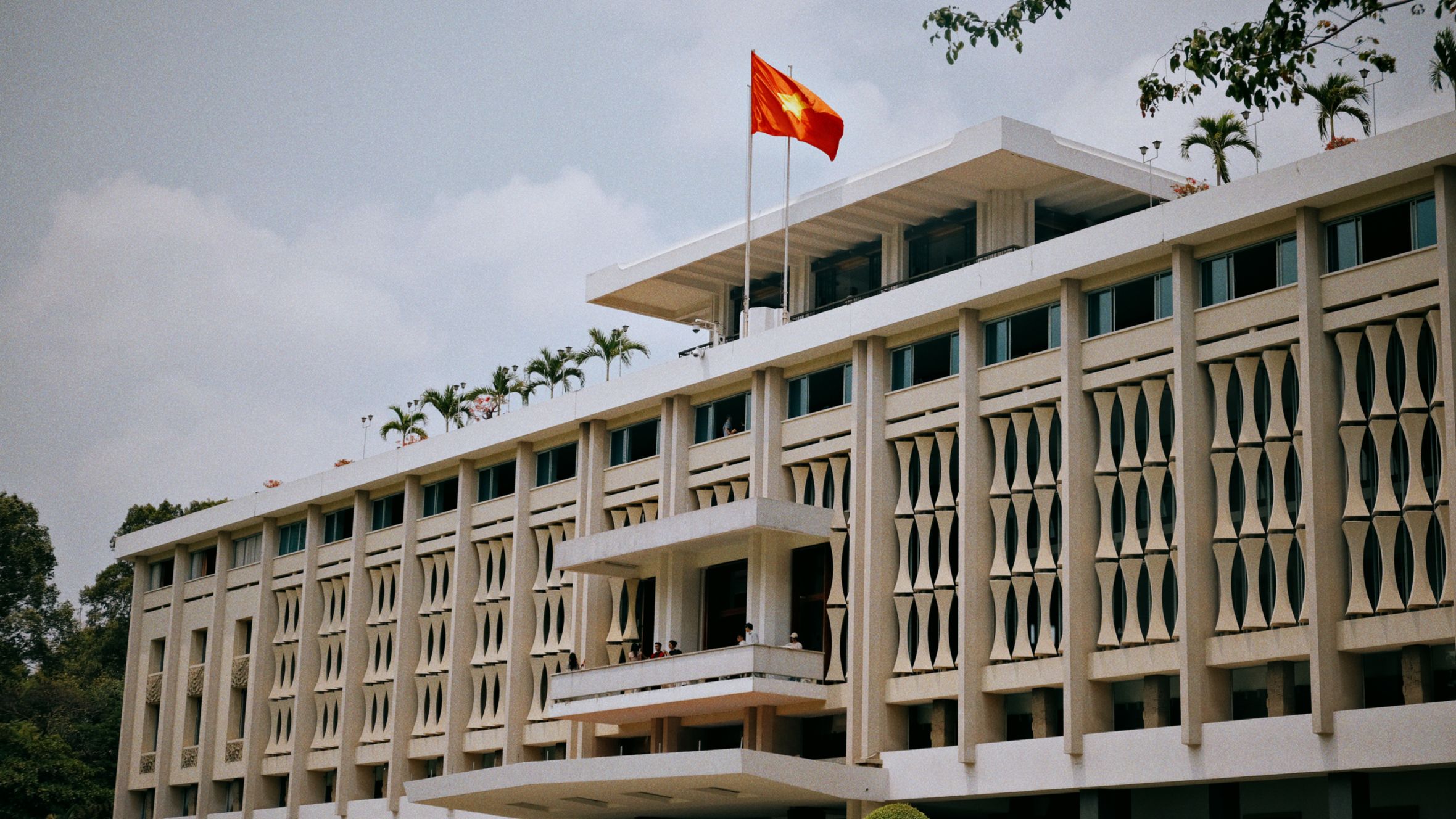
Independence Palace — known locally as Dinh Doc Lap or Reunification Palace — sits on a 12-hectare compound right in the center of Saigon, at the top of a wide boulevard lined with tamarind trees. The building you see today was designed by architect Ngo Viet Thu and completed in 1966, replacing an older French colonial structure that had been bombed beyond repair. It served as the presidential residence and workplace of the South Vietnamese government until April 30, 1975, when a North Vietnamese tank crashed through the front gates — an image most visitors recognize before they arrive.
Today it operates as a museum, preserved almost exactly as it looked in the 1960s and 70s. The furniture, the war-room maps, the rooftop helipad, the basement telecommunications center — all original.
Why travelers go
This isn't a place you visit for pretty photos. You go because walking through the building is like stepping into a frozen moment. The basement war command room still has its old maps pinned to the walls. The president's private cinema still has its projector. The reception halls upstairs feel like a 1960s time capsule — mid-century modern design with Vietnamese touches, all teak and marble and geometric screens.
It's also one of the few historical sites in Saigon (사이공 / 西贡 / サイゴン) where you can spend a solid two hours without running out of things to look at. Most pagodas and temples take 20 minutes. This place rewards slow exploration.
Best time to visit
Saigon's dry season runs from December to April — less chance of getting soaked walking the grounds. But honestly, the building is almost entirely indoors, so weather matters less here than at other sites.
What matters more is timing your arrival. Gates open at 7:30 AM. Show up right at opening on a weekday and you'll have the halls nearly to yourself. By 10 AM, tour buses start rolling in and it gets crowded, especially the basement levels. Avoid weekends and Vietnamese public holidays — particularly around Tet and the April 30 national holiday — unless you enjoy shuffling through narrow corridors shoulder-to-shoulder.
How to get there
The palace is at 135 Nam Ky Khoi Nghia, District 1 — walkable from most hotels in the center. From Ben Thanh Market, it's about a 10-minute walk north along Nam Ky Khoi Nghia Street. You can't miss the iron fence and the wide lawn.
From Tan Son Nhat Airport, a Grab car takes 20-40 minutes depending on traffic and costs roughly 80,000-130,000 VND. A metered taxi (Vinasun or Mai Linh) runs about the same. If you're staying in the backpacker area around Bui Vien, it's a 15-minute walk or a 15,000 VND motorbike taxi.

Photo by dong nhii on Pexels
What to do inside
Walk the basement war rooms
The underground level is the highlight for most visitors. The telecommunications room still has its old radio equipment. The war command center has a massive wall map of southern Vietnam (베트남 / 越南 / ベトナム). The tunnels connecting different sections feel genuinely claustrophobic — you get a real sense of how this building functioned under pressure.
Explore the state reception rooms
The upper floors are where the architecture shines. The Credentials Presenting Room, the State Banqueting Hall, the ambassadors' chamber — each one designed with lacquerwork panels, carved screens, and that particular Vietnamese modernist aesthetic that Ngo Viet Thu pioneered. The rooftop terrace gives you a view over the treetops of District 1.
See the rooftop helipad
Two helicopters still sit on the roof, including a UH-1 Huey. The helipad itself is marked with the original landing circle. On a clear day you can see across a wide stretch of Saigon from up here.
Check out the ground-floor exhibitions
Rotating photo exhibitions near the entrance document the building's history through archival images. These change periodically and are worth a few minutes before heading upstairs.
Sit in the gardens
The grounds are surprisingly peaceful for central Saigon. Mature trees, trimmed lawns, a few fountains. After the intensity of the interior, sitting on a bench outside for ten minutes is a good reset before heading back into the city.
Where to eat nearby
Walk south toward Le Thanh Ton and you're in one of Saigon's best eating corridors. "Com tam" — broken rice with grilled pork, a fried egg, and pickled vegetables — is the quintessential Saigon lunch. Com Tam Ba Ghien on Dang Van Ngu (about a 10-minute walk from the palace) serves a reliable plate for around 45,000-55,000 VND.
For something lighter, head to Nguyen Du Street for a bowl of "hu tieu" — the southern-style pork and prawn noodle soup that's thinner and sweeter than anything you'll find up north. A bowl runs 40,000-50,000 VND at most sidewalk spots.
If you need a caffeine hit after, there are dozens of Vietnamese coffee shops within a five-minute radius. Any small place with plastic stools will pour you a proper "ca phe sua da" for 25,000-35,000 VND.
Where to stay
District 1 has options at every price point, all within walking distance of the palace:
- Budget: Dorm beds around Bui Vien and Pham Ngu Lao run 150,000-250,000 VND per night. Private rooms in guesthouses start around 350,000 VND.
- Mid-range: Solid three-star hotels along Le Thanh Ton or Hai Ba Trung go for 600,000-1,200,000 VND per night. Clean rooms, breakfast included at most.
- Upper-range: Several international-brand hotels sit within a few blocks of the palace, starting around 2,500,000 VND per night.

Photo by Ngọc Khánh Nek on Pexels
Practical tips locals would tell you
- Admission is 65,000 VND for adults (as of early 2025). Pay at the ticket window inside the gate — no need to pre-book.
- Bring your own water. There's a small gift shop inside but no real cafe. The visit takes 1.5-2 hours and Saigon heat is no joke.
- Audio guides are available for rent near the entrance. The English version is decent and adds useful context to rooms that otherwise just look like empty offices.
- Photography is allowed everywhere except a few marked rooms in the basement. No flash.
- Combine it with nearby sites. The War Remnants Museum is a 10-minute walk west on Vo Van Tan. Notre-Dame Cathedral and the Central Post Office are a 5-minute walk east. You can cover all three in a morning.
Common mistakes to avoid
- Arriving after 10 AM on weekends. You'll spend more time in queues than in the actual rooms.
- Rushing through the basement. Most people beeline for the tanks out front and the war rooms, then leave. The upper floors and rooftop are worth your time.
- Skipping the gardens. The grounds are one of the few genuinely quiet green spaces in central Saigon. Use them.
- Taking a taxi for short distances nearby. District 1 traffic is gridlocked most of the day. Walking is faster for anything within a 1 km radius of the palace.
Practical notes
Budget around two hours for a thorough visit, three if you're a history or architecture nerd. Mornings are cooler and quieter. The palace pairs well with a half-day loop through District 1's other landmarks — and you'll be hungry enough afterward to justify a serious com tam lunch.
Last updated · May 29, 2026 · independently researched, never sponsored.