What it is
Lang Gia Long is the burial complex of Emperor Gia Long, founder of the Nguyen Dynasty and the man who unified Vietnam (베트남 / 越南 / ベトナム) under a single court in 1802. The tomb sits about 16 km southwest of central Hue, spread across a series of low hills flanked by pine forest and lotus ponds. Unlike the more famous Tomb of Tu Duc or Tomb of Khai Dinh, this one doesn't get tour buses. Most days, you'll share it with a handful of other visitors and a few groundskeepers trimming the grass with hand shears.
The complex covers roughly 28 hectares and was completed in 1820. Gia Long chose the site himself, reportedly riding out on horseback to survey the surrounding hills. It holds the tombs of both the emperor and Empress Thua Thien, set on adjacent hilltops connected by a processional courtyard, stone mandarins, and a crumbling stele pavilion. Time and war have worn the place down — several structures are partially ruined — but that's part of what makes it feel different from the polished tomb sites closer to the city.
Why travelers go
People come here specifically because it isn't on the standard Hue (후에 / 顺化 / フエ) tomb circuit. If you've already visited Tu Duc, Khai Dinh, and Minh Mang, Lang Gia Long is the logical next step — the one that rewards you for going a bit further. The grounds are overgrown in places, the stone elephants have moss on their backs, and the surrounding countryside is flat rice paddies interrupted by clusters of jackfruit trees. It's one of those spots where you actually feel the age of the place rather than reading about it on an information board.
Photographers like it for the textures — weathered laterite walls, lichen-covered statues, tree roots pushing through stonework. If you're interested in Nguyen-era architecture, this is also where you can see some of the earliest examples before the dynasty refined its style at later tombs.
Best time to visit
Hue's dry season runs roughly from March through August, with April and May being the sweet spot before the real heat kicks in. Temperatures sit around 28-32°C, rain is rare, and the light is good for the overgrown courtyards.
Avoid October through December if you can — Hue gets serious rain during this stretch, and the unpaved sections of road leading to the tomb turn muddy. January and February are cooler (18-22°C) and mostly dry, which also works well, though it can be overcast for days at a time.
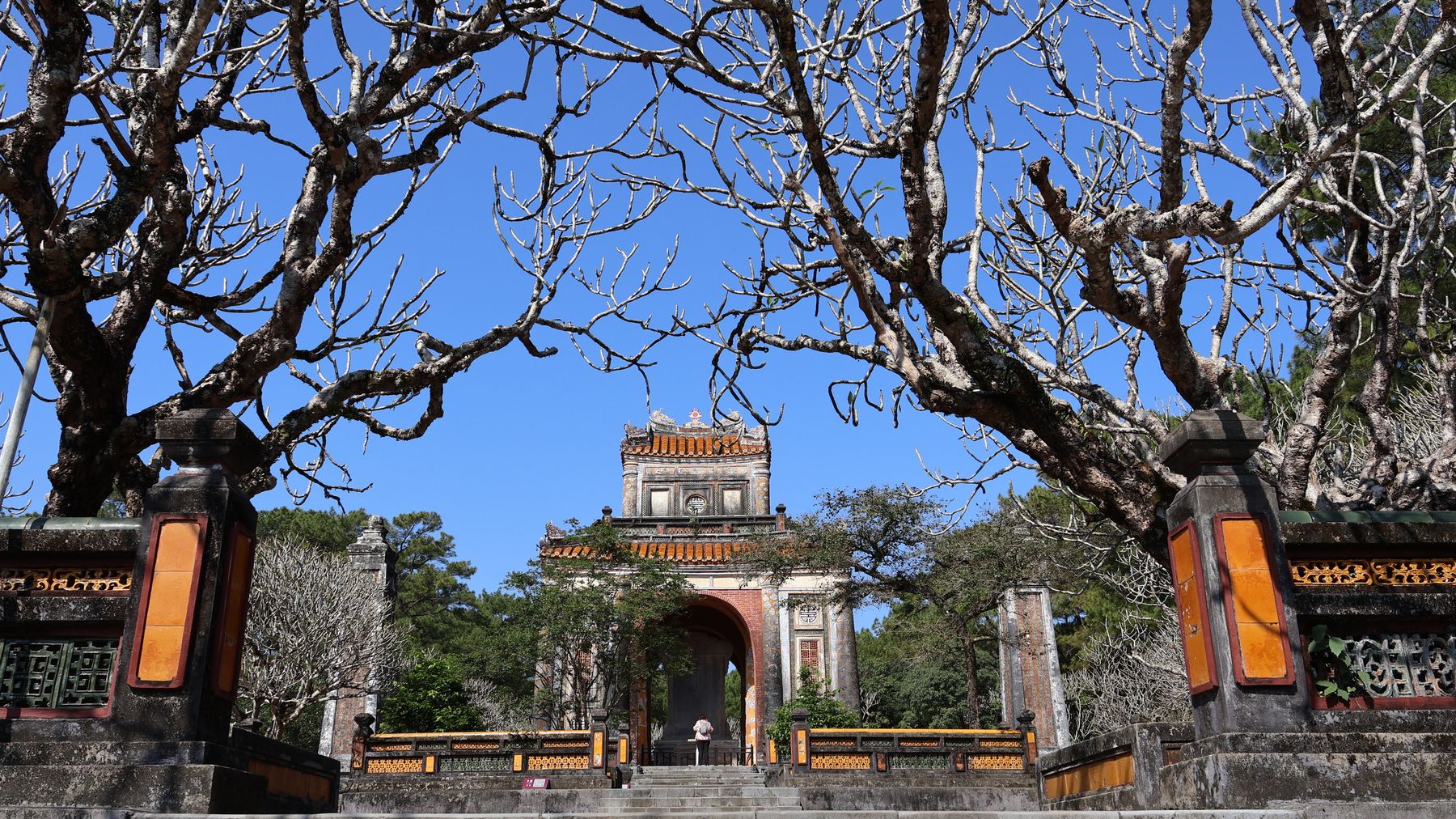
Photo by Minh Lê on Pexels
How to get there from Hue
The tomb is about 16 km from the city center, on the south bank of the Huong River. There are three practical ways to reach it:
Motorbike
The most common option. Rent a semi-automatic in the city for 120,000-150,000 VND/day and ride south along the river road past the other tomb sites. The route from central Hue takes about 40 minutes. The final 3 km is a narrow concrete lane through rice fields — follow signs for "Lang Gia Long" once you pass the village of An Bang. Parking at the site is free.
Grab or xe om
A Grab bike from central Hue runs around 60,000-80,000 VND one way, though you may struggle to book a return from the tomb area. A xe om (motorbike taxi) hired for a round trip with a 45-minute wait should cost 200,000-250,000 VND if you negotiate beforehand.
Boat
Some guesthouses and tour operators in Hue arrange boat trips up the Huong River that stop at Lang Gia Long along with Minh Mang's tomb. A shared boat typically costs 250,000-400,000 VND per person. The river approach is scenic — you dock near the tomb's southern gate and walk up through the pine grove. Worth it if you have half a day.
What to do
Walk the processional courtyard. The main axis runs from the entrance gate through a courtyard lined with stone mandarins, horses, and elephants. These are some of the oldest surviving stone figures in the Hue tomb complex — cruder than the ones at later tombs, but they have real presence. Count the mandarins: there are ten, five on each side, each in slightly different robes.
Climb to the emperor's burial mound. A stone staircase leads up the hill behind the courtyard to the actual burial site. The mound is surrounded by a low wall and shaded by old pine trees. It's a quiet spot with a clear view back over the complex and the surrounding hills.
Visit the empress's tomb. Empress Thua Thien's burial mound sits on a parallel hilltop connected by a path through the trees. Most visitors skip it or don't realize it's there. The walk takes five minutes and gives you a better sense of the full scale of the complex.
Photograph the stele pavilion. The pavilion housing Gia Long's funerary stele is partially open to the sky — the roof was damaged decades ago and never fully restored. The stele itself, inscribed by Emperor Minh Mang, is still legible. Morning light hits the interior around 9-10 AM.
Explore the surrounding grounds. The outer edges of the complex are semi-wild — lotus ponds, fruit trees, crumbling walls half-hidden in vegetation. Give yourself at least 90 minutes to walk the full site without rushing.
Where to eat nearby
There's nothing at the tomb itself — no cafe, no vendor stalls. Bring water.
On the ride back toward Hue, stop along Kim Long street for "bun bo Hue", the city's signature spicy beef noodle soup. Quan Bun Bo Hue O Phuong near Vo Thi Sau street does a solid bowl for around 35,000-40,000 VND. If you're heading back through the city center, detour to Hang Me street in the old quarter for "banh canh" — thick tapioca noodles in a pork-and-crab broth. A bowl runs about 30,000 VND.

Photo by Tuấn Vũ on Pexels
Where to stay in Hue
You'll base yourself in Hue city. Budget guesthouses around Pham Ngu Lao and Le Loi streets run 200,000-400,000 VND/night. Mid-range hotels with river views along Le Loi or Nguyen Cong Tru cost 600,000-1,200,000 VND. If you want something nicer, the south bank area near the Imperial Citadel Thang Long has a few boutique properties in the 1,500,000-3,000,000 VND range.
Practical tips locals would tell you
- Bring cash. There's no ticket booth with card payment — entrance is 40,000 VND per person, cash only.
- Wear proper shoes. The paths are uneven stone and dirt. Sandals work in dry season but you'll regret them after rain.
- Go in the morning. The site faces east. Morning light is better for photos, and you'll beat the midday heat from April onward.
- Combine with Minh Mang's tomb. It's only about 4 km away on the same road. Doing both in a single morning ride makes sense logistically.
- Download offline maps. Google Maps has the location pinned accurately, but mobile signal drops in and out near the tomb. Save the route before you leave the city.
Common mistakes to avoid
Don't try to visit Lang Gia Long as a quick add-on to a packed day of tomb-hopping. It's further out than the others and deserves at least 90 minutes on-site. Rushing it defeats the point.
Don't rely on finding a Grab at the tomb for the return trip — drivers are scarce in this area. Arrange round-trip transport or bring your own wheels.
Don't skip it just because it's less restored than the other tombs. The wear is the draw. This is the site that feels closest to what all these tombs looked like before tourism budgets arrived.
Last updated · May 26, 2026 · independently researched, never sponsored.