
Lung Cam sits in a narrow valley of grey karst peaks and terraced fields in Sung La commune, now part of Tuyen Quang province following Ha Giang's administrative merger. It's a small Hmong village — maybe forty households — that most Vietnamese travelers know from the 2010 film Chuyen Cua Pao (Pao's Story). The movie put Lung Cam on the domestic tourism map, and the village has leaned into that identity without losing its shape. This is not a theme park. People still farm here. But visitors are welcome, and there's enough to fill a solid half-day.
What Lung Cam actually is
Lung Cam is a Hmong cultural village, officially recognized as a heritage site by the local government. The houses are built from rough-cut stone with clay-tile roofs, enclosed by stone walls that double as livestock fences. The layout follows the valley floor, with homes clustered near a small stream and fields climbing the hillsides behind them.
The village gained attention after Chuyen Cua Pao was filmed here. The main house used in the movie — often called "Pao's House" — still stands and is open to visitors. It's a traditional Hmong home with a central hearth, low wooden furniture, and soot-blackened walls. Nothing has been staged or rebuilt for tourists; it just looks the way it always has.
Beyond the film connection, Lung Cam is one of the better-preserved examples of Hmong village architecture in the northeast highlands. The stone construction is distinctive to this part of Vietnam (베트남 / 越南 / ベトナム) and looks nothing like the wooden stilt houses you'll find in Sapa or Mai Chau.
Why travelers go
Most people visit Lung Cam as part of a loop through the Dong Van Karst Plateau — one of Vietnam's most dramatic landscapes. The village sits between Dong Van town and Sung La, along a road that also passes the old Vuong family mansion (a separate stop worth making).
The draw is simple: an intact Hmong village in a striking karst setting, without the commercial pressure of more popular stops. There are no ticket counters, no souvenir alleys, no loudspeaker tours. You walk in, look around, talk to people if you speak some Vietnamese, and leave when you're ready. For photographers, the combination of dark stone walls, green fields, and jagged limestone is hard to beat — especially in the golden light of late afternoon.
Best time to visit
September to November is ideal. The rice terraces around the valley turn yellow in late September and early October, and the weather is dry enough for comfortable riding. March and April bring peach and plum blossoms — the famous "hoa dao" season — though the roads can be wet.
December to February is cold. Temperatures drop below 10°C at night, and fog can close in for days. You'll have the village to yourself, but you'll also be layering up and watching the road carefully.
Avoid major Vietnamese holidays, especially Tet and the weekends around September 2nd (National Day). Domestic tourists flood the Dong Van loop during these windows, and the narrow roads get genuinely unpleasant.
How to get there
The nearest major hub is Ha Giang city, about 150 km south. From Ha Giang, take the QL4C north through Quan Ba and Yen Minh to Dong Van, then follow the road west toward Sung La. Lung Cam is roughly 15 km from Dong Van town, signposted off the main road.
By motorbike: The standard approach. Ha Giang (하장 / 河江 / ハーザン) to Lung Cam takes 5-6 hours if you ride straight through, but nobody does — the scenery demands stops. Most travelers spend two or three days on the loop, hitting Lung Cam on day one or two. Motorbike rental in Ha Giang runs 150,000-250,000 VND/day for a Honda Wave or Win.
By car or jeep tour: Organized tours from Ha Giang cost 1,500,000-3,000,000 VND per person for a 3-day loop, Lung Cam included. Private cars with driver start around 2,500,000 VND/day.
Getting to Ha Giang: Overnight buses from Hanoi's My Dinh station run nightly, 250,000-350,000 VND for a sleeper berth, arriving around 5-6 AM. The ride is roughly 300 km and takes 6-7 hours.

Photo by Du Tử Mộng on Pexels
What to do
Walk through the village
No map needed — there's one main path through the settlement. Take it slowly. Look at how the stone walls are fitted together without mortar. Peek into open courtyards where corn dries on racks. If a family is weaving or dyeing fabric, they'll usually let you watch. Don't barge in; wait at the gate and make eye contact first.
Visit Pao's House
The film location is marked with a small sign. Inside, you'll see the hearth, the sleeping platform, and the altar area typical of Hmong homes. There's sometimes a modest entry fee of 10,000-20,000 VND collected by the family. Worth it.
Hike the surrounding fields
Trails lead up the hillside behind the village into terraced fields with wide views of the karst valley. A 30-40 minute walk gets you above the roofline for a panoramic look at the village layout. Wear proper shoes — the paths are rocky and steep after rain.
Catch the Sunday market at Sung La
If your timing works, the weekly market at Sung La (about 3 km away) runs on Sunday mornings. It's where Hmong, Lo Lo, and Dao families come to trade livestock, vegetables, and textiles. Much less touristy than the Dong Van market, and you'll see traditional clothing worn as daily wear, not costume.
Photograph the triangular buckwheat fields
From October to November, the hillsides around Lung Cam bloom with "tam giac mach" (buckwheat flowers), carpeting the slopes in pink and white. This is the signature image of the Ha Giang plateau in autumn.
Where to eat nearby
Lung Cam itself has no restaurants. Head to Dong Van town for meals.
Look for "thang co" — a Hmong hotpot made from horse meat and offal, cooked with cardamom and lemongrass. It's an acquired taste, but it's the defining dish of the plateau. A bowl runs 30,000-50,000 VND at market stalls. For something more approachable, "pho" shops in Dong Van serve solid bowls for 35,000-45,000 VND. Egg coffee hasn't made it this far north in any convincing form — stick to tra da (iced tea) or local corn wine if someone offers.
Where to stay
No accommodation in Lung Cam itself. Dong Van town is your base.
- Budget homestays: 150,000-300,000 VND/night. Basic rooms, shared bathrooms, warm blankets. Often the most interesting option — hosts cook dinner.
- Guesthouses: 300,000-600,000 VND/night. Private rooms with hot water. A few places along the main road in Dong Van are reliable.
- Higher-end options: A handful of boutique-style spots have opened recently, 800,000-1,500,000 VND/night. Nice views, proper heating, but you're still in a small mountain town.
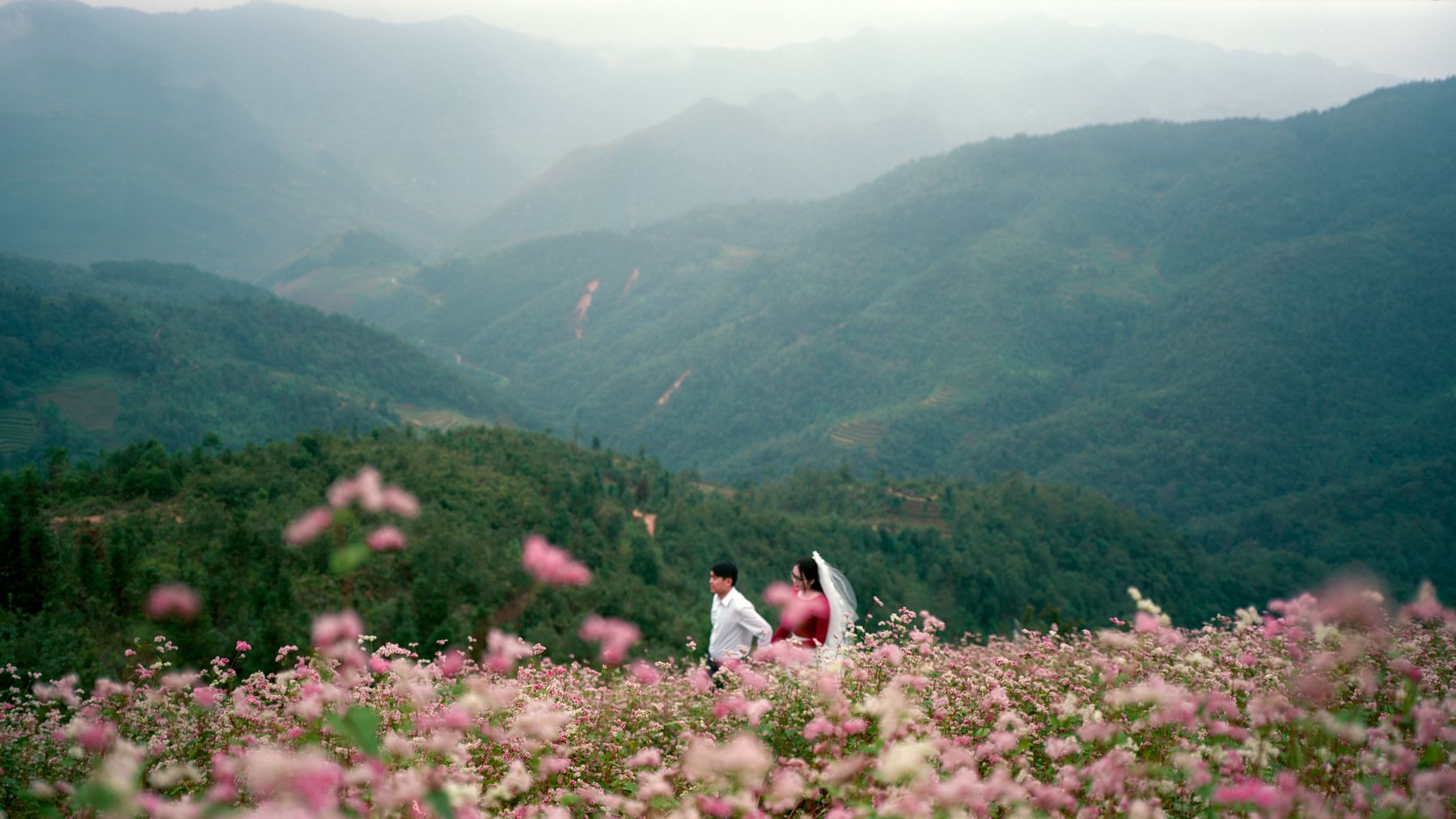
Photo by Q. Hưng Phạm on Pexels
Practical tips locals would tell you
- Bring cash. There are a few ATMs in Dong Van, but they run out of money on busy weekends. Load up in Ha Giang city.
- Dress modestly. This is a conservative Hmong community. Cover shoulders and knees. It's also just cold most of the year, so you'll want layers anyway.
- Ask before photographing people. This matters everywhere, but especially in small ethnic-minority villages where camera fatigue is real. A smile and a gesture go further than a zoom lens.
- Fuel up in Dong Van. Petrol stations are sparse on the plateau. Don't assume you'll find one between towns.
Common mistakes to avoid
- Rushing through. Lung Cam rewards slow visits. Budget at least an hour, ideally two. People who stop for ten minutes and a selfie miss the point.
- Visiting only Pao's House. The village itself is more interesting than the film set. Walk the whole settlement.
- Skipping Sung La market. If you're here on a Sunday and don't go, you've missed the most authentic cultural experience in the area.
- Underestimating the cold. Even in October, mornings on the plateau hover around 12-15°C. A light jacket won't cut it in December.
Practical notes
Lung Cam works best as one stop on a multi-day Dong Van loop from Ha Giang. Pair it with the Ma Pi Leng pass, the Vuong mansion, and Sung La market for a full picture of life on the karst plateau. No entrance fee for the village itself. Respect the community, leave nothing behind, and you'll find a place that's exactly as real as it looks.
Last updated · May 29, 2026 · independently researched, never sponsored.





