
Ly Son sits about 25 km off the coast of Quang Ngai province — a tiny volcanic island that most international travelers have never heard of. It's raw, unhurried, and one of the few places in central Vietnam (베트남 / 越南 / ベトナム) where you can still feel genuinely off the beaten path without roughing it.
What Ly Son is and why it matters
Ly Son is actually two islands: Lon (Big Island), where nearly everyone lives and visits, and Be (Small Island), a wilder speck of land you can day-trip to by boat. Both are remnants of ancient volcanic eruptions, and the geology is visible everywhere — dark basalt cliffs, red-brown soil, and craters that have softened into grassy bowls over thousands of years.
The island has been inhabited for centuries. Fishing and garlic farming are the backbone of local life, and you'll see both within minutes of stepping off the ferry. Fields of garlic stretch across the flat interior of Lon Island, their green shoots impossibly bright against the volcanic soil. Ly Son garlic is famous across Vietnam — smaller, more pungent, and more expensive than mainland varieties.
Foreign tourism here is still minimal. You'll mostly encounter Vietnamese visitors, especially on weekends and holidays. English signage is rare. That's part of the appeal.
Why travelers go
People come to Ly Son for the landscape, the quiet, and the food. The volcanic rock formations along the coast are genuinely unusual — twisted columns and sea-carved arches that look like something from Iceland, not Southeast Asia. The water is clear, the beaches are uncrowded, and the pace is slow enough that you can cover the whole main island in a day by motorbike and still have time for a long seafood lunch.
It's also one of the cheapest island trips you can do in Vietnam. No resort markups, no party scene, no water-sports touts on the beach.
Best time to visit
March through August is the window. The sea is calmest from April to July, which matters because the ferry crossing can get rough. June through August are the warmest months and best for swimming and snorkeling around Be Island.
Avoid October through February. Storms and high seas frequently cancel ferries, and you can get stranded on the island for days — not in a romantic way, more in a "nothing's open and the power flickered out" way. The Tet holiday period (usually late January or February) also brings huge domestic crowds.
How to get there
The launching point is Sa Ky port, about 20 km east of Quang Ngai city.
Getting to Quang Ngai: The easiest route is to fly into Da Nang (the nearest major airport, about 130 km north) and then take a bus or train south. The train from Da Nang to Quang Ngai takes around 2.5 hours and costs about 80,000–120,000 VND for a hard seat. Buses run frequently and cost roughly the same. If you're coming from Hoi An, it's about 150 km — a 3-hour bus ride.
Sa Ky port to Ly Son: High-speed ferries depart daily, usually in the morning (first boat often at 7:30 or 8:00). The crossing takes about 35–45 minutes. Tickets run 160,000–200,000 VND one way. Buy your ticket the afternoon before if visiting on a weekend — boats do sell out. You can also book through your hotel or guesthouse on the mainland.

Photo by AN Nhol on Pexels
What to do
Ride around Lon Island
Rent a motorbike (100,000–150,000 VND per day) and circle the main island. The coastal road is only about 10 km, but you'll stop constantly. Key spots: Thoi Loi peak (the old volcanic crater at the island's highest point — a short walk up for wide views), Chua Hang (a pagoda built into a sea cave on the island's east side), and To Vo Gate, a natural basalt arch on the northeastern shore where the rock looks like it was poured in layers.
Day-trip to Be Island
Small boats shuttle visitors to Be Island from the main harbor, usually leaving around 8:00–9:00 and returning by early afternoon. The trip costs about 100,000–150,000 VND round trip. Be Island is almost entirely undeveloped — a few paths, no vehicles, and some of the clearest water around Ly Son. Bring your own water and snacks. Good snorkeling off the rocks on the south side.
Walk the garlic fields
This sounds mundane, but it's oddly one of the best things on the island. The fields sit in sandy volcanic soil between low stone walls, and during harvest season (March–April) the whole island smells sharp and green. Locals are generally happy to chat if you show interest — just don't trample the crops.
Hang Cau beach
On the western side of Lon Island, Hang Cau is a small cove backed by dark cliffs. It's the best swimming beach on the main island and rarely crowded on weekdays. The water is shallow and calm in summer.
Mu Cu Islet
A rocky islet just off the southern coast, reachable by short boat trip. Worth it mainly for the bizarre rock formations and tide pools. Ask at the harbor — informal boats go when there's enough interest, usually 50,000–80,000 VND per person.
Where to eat
Seafood is the obvious play. Restaurants along the harbor serve whatever came in that morning — grilled squid, steamed clams, sea urchin with lime and chili. Sea urchin is the island's signature. Prices are low by coastal standards: a full seafood spread for two runs 200,000–400,000 VND.
Look for "goi rong bien" — a seaweed salad made with a local variety that grows on the volcanic rocks. It's tossed with peanuts, herbs, and a fish-sauce dressing. Simple but specific to Ly Son.
For breakfast, most guesthouses serve "banh canh" — a thick noodle soup, here made with fish. It's hearty and cheap, around 25,000–35,000 VND.
Where to stay
Accommodation is basic. There are no resorts on Ly Son — mostly family-run guesthouses and a handful of small hotels. Expect to pay 200,000–500,000 VND per night for a clean room with air conditioning, hot water, and Wi-Fi. A few newer places near the harbor charge up to 700,000–900,000 VND and have slightly more polish. Booking ahead is smart for weekends and holidays; on weekdays you can often just show up.
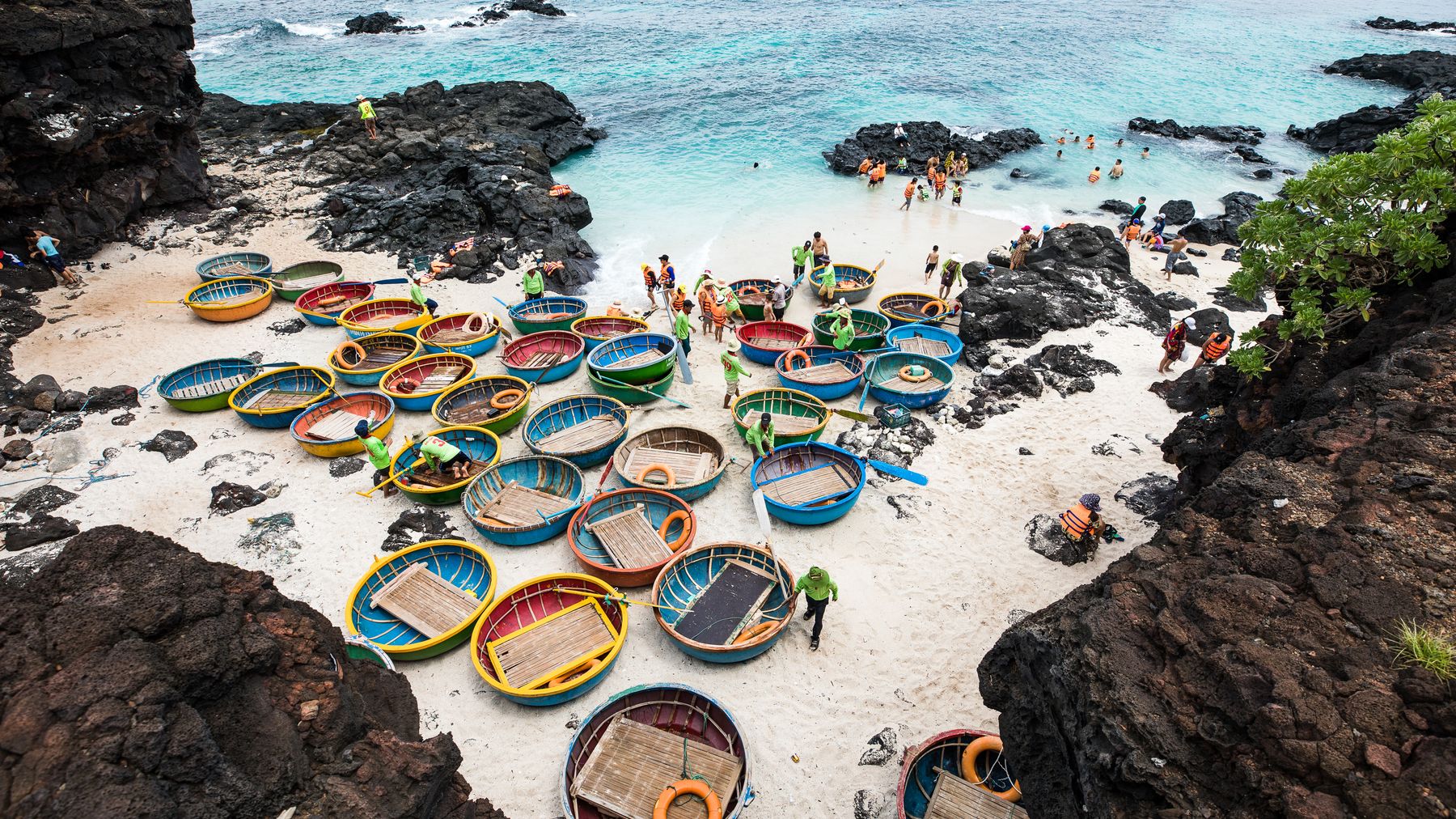
Photo by Son Tung Tran on Pexels
Practical tips locals would tell you
- Bring cash. ATMs exist but are unreliable. Card payments are essentially nonexistent on the island.
- Sunscreen and a hat are non-negotiable. There's almost no shade on the coastal roads or at the crater viewpoints.
- Charge your phone before the ferry. Power outlets on the boats are limited.
- Learn a few Vietnamese phrases. English is rarely spoken. Having Google Translate downloaded offline helps enormously.
- Fill up your motorbike early. There are only a couple of gas stations on Lon Island.
Common mistakes to avoid
Don't plan a one-night trip. The ferry schedule means you'll arrive mid-morning and need to leave mid-morning the next day, giving you barely an afternoon. Two nights is the minimum to see both islands without rushing.
Don't assume ferries run in bad weather. Check conditions before heading to Sa Ky port, especially in shoulder months (September, March). Your guesthouse or the ferry company's hotline can confirm.
Don't skip Be Island because it looks small on the map. It's the highlight for many visitors and worth the extra boat fare.
Practical notes
Ly Son works well as a two- or three-day detour on a longer central Vietnam trip between Da Nang (다낭 / 岘港 / ダナン) and Quy Nhon. Pair it with a day exploring Quang Ngai city on the mainland — the province is underrated for "mi quang" and regional cooking. The island is small enough to feel manageable but distinct enough to stick with you.
Last updated · May 26, 2026 · independently researched, never sponsored.





