The first time I sat on a plastic stool at 6:15 AM on Bat Dan street in Hanoi, a woman dropped a bowl of beef pho in front of me without asking what I wanted — because there was only one thing on the menu. That bowl, clear-topped and brutally simple, taught me more about "pho" than any cookbook ever had. This guide breaks down what makes pho different across Vietnam, where to eat the real thing, and how to navigate a pho shop like someone who actually lives here.
Pho at a Glance
- What it is: Rice noodle soup with slow-cooked bone broth, served with beef ("pho (쌀국수 / 越南河粉 / フォー) bo") or chicken ("pho ga")
- Origin: Nam Dinh province and Hanoi (하노이 / 河内 / ハノイ), early 1900s
- Average price, Hanoi street stall: 40,000–60,000 VND ($1.60–$2.40 USD)
- Average price, Saigon street stall: 50,000–75,000 VND ($2.00–$3.00 USD)
- Average price, upscale pho restaurant: 85,000–150,000 VND ($3.40–$6.00 USD)
- Best time to eat: 6:00–9:00 AM (breakfast) or 6:00–8:30 PM (dinner). Many legendary shops sell out by mid-morning.
- Hanoi style: Clear broth, fewer herbs, restrained toppings
- Saigon style: Sweeter broth, overflowing herb plate, hoisin and sriracha on the table
- Noodle type: Flat rice noodles ("banh pho"), fresh-cut daily at serious shops
Where Pho Comes From — A Short, Honest History
Pho is younger than most people assume. The dish emerged in the early 20th century in northern Vietnam, likely around Nam Dinh province and Hanoi's French Quarter, where beef became more available due to French colonial demand for cattle. The name itself probably derives from the French "pot-au-feu," though Vietnamese food historians still argue about this — and they argue loudly.
What's clear is that by the 1930s, pho vendors were a fixture on Hanoi streets, carrying everything on shoulder poles: broth in one pot, noodles and toppings in the other. The dish was beef-only in the north for decades. Chicken pho emerged partly out of necessity — the government banned beef sales on certain days of the week in the mid-20th century, so cooks adapted.
After 1954, when roughly a million northerners moved south, pho traveled to Saigon and evolved. Southern cooks added sugar to the broth, piled on fresh herbs, and introduced accompaniments like hoisin sauce and chili paste that would horrify a Hanoi purist. Both versions are legitimate. Neither is "the original" anymore — they've diverged for 70 years.
Today pho is Vietnam's de facto national dish, eaten at breakfast, lunch, dinner, and 2 AM after too many glasses of "bia hoi" on Ta Hien street. It's also the dish most often butchered overseas, which is why eating it here matters.
Hanoi Pho vs. Saigon Pho: The Real Differences
This isn't a debate with a winner. It's two distinct culinary philosophies expressed through the same dish.
The Broth
Hanoi pho broth is built on beef bones (usually leg and knuckle), charred ginger, and charred onion, simmered for 12–16 hours. The goal is clarity — physical and flavor. A great Hanoi broth is nearly transparent, with a deep savory backbone and zero sweetness. Rock sugar does not belong here. The fat is skimmed obsessively or left as a thin, deliberate slick on top.
Saigon pho broth uses the same base but adds rock sugar (sometimes a startling amount), star anise and clove in heavier proportions, and occasionally roasted dried squid for a faint umami undertone. The result is rounder, sweeter, and darker. Neither is better — but they taste like different soups.
The Noodles
Both cities use flat rice noodles, but Hanoi shops tend toward slightly wider, chewier cuts. Some Hanoi institutions — Pho Gia Truyen on Bat Dan is the famous example — have their noodles delivered fresh multiple times per morning from a specific supplier. In Saigon, the noodles are often thinner and softer. If your noodles arrive pre-cut into short strips, you're probably in the south.
The Herb Tray
This is the most visible difference.
Hanoi herb tray (often nonexistent):
- Sliced green onion and cilantro (already in the bowl)
- "Quay" — fried dough sticks, for dipping
- Chili sauce on the table, maybe vinegar-pickled garlic
- That's it. No basket of greens.
Saigon herb tray (a garden on a plate):
- Thai basil ("rau que")
- Bean sprouts (raw)
- Saw-leaf herb ("ngo gai")
- Culantro
- Lime wedges
- Sliced bird's-eye chili
- Hoisin sauce and sriracha (on every table)
If someone puts hoisin sauce in their pho in Hanoi, nearby diners will stare. In Saigon, hoisin and sriracha go in before the first slurp.
The Toppings
Hanoi pho bo typically offers: rare-sliced beef ("tai"), well-done flank ("nam"), brisket ("gau"), and sometimes tendon ("gan"). You pick your combination. Pho ga in Hanoi comes with hand-shredded chicken, often from a free-range bird with noticeably firmer texture.
Saigon pho adds more variety: beef meatballs ("bo vien"), tripe ("sach"), and fatty brisket. Some Saigon shops let you combine beef and chicken, which would be considered unhinged in Hanoi.

Photo by Hiếu Vũ Vlog on Pexels
How to Order Pho Like a Local
At most street-level pho shops, you don't get a menu. Here's how it works:
- Sit down at any open stool. Don't wait to be seated — there's no host.
- Tell the server what you want. At a beef-only shop, you're choosing cuts. At a shop serving both, you start with bo (beef) or ga (chicken).
- Use these phrases:
- "Cho toi mot bat pho bo" — Give me one bowl of beef pho
- "Cho toi pho tai nam" — Pho with rare beef and flank
- "Pho ga, khong rau thom" — Chicken pho, no herbs
- "Them mot bat" — One more bowl (you'll need this)
- Wait about 90 seconds. Assembly is fast — the broth is already simmering.
- Add condiments. In Hanoi: chili sauce, maybe a squeeze of lime if available. In Saigon: tear herbs, squeeze lime, add hoisin and sriracha to taste.
- Pay when you leave. Most shops don't bring a bill — you tell them what you had. At busy places, the owner tracks it mentally. Trust the system.
One tip: if a pho shop has a line out the door at 7 AM and the place next to it is empty, get in line. Pho is a dish where reputation is earned one bowl at a time, and Vietnamese diners do not tolerate mediocre broth.
The 6 Best Pho Shops in Hanoi
These aren't trendy openings. Most have been serving pho for 30–70 years. Lines are part of the experience.
Pho Gia Truyen (Bat Dan)
Address: 49 Bat Dan, Hoan Kiem Price: 50,000–60,000 VND Hours: ~6:00 AM until sold out (usually by 9:30–10:00 AM)
The most famous pho shop in Hanoi, and it earns the reputation. Beef only. The broth is startlingly clear with a slow-burn depth that hits you after the first few spoonfuls. They add a small amount of MSG — this is normal and correct in Hanoi pho. The "quay" (fried dough) is fresh and worth ordering. No signage in English. The line moves fast; staff are brusque and efficient. Don't linger over your bowl — people are waiting.
Pho Suong
Address: 24B Trung Yen, Hoan Kiem (alley entrance off Dinh Liet) Price: 50,000–65,000 VND Hours: ~6:00 AM – 10:00 AM, 6:00 PM – 9:00 PM
Tucked in an alley near Hoan Kiem Lake, Pho Suong runs quieter than Bat Dan but the broth is on par. Slightly more fat on top — intentional, not lazy. Good for anyone who finds Gia Truyen's chaos overwhelming. The evening session is less crowded.
Pho Thin (Lo Duc)
Address: 13 Lo Duc, Hai Ba Trung Price: 50,000–60,000 VND Hours: ~6:00 AM – 8:30 PM
A different style: the beef is stir-fried in garlic and oil before being ladled into the broth. This makes the broth richer, with visible oil, and gives the meat a seared flavor you won't find at Bat Dan. Pho Thin is polarizing — Hanoi locals either love it or consider it not-quite-pho. Try it. The garlic-seared beef is genuinely excellent.
Pho 10 Ly Quoc Su
Address: 10 Ly Quoc Su, Hoan Kiem Price: 55,000–70,000 VND Hours: ~6:00 AM – 10:00 PM
More tourist-friendly than Bat Dan (there's a printed menu, the seating is indoors, staff speak some English) but the pho is solid. The broth runs a touch sweeter than strict Old Quarter traditionalists prefer, but the beef quality is high. A reasonable first-day-in-Hanoi option while you find your bearings.
Pho Vui (Hang Giay)
Address: 25 Hang Giay, Hoan Kiem Price: 40,000–55,000 VND Hours: ~6:00 AM – ~9:00 AM
A locals-only breakfast spot that most visitors walk past. Smaller bowls, thinner broth, lower price — but the flavor-to-cost ratio is hard to beat. No English, no frills, no second chances if you arrive after 8:30.
Pho Bat Dan 47
Address: 47 Bat Dan, Hoan Kiem Price: 50,000–55,000 VND
Two doors down from Gia Truyen and perpetually in its shadow, but this shop holds its own. Slightly more generous with beef, slightly less intense broth. Worth knowing about when the line at 49 wraps around the corner and you're too hungry to wait.
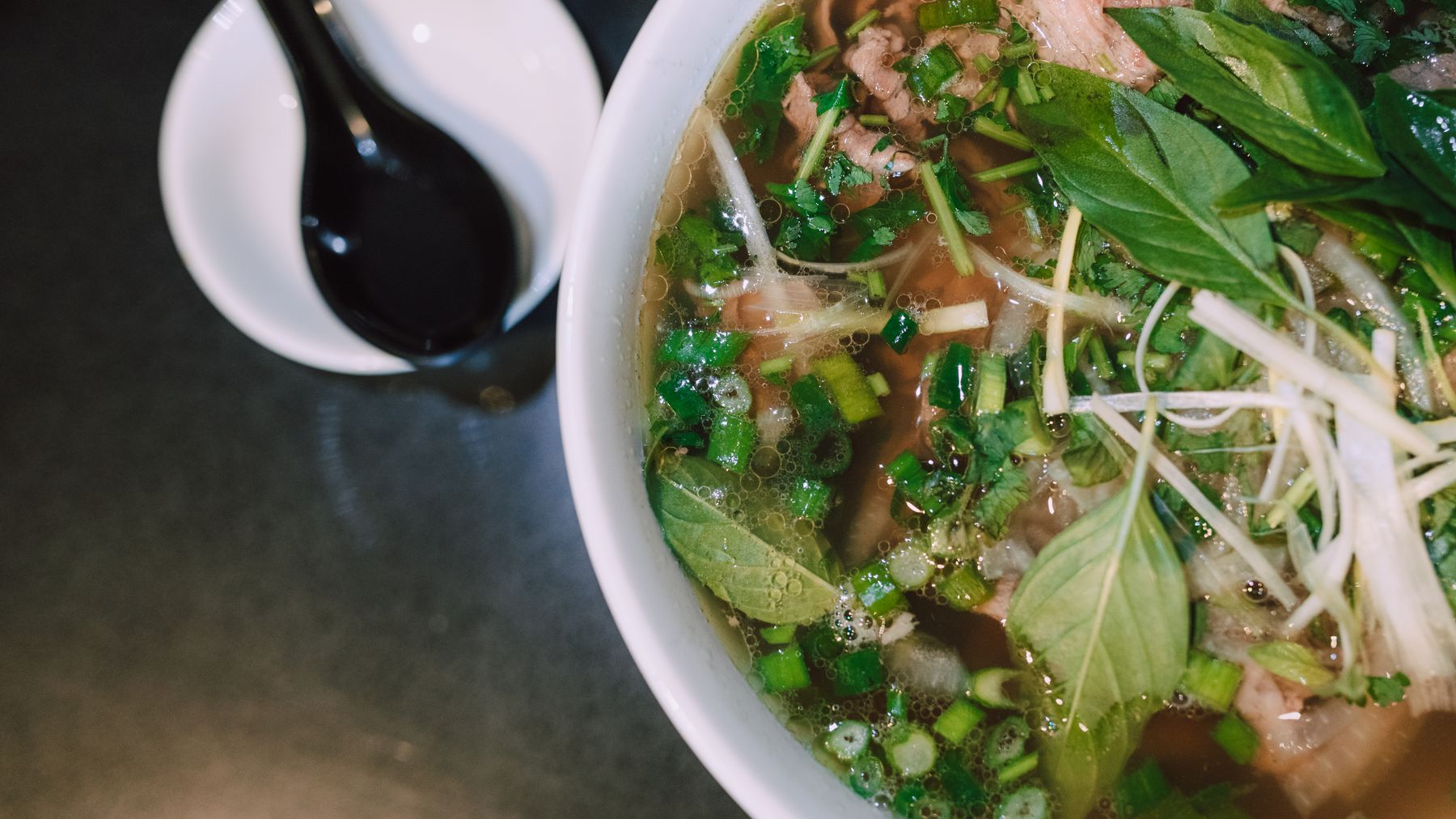
Photo by RDNE Stock project on Pexels
The 4 Best Pho Shops in Saigon
Saigon's pho scene is broader and more diverse. Southern-style dominates, but you'll also find northern-style shops opened by families who moved south decades ago.
Pho Hoa Pasteur
Address: 260C Pasteur, District 3 Price: 75,000–95,000 VND Hours: 6:00 AM – midnight
One of Saigon's longest-running pho institutions, operating since 1968. The broth is textbook southern style: sweet, aromatic, with heavy star anise. The herb plate is enormous. Pho Hoa serves until midnight, making it one of the few reliable late-night options. Prices are higher than average — you're paying for consistency and history.
Pho Quynh
Address: Multiple locations; the original is at 323 Pham Ngu Lao, District 1 Price: 65,000–85,000 VND Hours: 24 hours (Pham Ngu Lao location)
Open around the clock near the backpacker district. Despite the location, this is a legitimate pho shop, not a tourist trap. The broth is rich and sweet, the beef meatballs are house-made, and at 3 AM after a night out, this place is a temple. The Pham Ngu Lao branch gets loud; for a calmer bowl, try the District 3 location.
Pho Le
Address: 413-415 Nguyen Trai, District 5 (Cholon) Price: 70,000–90,000 VND Hours: ~5:00 AM – late morning, reopens afternoon
Deep in Cholon, Saigon's Chinatown district, Pho Le is known for one thing: the beef. Specifically the "tai lan" — rare beef flash-seared at your table in a hot stone bowl before being added to the broth. The broth itself is clean by Saigon standards, less sweet than Pho Hoa. Portion sizes are large. Getting here requires a motorbike or taxi — the Nguyen Trai address is a 15-minute ride from District 1.
Pho Phu Vuong
Address: 338/28 Le Van Sy, District 3 Price: 60,000–80,000 VND Hours: ~6:00 AM – 10:00 PM
A local favorite in District 3 with a loyal following. The broth splits the difference between Hanoi austerity and Saigon sweetness — some regulars call it balanced, others call it indecisive. Either way, the quality is consistent, the herbs are fresh, and it's rarely overrun with tour groups.
Common Pho Mistakes and Tourist Traps
Pho is straightforward to eat, but a few things trip up first-timers.
- Drowning the bowl in hoisin and sriracha before tasting. Even in Saigon, taste the broth first. A cook who's been simmering bones for 14 hours deserves that much respect.
- Ordering pho at a "com binh dan" (rice shop). Some rice-and-dish lunch spots offer pho as a side item. It's never good. Go to a dedicated pho shop.
- Paying inflated tourist prices. A bowl of pho at a sidewalk stall should not cost more than 80,000 VND in Hanoi or 100,000 VND in Saigon. If someone quotes you 150,000 VND on the street, they've seen your backpack and adjusted. Walk to the next block.
- Assuming all pho is the same. A bowl at a Hanoi institution and a bowl at a Saigon chain restaurant are fundamentally different meals. Seek out specific shops, not generic "pho" signs.
- Skipping pho ga. Visitors fixate on pho bo, but chicken pho — especially in Hanoi, where the birds are free-range and the broth is lighter — is a separate experience worth having. Some mornings it's exactly what you want.
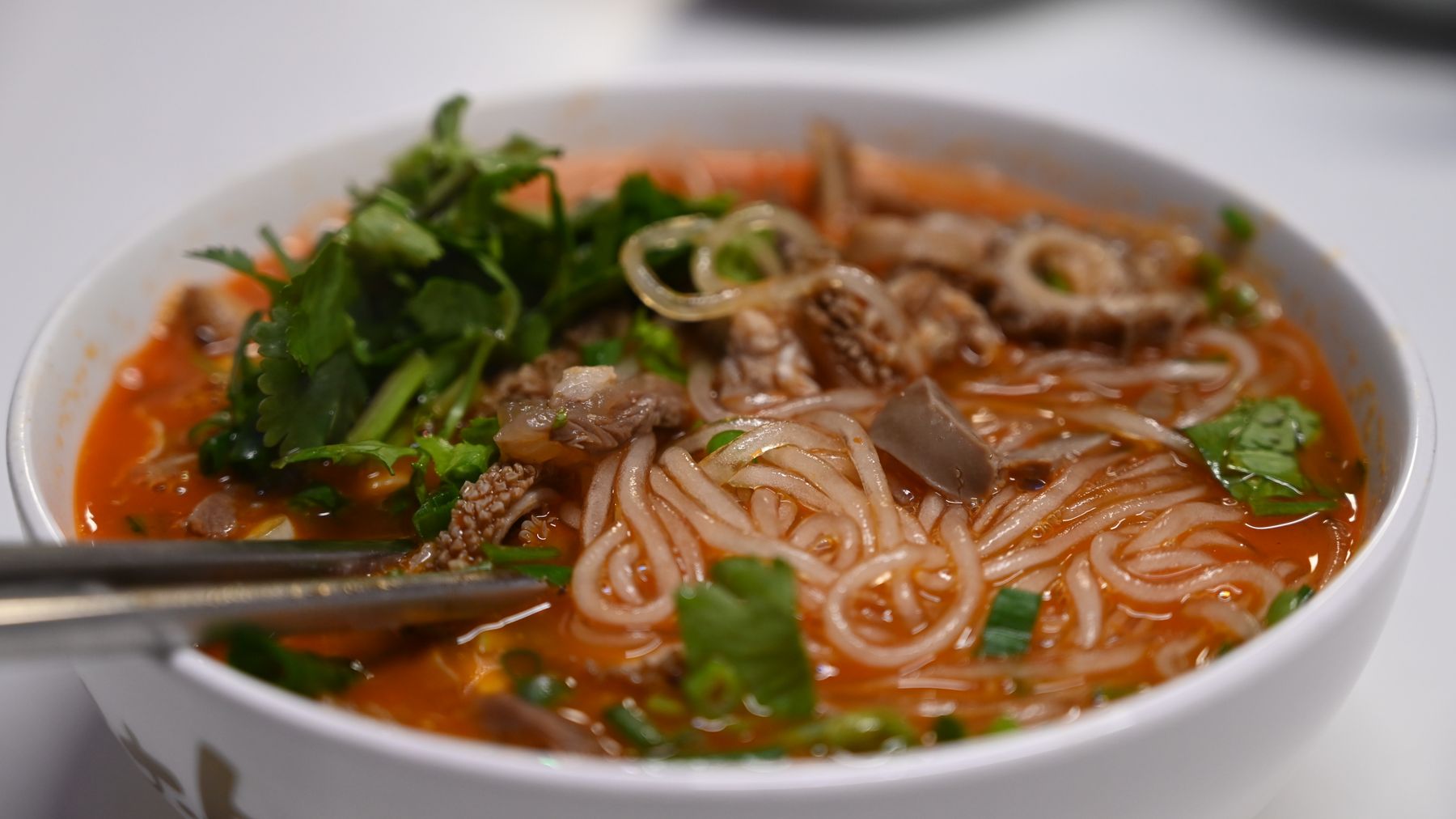
Photo by J.D. Books on Pexels
Beyond Pho: Vietnam's Other Essential Noodle Soups
Pho gets the global fame, but Vietnam's noodle soup tradition is vast. Once you've had your fill, start working through these:
- "Bun bo Hue" — Hue's signature: a spicy, lemongrass-heavy beef and pork broth with thick round noodles. More complex than pho, and the chili oil will wake you up. Eat it in Hue at Bun Bo Hue O Phung (off Nguyen Du, about 35,000 VND) or at dedicated shops in Saigon's District 1.
- "Bun rieu" — Crab-and-tomato noodle soup, tangy and rich, topped with tofu and congealed pork blood (skip that last part if you want, but try it once). Common in Hanoi.
- "Bun thang" — A delicate Hanoi soup with chicken, pork, egg, and shrimp paste. Lighter and more refined than pho. Hard to find done well, but worth seeking out.
- "Hu tieu" — Southern-style pork noodle soup, often served with a choice of broth or dry (tossed). A Saigon breakfast staple, especially in Cholon. The broth is pork-bone-sweet with dried shrimp.
- "Banh canh" — Thick tapioca-and-rice noodles in a starchy, rich broth, usually with crab or pork knuckle. Common in central and southern Vietnam.
- "Mi quang" — A Da Nang specialty: turmeric-tinted noodles with almost no broth, topped with pork, shrimp, peanuts, rice crackers, and herbs. Not technically a soup — more of a wet noodle dish.
- "Cao lau" — Hoi An's iconic noodle dish with chewy, smoky noodles said to be made with water from a specific well. Pork, herbs, croutons. You'll eat it in Hoi An's central market for about 40,000 VND.
Each of these deserves its own morning. Vietnam's noodle repertoire runs deep — pho is the entry point, not the destination.
Practical Tips for Eating Pho in Vietnam
- Go early. The best shops open at 5:30 or 6:00 AM and many sell out their broth by mid-morning. Pho is traditionally a breakfast food, and the early bowls get the freshest noodles.
- Follow the crowds. A pho shop packed with Vietnamese office workers at 7 AM is almost certainly good. An empty shop at peak breakfast hour is a red flag.
- Bring small bills. Most pho stalls don't accept cards. Carry 10,000, 20,000, and 50,000 VND notes.
- Use chopsticks and spoon together. Chopsticks in your dominant hand for noodles and meat, spoon in the other for broth. Lift noodles, slurp from the spoon. Slurping is fine.
- Ask for extra broth. "Them nuoc dung" gets you a ladle of extra broth if your noodle-to-soup ratio is off. Most shops do this free.
- Don't skip the "quay" in Hanoi. The fried dough sticks served alongside northern pho are meant to be torn and dipped into the broth. They soak up flavor and add texture. Usually 5,000–10,000 VND extra.
- Check opening days. Some Hanoi shops close one or two days a week, often with no posted schedule. Pho Gia Truyen on Bat Dan, for example, occasionally closes without warning.
Bottom Line
Pho is the dish that brings you to Vietnam, but eating it here — at a proper shop, at the right hour, in the right city — is nothing like what you've had abroad. The gap between a great bowl on Bat Dan street and a bowl at a chain restaurant overseas is the gap between hearing a song live and hearing it through a phone speaker. Go early, eat where the line is, taste the broth before you add anything, and then do it all again the next morning. You have two cities and decades of pho tradition to work through — start now.
Last updated · May 29, 2026 · independently researched, never sponsored.