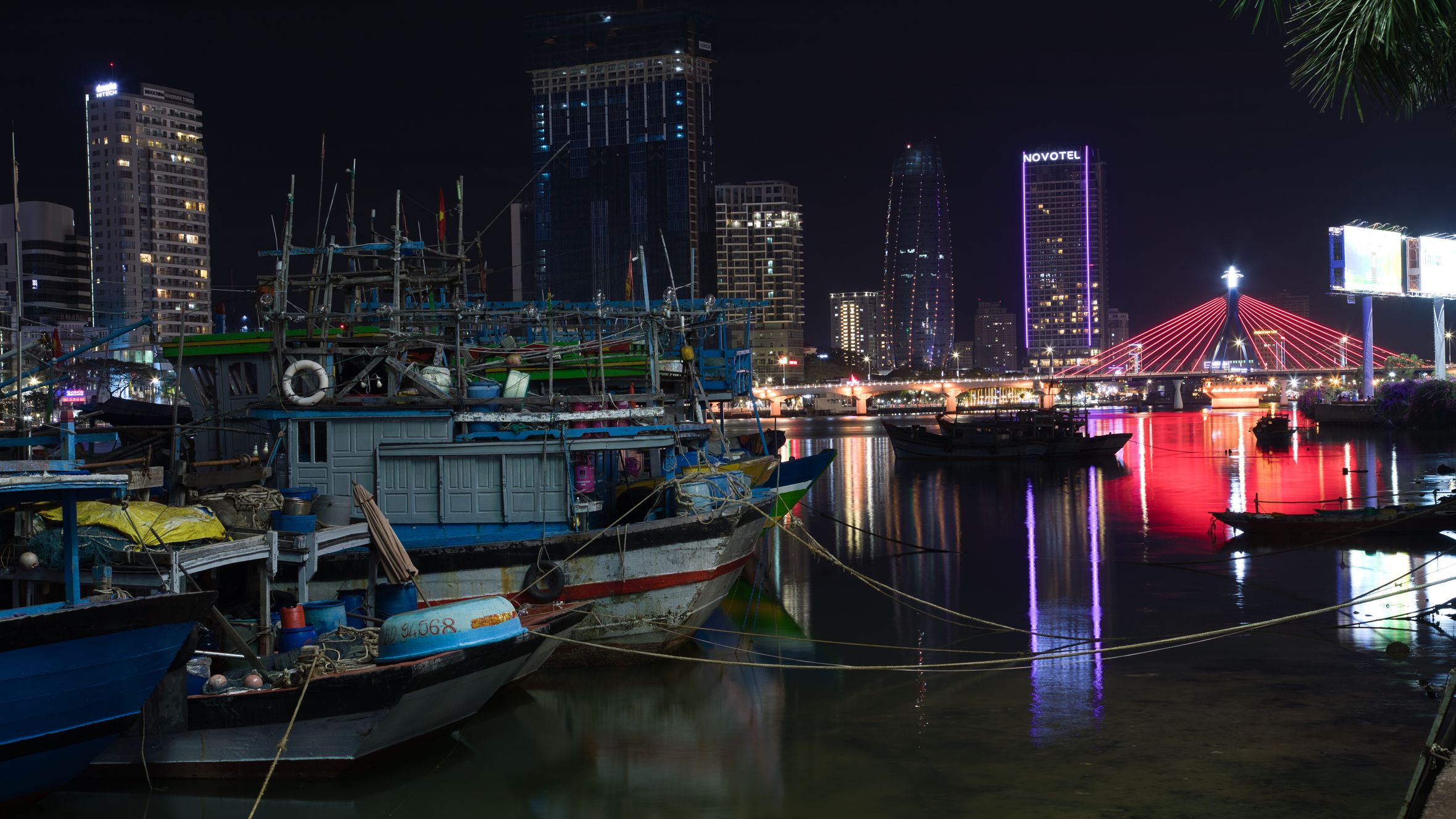
Song Han Bridge isn't the flashiest crossing in Da Nang — that title probably goes to the Dragon Bridge a few hundred meters south — but it's the one that matters most to locals. When it opened in 2000, it was the first bridge built with public donations from Da Nang residents, and it remains the emotional center of the city's riverfront.
What it is and why it matters
Song Han Bridge (Cau Song Han) spans the Han River, connecting Hai Chau District on the west bank to Son Tra District on the east. It runs about 487 meters long and was Vietnam's first swing bridge: the central span rotates 90 degrees overnight to let river traffic pass. That rotation — quiet, slow, oddly satisfying — still draws small crowds on weekend nights.
Before the bridge existed, east-bank residents relied on ferries to reach central Da Nang (다낭 / 岘港 / ダナン). The bridge changed the city's geography, opening up the beaches along My Khe and the Son Tra Peninsula to development. If you've eaten seafood on the east bank or watched the sunrise from My Khe Beach, you have this bridge to thank for making it easy to get there.
A quick logistics note: Da Nang and Quang Nam province officially merged into a single administrative unit in 2025. For travelers, not much changes day-to-day — Da Nang still operates as the main urban hub, and Hoi An, My Son, and the Quang Nam coast are still easy day trips. But you may see the combined name on newer maps and government signage.
Best time to visit
Da Nang's dry season runs from roughly March through August, with April and May being the sweet spot — warm but not yet at peak summer heat, and hotel prices haven't spiked for the domestic tourism rush in June-July. Evenings along the Han River are comfortable year-round, usually dropping to 24-26°C even in summer.
If you specifically want to watch the bridge rotate, it swings between midnight and 4 AM on weekend nights (Saturday into Sunday). The schedule shifts occasionally, so ask your hotel to confirm. The rotation is functional, not a light show — but standing on Bach Dang Street at 1 AM watching 487 meters of steel quietly pivot is a genuinely strange and cool thing to witness.
Avoid October through mid-November if you can. That's peak typhoon season, and the Han River floods aren't pretty.
How to get there
Da Nang International Airport sits about 3 km west of Song Han Bridge. A Grab car from the airport to the bridge area costs 40,000-60,000 VND and takes 10-15 minutes outside rush hour.
If you're coming from Hoi An (호이안 / 会安 / ホイアン), it's roughly 30 km north. A Grab runs 200,000-280,000 VND, or you can take the yellow local bus (route 1) for 30,000 VND — it takes about 70 minutes and drops you near the west end of the bridge on Bach Dang Street.
From Hue, the train to Da Nang takes around 2.5-3 hours and costs 60,000-120,000 VND depending on seat class. Da Nang's train station is about 1.5 km from the bridge — walkable or a quick 15,000 VND Grab bike ride.

Photo by Anh Huynh Tuan on Pexels
What to do
Walk the riverfront at night
Bach Dang Street runs along the west bank of the Han River, and the stretch near Song Han Bridge is where Da Nang does its evening promenade. Families, couples, street food carts, balloon sellers — it's lively without being chaotic. Walk south from Song Han Bridge toward Dragon Bridge (about 800 meters) for the best views. Dragon Bridge shoots fire and water at 9 PM on Saturday and Sunday nights, and you get a clear sightline from the path.
Cross to Son Tra side for My Khe Beach
Walk or ride across the bridge to the east bank and you're a 10-minute walk from My Khe Beach. Early morning is best — local swimming clubs are out by 5:30 AM, and the beach is wide and uncrowded before 8 AM. The surf is gentle most of the year, though it picks up in winter.
Visit the Cham Museum
The Museum of Cham Sculpture sits about 1 km south of the bridge on the west bank. It holds the world's largest collection of Cham artifacts — sandstone carvings, altar pieces, and lingas dating from the 7th to 15th centuries. Entrance is 60,000 VND. Budget 45 minutes to an hour. If you're planning a trip to My Son, this museum gives useful context for what you'll see at the ruins.
Photograph the bridge lineup
Da Nang has six bridges crossing the Han River within a few kilometers of each other. From the rooftop bars along Bach Dang Street — Brilliant Top Bar or Sky36 — you can see Song Han, Dragon, Tran Thi Ly, and Thuan Phuoc bridges all lit up at once. It's one of the better urban night views in Vietnam, and a "bia hoi" or a local craft beer up there costs 50,000-80,000 VND.
Day-trip to Son Tra Peninsula
Once you cross to the east bank, Son Tra Peninsula is about 10 km northeast. Rent a motorbike (120,000-150,000 VND/day from shops near My Khe) and ride up to the Linh Ung Pagoda and its 67-meter Lady Buddha statue. The coastal road has good views and almost no traffic on weekday mornings.
Where to eat nearby
The west bank near the bridge is solid for "mi quang" — Da Nang's turmeric-tinted noodle dish with pork, shrimp, peanuts, and crispy rice crackers. Mi Quang Ba Vi on Le Duan Street (about 600 meters south of the bridge) does a reliable bowl for 35,000-45,000 VND.
For "banh xeo" — the crispy stuffed crepe — head to Banh Xeo Ba Duong on Hoang Dieu Street. It's a 5-minute taxi ride from the bridge and perpetually packed with locals. A plate runs 30,000-50,000 VND. Wrap the pieces in rice paper with fresh herbs the way everyone else at the table does.
On the east bank, the seafood restaurants along Pham Van Dong Street serve grilled clams, garlic butter shrimp, and salt-and-pepper crab. Prices are posted per kilogram — expect to pay 150,000-400,000 VND per plate depending on what you order.
Photo by Kirandeep Singh Walia on Pexels
Where to stay
Budget guesthouses on the west bank near Bach Dang Street run 250,000-450,000 VND/night. Mid-range hotels with river views go for 600,000-1,200,000 VND. If you want beachfront, cross to My Khe on the east side — hotels there range from 400,000 VND for a basic room to 3,000,000+ VND for the resort-style places.
Staying on the west bank puts you closer to restaurants, the night market, and Dong Da local street food alleys. Staying east puts you on the beach. Both sides are a 5-minute bridge crossing from each other, so it's not a major decision.
Practical tips
- The bridge sidewalks are open to pedestrians 24 hours, but motorbike traffic is heavy during rush hour (7-8:30 AM, 5-6:30 PM). Walk it in the evening instead.
- Da Nang tap water is not drinkable. Bottled water is 5,000-10,000 VND everywhere.
- If you're visiting during Tet / 越南春节 / テト), the bridge and riverfront get elaborate light installations. It's crowded but genuinely festive — Da Nang takes its Lunar New Year decorations seriously.
- Don't confuse Song Han Bridge with Thuan Phuoc Bridge (the long suspension bridge at the river mouth). Grab drivers sometimes autocorrect to the wrong one — confirm by saying "Cau Song Han, gan Bach Dang" (Song Han Bridge, near Bach Dang Street).
Common mistakes
Showing up expecting a Golden Bridge-style spectacle. Song Han Bridge is a real piece of city infrastructure, not a tourist attraction with a ticket booth. Its appeal is contextual — the riverfront, the night atmosphere, the rotation if you stay up late enough. Treat it as a starting point for exploring the riverfront, not a destination in itself.
Skipping the east bank entirely. A lot of travelers park themselves on Bach Dang Street and never cross over. The east side has the beach, Son Tra, and cheaper seafood. Use the bridge.
Last updated · May 29, 2026 · independently researched, never sponsored.