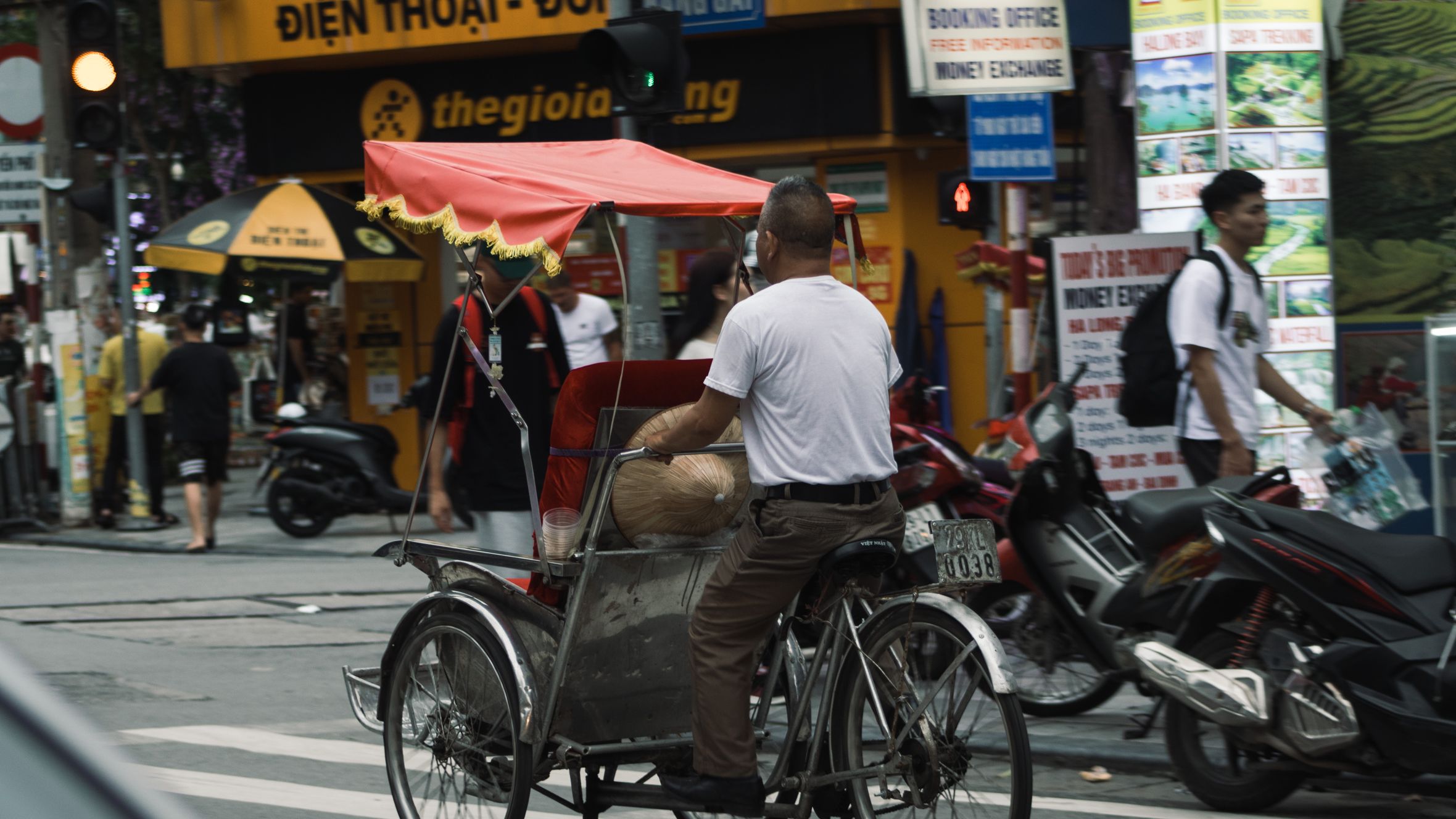
The scams that work because tourists don't see them coming
Every guidebook warns about taxi meters. What they don't tell you: some of the nastiest taxi fraud has nothing to do with the meter at all. You'll hand over cash, get change, and only realize hours later the bills were counterfeit. Or you'll arrive at your destination and the driver insists the fare is three times what the meter shows. These aren't edge cases—they happen regularly in Hanoi, Saigon, Da Nang, and smaller cities.
The meter is only your first line of defense.
Fake taxi colors and plates
In Hanoi and Saigon (사이공 / 西贡 / サイゴン), official taxis are registered with specific colors: white-and-blue Taxi Group, yellow-and-black Mailinh, white Mai Linh, etc. Unlicensed "taxis" copy these colors almost perfectly. The plates are often fakes—slightly wrong numbering, wrong lettering fonts, or laminated over real plates so they peel back to hide the original.
Why this matters: these vehicles have zero regulation. No meter inspection. No insurance. If the driver wants 500,000 VND for a 3 km trip, there's no authority to appeal to.
How to spot them: before you get in, check the license plate against the taxi company's official list (Mailinh, Taxi Group, etc. all publish theirs online). Look at the plate itself—real plates are embossed metal, not printed plastic. If you're at an airport or hotel, use the taxi rank, not someone flagging you from the curb.
Rigged meters that run faster than time
This is different from "not using the meter at all." Some taxis have meters that count up correctly by distance, but the meter hardware is tampered with so it registers more distance than you've actually traveled. The meter clicks up every 300 meters instead of every 500 meters. It looks official. The receipt looks real. You didn't negotiate—you agreed to the meter.
You won't notice in heavy traffic. In light traffic, a 3 km trip might register as 5 km on the meter.
How to avoid it: use Grab or Be instead. Their GPS-based fares eliminate this entirely. If you must take a regular taxi, screenshot the meter reading at the start and note the kilometers. Do the math yourself when you arrive. If it seems wrong, refuse to pay and call the taxi company's hotline (they'll back you up for a rigged meter—it's also fraud against them).

Photo by Tim Samuel on Pexels
Intentional detours and "no direct route" lies
A driver picks you up and says "the main road is blocked by construction" or "there's a festival—we have to go around." You don't know the city, so you trust them. You end up paying for 8 km when the direct route is 4 km.
Sometimes this is true. Sometimes it's not. And sometimes the driver makes a detour that technically works but adds 20–30% to the fare.
Prevention: use Google Maps on your phone and watch the route in real time. If the driver goes wildly off course, speak up immediately. Don't wait until you arrive. Ask the driver to explain the detour before you leave the starting point.
Counterfeit bills handed back as change
You pay with a 500,000 VND note. The driver hands back change in smaller bills. One or more of them are counterfeit—cheap prints that feel thin, have blurry ink, or have wrong security features. By the time you realize (maybe at a shop the next day), you can't go back to the driver.
This happens regularly in tourist areas. Saigon's Ben Thanh Market and Hanoi (하노이 / 河内 / ハノイ) Old Quarter are common spots.
What to do: inspect every bill the driver hands you before you leave the taxi. Feel the texture—real Vietnamese bills have a distinct raised pattern that's hard to fake. Hold it up to light and look for the security thread. If something seems off, refuse it and ask for different bills. The driver will swap them out (they don't want the police involved either).
Airport and late-night premium pricing
At Tan Son Nhat (Saigon), Noi Bai (Hanoi), or Da Nang airport, unlicensed "taxis" cluster outside the official taxi stand. They'll charge 400,000–600,000 VND for what a metered taxi would do for 150,000–250,000 VND. At 2 a.m., a tired traveler is an easy target.
Better taxis also exist at the airport, but they're crowded and queued. Unlicensed drivers find you before the licensed ones do.
The fix: ignore anyone offering a taxi outside the terminal. Use the official taxi stand inside the arrival hall, or use Grab (which works at all major airports). The wait is longer, but the fare is fair and tracked. If you're jet-lagged and tired, that's exactly when you should not negotiate with a stranger on the curb.

Photo by Lukasz Radziejewski on Pexels
Why Grab and Be are safer
Grab (ride-hailing, similar to Uber) and Be (motorbike taxis) use GPS-based fares set before you ride. The driver's real name, face, and vehicle are visible. Your route is tracked. If something goes wrong, you have a complaint record and the company backs you up.
This doesn't mean Grab is perfect—drivers are still people, and occasional bad actors slip through. But the transparency, route tracking, and accountability make it genuinely harder to scam. The driver has no incentive to take a detour (the fare is already set) or hand you fake money (you paid digitally).
Grab is also 10–20% cheaper than a flagged taxi in most cities, and it works even if you don't speak Vietnamese.
Street-level prevention playbook
- Always use Grab or Be if you have a smartphone and data. Full stop. It's not more expensive, and it removes most scam vectors.
- If you must flag a taxi: only use official colors and plates. Check the plate online first.
- Watch the meter from the start. Note the kilometer reading. If it jumps faster than your actual speed (you're going 30 kph but the meter ticks like you're going 50 kph), object immediately.
- Know the rough fare beforehand. Use Google Maps to check distance. Hanoi and Saigon meters are roughly 10,000–15,000 VND per km as of late 2024, plus a small base charge. Do the math.
- Inspect change carefully. Feel the bills, hold them to light. Take 5 seconds. It's your money.
- At night or airports, use the official taxi stand, not a stranger on the curb. Wait 5 extra minutes. It's worth it.
Frequently Asked Questions
How can I tell if a taxi meter has been tampered with in Vietnam?
Rigged meters count distance faster than actual travel — a meter may click up every 300 meters instead of every 500 meters, making a 3 km trip register as 5 km. To catch this, screenshot the meter reading at the start and track kilometers yourself. If the final fare seems wrong, refuse to pay and call the taxi company's hotline — a rigged meter is fraud against them too.
What are the safest ways to avoid fake taxis in Hanoi and Saigon?
Use the official taxi rank at airports and hotels rather than accepting rides from drivers who approach you on the curb. Before getting in, check the license plate against the taxi company's published list — Mailinh and Taxi Group both post these online. Real plates are embossed metal, not printed plastic. Better still, use Grab or Be, whose GPS-based fares bypass meter fraud and fake vehicles entirely.
When should I inspect the change a taxi driver gives me in Vietnam?
Inspect every bill before you exit the taxi, not after. Counterfeit notes are common in tourist areas including Hanoi's Old Quarter and Saigon near Ben Thanh Market. Fake bills feel thin, have blurry ink, and lack correct security features. Once you leave the vehicle, there is no way to go back to the driver, so checking while still seated is the only reliable window to catch and reject bad notes.
Bottom line
Taxi scams in Vietnam aren't sophisticated—they rely on you not paying attention or not knowing what to look for. Most are avoidable with a smartphone and Grab. If you do flag a taxi, watch the meter, check your change, and don't get in a vehicle with a plate that looks off. Street-level awareness beats any guidebook warning.
Last updated · May 29, 2026 · independently researched, never sponsored.