The geography of a single dish
"Cao lau" — the chewy noodle soup that tastes almost nowhere else — exists because of Hoi An's well water. Not marketing. Actual chemistry. If you've had it elsewhere and found it thin or off, that's why.
The dish uses two non-negotiable things: water from Hoi An's ancient wells (which run high in minerals and iron oxide), and lye made by burning wood from local cay tram trees. Together, they create a noodle with a dense, slightly gelatinous chew that you can't replicate outside the town. Restaurants in Hanoi, Saigon, or elsewhere can approximate it — good cooks manage decent versions — but the original sits squarely in Hoi An, and restaurants here know it.
The well most often cited is the Ba Le well, tucked into an alley off Phan Chu Trinh Street about 400 meters from the Japanese Covered Bridge. It's not a tourist attraction — just a shallow stone well behind a residential gate — but noodle makers in the area have drawn from it for generations. A few other wells in the Old Quarter contribute too, but Ba Le is the one locals name first. The water table under Hoi An (호이안 / 会安 / ホイアン) is shallow and mineral-rich, fed by the Thu Bon River's floodplain geology. That matters more than any recipe.
A quick history: trade-port noodles
Hoi An was a major international trading port from the 16th to the 18th century. Japanese, Chinese, Indian, and Portuguese merchants all passed through, and the town's cuisine absorbed their influences. Cao lau reflects that layering. The thick noodles echo Japanese udon in their heft. The roasted pork topping nods to Chinese "char siu." The fresh herbs and pickled greens are unmistakably Vietnamese. Some food historians argue that cao lau descends from a dish that Japanese merchants brought during the Tokugawa period, though hard evidence is thin.
What's not debated is that the dish stayed local. While "pho" spread from Hanoi south and eventually worldwide, and "banh mi" became a global sandwich, cao lau (까오러우 / 高楼面 / カオラウ) never left its zip code in any serious way. The water dependency is the main reason, but tradition plays a role too — Hoi An's noodle families guard their process closely. Some have been making it for three or four generations, and they don't franchise.
Today the dish is one of the reasons food-focused travelers detour to Hoi An instead of heading straight to Da Nang (only 30 km north) or down to Hue (about 130 km northwest). It pairs well with a morning spent in the Old Quarter, especially if you combine it with a "banh mi" from Madam Khanh (also called the Banh Mi Queen, on Tran Cao Van Street, 25,000 VND) and an iced "ca phe" from one of the riverside cafes.
Where the best ones are
Quan Cao Lau Thanh
On Nguyen Hue Street, this place is small and unlabeled from the outside, which is a good sign. You'll recognize it by the metal pot of broth simmering constantly near the entrance. A bowl costs 40,000 VND. The noodles have proper weight; the broth is pork-and-beef based, clear and not oversalted. They don't add much — some pickled greens, a handful of herbs, maybe half a quail egg — which lets the noodle and broth do the work. Eat this standing at a plastic table or take it to go. Open from around 7 a.m. until early afternoon.
Quan Trung Bac
On Tran Phu Street (the main pedestrian drag), Trung Bac is the noisier, more visible option. Tourists find it easily; locals still eat here. Bowl is 40,000–50,000 VND depending on size. The noodles are excellent — chewy and slightly slick in the broth — and they're generous with the "thit heo quay" (roasted pork) and "thit bo" (braised beef). The broth is richer here, more heavily pork-based. It's busier, less atmospheric, but the food is solid. Hours: 6 a.m.–noon, roughly.
Lien Hoa
Walking toward the market from the Old Quarter, Lien Hoa operates from a corner stall. Bowl is 35,000–40,000 VND. The proprietor is precise with the noodles — thin strands, properly cooked — and doesn't oversell the add-ons. Simple herbs, some cracklings if you ask. The broth is lighter and more mineral-forward than the others, which tells you she's leaning into the well-water story. Hours: early morning until mid-afternoon, closed some days.
Inside the Central Market (Cho Hoi An)
If the three spots above are too far from your walking route, head to the Central Market on Tran Phu Street. Multiple vendors sell cao lau from small counters inside. Quality varies — some stalls pre-cook noodles in batches that sit too long — but the stall closest to the Tran Phu entrance (no name, look for the older woman with a wood-fired pot) consistently serves a proper bowl for 35,000 VND. The market is also where you can try "banh xeo" (crispy crepe) and "goi cuon" (fresh spring rolls) from neighboring vendors, so you can build a cheap multi-dish breakfast for under 100,000 VND total.

Photo by Vika Glitter on Pexels
Why cao lau can't be made elsewhere
The well water is the literal foundation. Hoi An sits above aquifers with high iron and mineral content; the water runs faintly orange if you hold it to the light. That's not decoration — it affects gluten development and how the noodle absorbs broth. The lye ("nuoc vo cam" or water from burnt cay tram bark) raises the pH and gives the noodle its characteristic yellow tint and firm snap.
You can buy cao lau flour and lye packets online now, but the water can't travel. This is why the dish has never gone national, the way "pho" or "banh mi" have. Cao lau is intentionally local.
Some restaurants in other cities will tell you they source the lye and use filtered mineral water to approximate it. That's effort. But it's still an approximation. The original noodle shops in Hoi An aren't being precious — the ingredients really do differ.
For comparison, think about how "mi quang" — Da Nang's turmeric noodle dish — can travel a bit more freely because its defining character comes from turmeric and broth technique rather than a single water source. Or how "bun bo Hue" (the spicy beef noodle from Hue) has successfully spread to Saigon and abroad because its lemongrass-shrimp paste base is replicable anywhere with good ingredients. Cao lau doesn't have that portability. The water is the recipe.
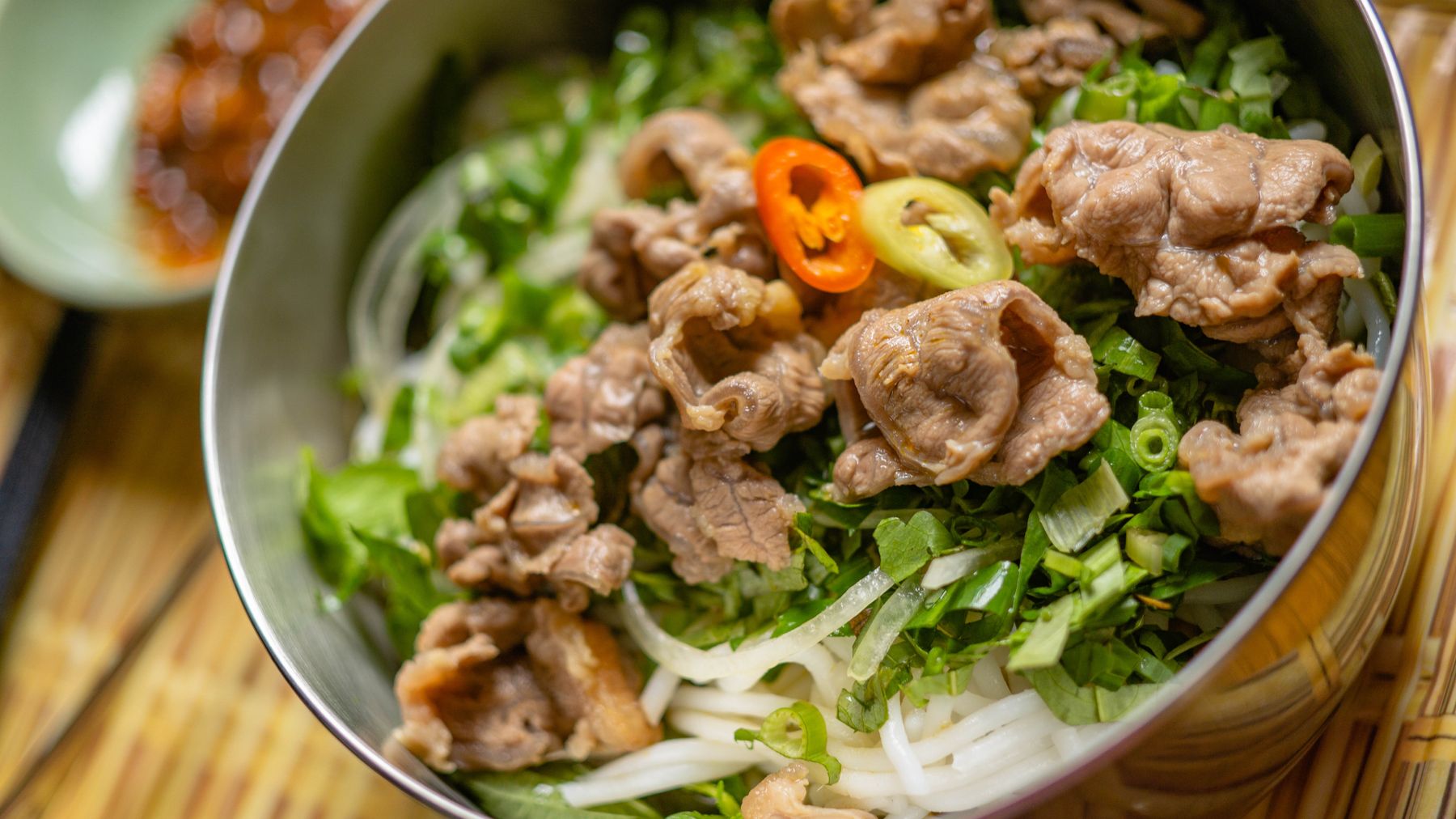
Photo by FOX ^.ᆽ.^= ∫ on Pexels
Texture, not flavor
Don't come expecting a rich or complicated broth. Cao lau's charm is textural. The noodle should be dense and slightly gelatinous, with a faint chew that holds its shape in the broth. Other Vietnamese noodles — "hu tieu", "bun rieu", "banh canh" — are silkier, or brothier, or fluffier. Cao lau is heavy. It sits in your stomach.
The broth is supporting actor: pork and beef, sometimes a touch of star anise or cinnamon, but not overdone. The pickled greens and pork cracklings add sharpness and texture contrast. The whole thing tastes more like a working lunch — fuel — than a restaurant dish. Which is what it originally was.
The toppings deserve a closer look. "Thit heo quay" — roasted pork belly with crispy skin — is the protein you'll see most often. Good stalls roast it in-house; lesser ones buy pre-made slabs that go rubbery by mid-morning. Cracklings ("toc moi") are fried pork rinds crumbled over the top for crunch. Fresh herbs include sawtooth coriander, mint, and sometimes banana blossom shreds. A wedge of lime on the side is standard. Some stalls offer chili paste; use it sparingly because the broth is meant to be subtle.
How to order like a local
At most stalls, you don't need to say much. Point at the pot and hold up fingers for how many bowls. But a few Vietnamese phrases help:
- "Cho toi mot to cao lau" — Give me one bowl of cao lau
- "Them thit" — Extra meat (expect 10,000–15,000 VND more)
- "Khong cay" — Not spicy
- "It nuoc" — Less broth (some people prefer it drier, almost like a tossed noodle)
The "it nuoc" version is worth trying. With less broth, the noodle's chew becomes more prominent and the pork cracklings stay crispier longer. Think of it as the difference between a soup and a dressed noodle salad. Both are standard — you're not making a weird request.
Pay at the end. Most stalls expect cash in small denominations: 10,000, 20,000, or 50,000 VND notes. Handing over a 500,000 VND note at a street stall is awkward — they may not have change, and it slows everything down.
Common mistakes foreigners make
Eating it at dinner. Cao lau is a morning and lunch dish. By 2 p.m., the best stalls have closed and their noodles are gone. Tourist restaurants that serve it at 7 p.m. are working with noodles that were made hours ago — the texture goes flat.
Comparing it to pho. Visitors try cao lau expecting pho's fragrant, long-simmered broth, then feel underwhelmed. They're different categories. Pho is broth-forward; cao lau is noodle-forward. Adjust your expectations before the first bite.
Drowning it in sauce. The bowl arrives with a balance the cook intended. Dumping in hoisin, sriracha, or fish sauce before tasting it covers up the mineral quality of the broth and the noodle's natural flavor. Taste it plain first. Add lime if you want brightness, chili if you need heat, but go easy.
Ordering from restaurants with photo menus in four languages. These spots cater to tour groups and typically charge 70,000–100,000 VND for a bowl that's worse than the 35,000 VND version two blocks away. If the menu is laminated and features stock photos, walk past.
Skipping the market. Cho Hoi An (the Central Market) is where many locals eat their morning bowl. It's not curated or photogenic, but the food is priced for people who eat there daily, and the turnover means nothing sits around.
Cao lau at a glance
- Price range: 35,000–50,000 VND at street stalls and market vendors; 70,000–100,000 VND at tourist-facing restaurants
- Best hours: 7 a.m. to noon
- Key ingredients: well water (high iron/mineral), cay tram lye, rice flour, roasted pork, pork cracklings, fresh herbs, pickled greens
- Texture: dense, chewy, slightly gelatinous — heavier than pho or bun
- Broth: light pork-beef base, not the star of the dish
- Where to eat: Quan Cao Lau Thanh (Nguyen Hue St), Quan Trung Bac (Tran Phu St), Lien Hoa (near market), Central Market vendors
- Tipping: not expected at street stalls
- Pairs with: "banh mi" from a nearby vendor, iced "ca phe sua da" from a riverside cafe
- Closest comparison: none, really — but if pressed, think udon meets "com tam" in spirit: humble, filling, specific to its place
Practical notes
Eat cao lau in the morning or early afternoon. Most stalls close by 2 p.m. Avoid the tourist restaurants on the main square; they charge 80,000–100,000 VND and the noodles taste rushed. The best bowls are in unpretentious spots on side streets or inside the covered market. Bring small bills; not all stalls have change for large notes. Water is free; bring your own bottle or ask at the stall.
If you're spending more than a day in Hoi An, eat cao lau at two different stalls to compare. The differences are subtle — broth richness, noodle thickness, cracklings-to-herb ratio — but they tell you a lot about how personal the dish is to each cook. And if you're heading north to Da Nang or Hue afterward, eat one more bowl before you leave. You won't find it on the road.
Bottom line
Cao lau is one of the few Vietnamese dishes that genuinely cannot be separated from its geography. The well water, the local lye, the Old Quarter stalls that have been making it for decades — these aren't marketing details, they're the recipe. Eat it in Hoi An, eat it in the morning, eat it cheap, and pay attention to the noodle. That's where the whole story lives.
Last updated · May 29, 2026 · independently researched, never sponsored.