The difference between real Hue and the rest
"Bun bo Hue" — the spicy beef noodle soup from central Vietnam (베트남 / 越南 / ベトナム) — has spread across the country. Hanoi and Saigon restaurants serve passable versions. But there's a reason locals in Hue will tell you those are imitations.
Authentic Hue style uses beef shank and oxtail simmered for hours in a broth built on lemongrass, chili, and shrimp paste. The noodles are thicker, chewier "banh canh"-style rather than thin pho strands. And the crucial ingredient most places outside Hue skip: "mam ruoc" — a pungent, fermented shrimp-and-crab paste that you stir directly into the bowl.
Without "mam ruoc", the bowl tastes flat and generic. With it, you taste why Hue (후에 / 顺化 / フエ) cooks have made this dish for generations.
1. Bun Bo Hue Ba Tuyet
Located on Chu Van An street near the Perfume River, Ba Tuyet is the institution. The stall opens around 7 a.m. and sells out by 10:30.
The broth here is deep and slightly sweet — they use both beef bones and pork to build complexity. The beef shank is soft enough to cut with your spoon, and the "mam ruoc" is noticeably aggressive, almost funky in the best way. A bowl costs 35,000–40,000 VND. Seating is standing room or a plastic stool; you're eating shoulder-to-shoulder with construction workers, students, and pensioners.
The real tell: locals queue before opening.
2. Bun Bo Hue Ba May
Ba May operates from a narrow stall on Hung Vuong street, a few blocks west of the Citadel. She's been there for over 20 years.
Her broth is leaner than Ba Tuyet's — less pork fat, more pronounced chili heat. If you prefer a cleaner, spicier bowl, this is it. The beef is tender but holds its shape, and she generously portions the noodles. The "mam ruoc" here is milder, letting the lemongrass shine.
Expect to pay 30,000–35,000 VND. Arrive by 8 a.m.; she closes by 11.

Photo by Pew Nguyen on Pexels
3. Quan O Khong Ten ("The Unnamed Shop")
This stall has no sign. It's tucked under an awning on a side street branching off Chu Van An, about 200 meters south of the Hue Citadel. Locals know it by reputation alone.
The owner is a quiet woman in her 60s who will stare at you blankly if you ask for a menu — there's one dish, and you order a small or large bowl. The beef here is the star: thick shank slices that have sat in the broth since before dawn. The broth itself is darker and richer than the others, almost like a beef pho concentrate but spiced with that signature Hue red chili kick.
35,000 VND gets you a generous bowl. Seating is limited to four plastic stools. It fills up quickly after 8 a.m.
4. Bun Bo Hue Hoa Dong Y
On Vo Thi Sau street, near the morning market, this stall is larger and more accessible than the others — actual tables, a few fans, even a printed menu.
The broth is heavier on beef bone, lighter on pork. The noodles are chewy and substantial. What sets it apart: the toppings. Fresh herbs come in a larger pile than elsewhere — Thai basil, sawtooth coriander, lime leaves. The beef is cut thinner here, which some prefer because it absorbs the broth faster.
Price: 35,000–45,000 VND depending on size. Less cramped than Ba Tuyet, but also slightly less intense.
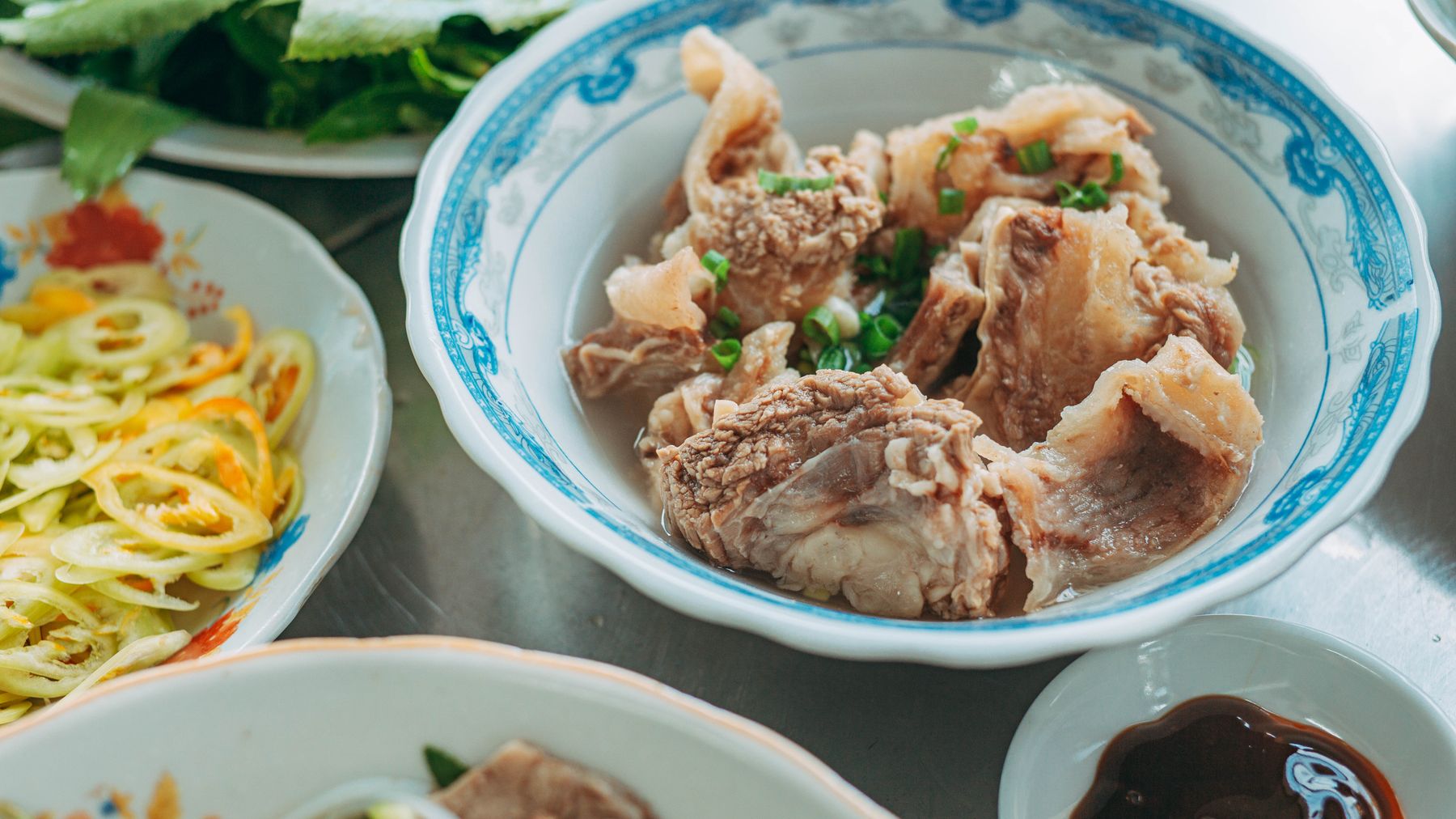
Photo by FOX ^.ᆽ.^= ∫ on Pexels
5. A stall near Dong Ba Market (no fixed name)
Just outside Dong Ba Market's northeast entrance, a vendor sets up a cart with four small tables around 6:30 a.m. She closes by 10. She doesn't advertise; you'll only find her if you're in the market at dawn.
Her broth is the most delicate — less chili, more nuance from the shrimp paste and lemongrass. If you're sensitive to spice or prefer a lighter bowl, this is it. The beef is cut thick and square, almost candied in texture from the long simmer. She's generous with "mam ruoc" — a little spoon comes on the side so you can dose it yourself.
Price: 30,000–35,000 VND. Tightly touristed, but real locals still eat here.
What to order and how to eat it
Always ask for the full bowl ("tô to"). Skip the half version; "bun bo Hue" is meant to be eaten as a complete, slow dish — noodles, broth, and meat in one rhythm.
When the bowl arrives, don't immediately stir. Look at the layers: the noodles at the bottom, the beef and oxtail arranged on top, the broth clear or reddish depending on the stall's style. The fresh herbs come separate — a mound of basil, coriander, and lime leaves. Add them as you eat; they wilt into the hot broth.
The "mam ruoc" is the moment. A spoonful of this paste tastes like low-tide funk and umami — it's an acquired taste. Stir it directly into the broth until it dissolves. If you hate it, don't force it. But most people who've had real "bun bo Hue" here will tell you that the bowl without it tastes like a draft.
Finish the noodles and broth, then the meat. You'll likely be sweating a little. That's the point.
Frequently Asked Questions
How much does a bowl of bun bo Hue cost at local stalls?
A bowl at the local stalls covered in this guide ranges from 30,000 to 45,000 VND. Ba May on Hung Vuong street is the most affordable at 30,000-35,000 VND, while Ba Tuyet on Chu Van An runs 35,000-40,000 VND and Hoa Dong Y on Vo Thi Sau street goes up to 45,000 VND for a large bowl.
What makes authentic Hue-style bun bo Hue different from versions sold elsewhere?
Authentic Hue bun bo Hue uses beef shank and oxtail simmered for hours in broth built on lemongrass, chili, and shrimp paste. The noodles are thicker and chewier than pho strands. The key ingredient most restaurants outside Hue omit is mam ruoc — fermented shrimp-and-crab paste stirred directly into the bowl. Without it, the broth tastes flat. Hanoi and Saigon versions are generally considered imitations by Hue locals.
When should you arrive at bun bo Hue stalls to avoid selling out?
Most stalls open around 7 a.m. and close before noon. Ba Tuyet on Chu Van An sells out by 10:30 a.m., and locals queue before it opens. Ba May on Hung Vuong closes by 11 a.m., so arriving by 8 a.m. is advisable. The unnamed stall on the Chu Van An side street fills its four seats quickly after 8 a.m.
Practical notes
All five stalls operate early morning, usually 6:30 a.m. to 11 a.m., and close after the lunch crowd fades. Cash only. Hue is a walkable city, but hiring a taxi for 20,000–30,000 VND to hop between stalls (if you're sampling multiple) is cheaper than searching on foot. If you're visiting in summer (May–September), the heat and humidity are intense; eat early, before 9 a.m.
Last updated · May 29, 2026 · independently researched, never sponsored.