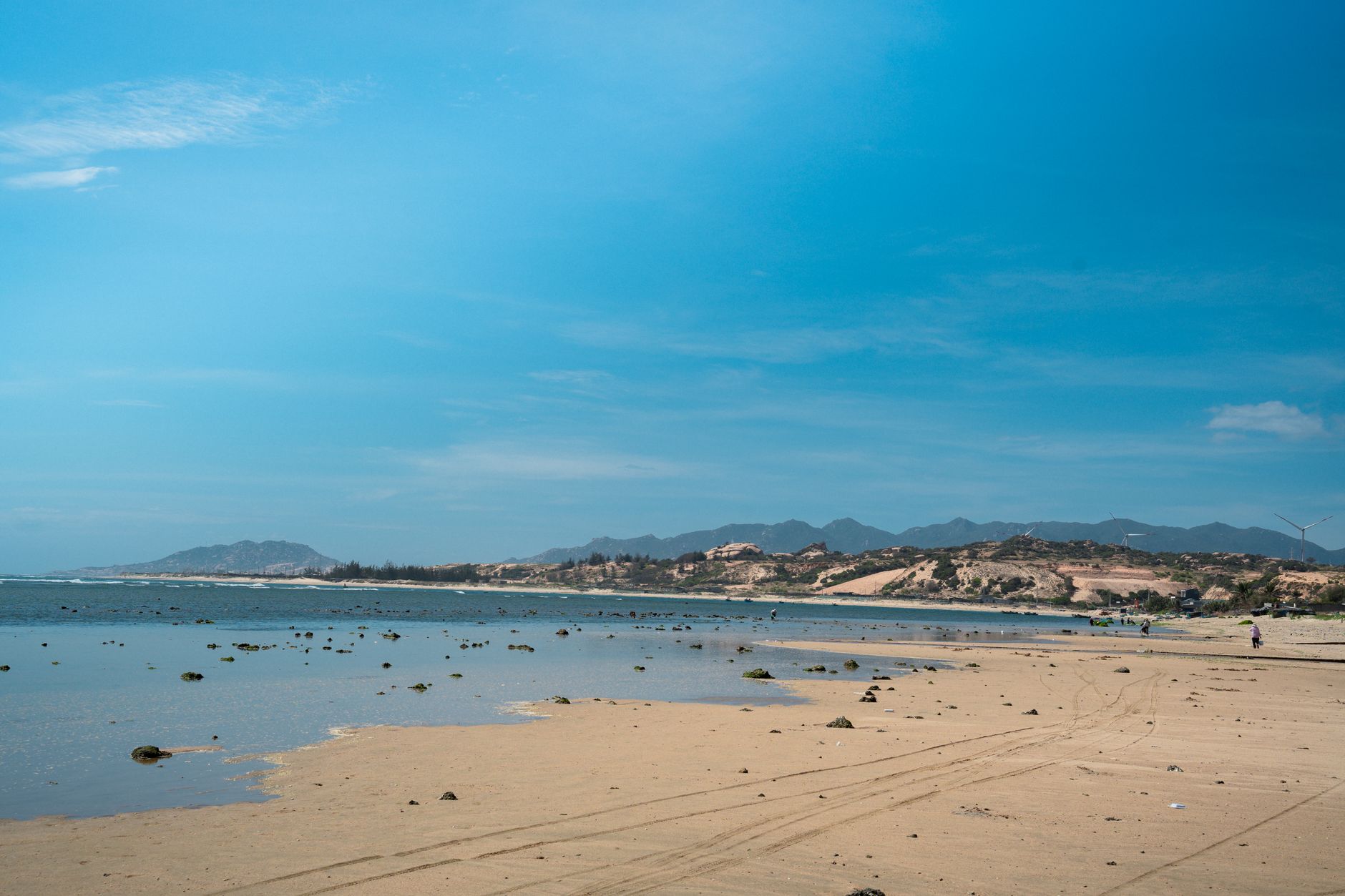
Bien Quynh sits about 75 km southeast of Vinh city in Nghe An province — a wide, flat beach backed by casuarina trees and fishing villages that haven't been rezoned into resort complexes yet. If you're traveling through central Vietnam (베트남 / 越南 / ベトナム) and want a beach day without the crowds of Da Nang or the package-tour energy of Cua Lo, this is a reasonable option.
What it is
Bien Quynh refers to the coastline running through Quynh Luu district, roughly from Quynh Phuong commune down to Quynh Long. The sand is a pale tan color, firm underfoot, and the water is shallow enough to wade out a good distance. It's not a single defined beach with a parking lot and ticket booth — it's more of a coastal stretch dotted with small seafood shacks, a few guesthouses, and a lot of fishing boats pulled up on shore.
The area has been a fishing community for generations. You'll see wooden boats with painted eyes on their prows (a tradition meant to help the vessel "see" its way through the sea), nets drying in yards, and women sorting the morning catch right on the sand. Tourism infrastructure exists but remains modest — this is still very much a working coast.
Why travelers go
Honestly, most foreign travelers don't. Bien Quynh draws mainly domestic visitors from Vinh and Hanoi looking for a weekend escape. That's part of its appeal if you prefer places that haven't been optimized for tourists. There are no banana boats, no Russian-language menus, no infinity pools.
What you get instead: genuine fishing village atmosphere, cheap and absurdly fresh seafood, and a beach where you can walk for a long time without hitting a sun-lounger rental operation. It pairs well with a broader Nghe An itinerary — especially if you're already visiting Vinh for its Ho Chi Minh (호치민 / 胡志明 / ホーチミン)-related historical sites or passing through on the train between Hanoi and Hue.
Best time to visit
April through August is the sweet spot. The water is warm, rain is infrequent (compared to the September–November stretch when storms roll through), and temperatures sit around 30–34°C. July and August are peak domestic season, so weekends get busier — come midweek if you can.
Avoid October to December. Nghe An's coast catches the tail end of the typhoon season, and even when there's no direct hit, the sea gets rough and grey. January through March is cool and overcast, not ideal for swimming but fine if you're just passing through for the seafood and scenery.
How to get there
The nearest major hub is Vinh, which has an airport (VII) with daily flights from Hanoi and Saigon. From Vinh, you have a few options:
- Motorbike or car: Take QL1A north then cut east toward Quynh Luu. About 75 km, roughly 1.5–2 hours depending on traffic through the towns. A Grab car from Vinh runs around 350,000–450,000 VND one way.
- Local bus: Buses from Vinh's northern bus station (Ben xe Bac Vinh) run to Quynh Luu district. Expect to pay 40,000–60,000 VND. The ride takes about 2 hours with stops. From Quynh Luu town, you'll need a xe om (motorbike taxi) for the last 5–10 km to the beach — around 30,000–50,000 VND.
- Train: Vinh is a major stop on the Reunification Express between Hanoi and Hue. If you're coming from either city, the train is comfortable and scenic. From Hanoi, expect 5–7 hours and tickets from around 200,000 VND for a hard seat to 600,000+ VND for a soft sleeper.
If you're on a motorbike trip through central Vietnam, Bien Quynh makes a natural overnight stop between Ninh Binh and Hue.

Photo by Haneul Trac on Pexels
What to do
Walk the fishing villages
Quynh Phuong and Quynh Long communes are active fishing settlements. Early morning (around 5:00–6:00 AM) is when the boats come in and the informal fish market happens right on the beach. Nobody will mind you watching — just stay out of the way of people hauling nets. The light at that hour is good for photos.
Swim and do nothing
The beach is wide and the water is calm from May through August. There are no lifeguards in most spots, so use common sense. The shallow gradient means you can walk out quite far before it gets deep, which is good for kids but means the swimming isn't exactly thrilling for adults.
Visit the Quynh Luu salt fields
Inland from the coast, there are salt-making operations where seawater is evaporated in shallow ponds. It's a traditional industry in this part of Nghe An. Not a formal tourist attraction — just drive through and stop when you see the white ponds glinting. Workers are usually happy to explain the process if you speak some Vietnamese or have a translation app ready.
Rent a boat to the offshore sandbar
Local fishermen sometimes take visitors out to a sandbar that appears at low tide, a short boat ride offshore. Negotiate the price before you go — expect around 150,000–200,000 VND for a small group. It's not always available; ask at your guesthouse.
Cycle the coast road
The road running parallel to the beach through the communes is flat and quiet. Borrow or rent a bicycle from your accommodation and ride it. You'll pass through small hamlets, shrimp ponds, and casuarina groves. Ten to fifteen kilometers is enough to get a feel for the area.
Where to eat
Seafood is the obvious play here. Small restaurants along the beach road serve whatever came in that morning — grilled squid, steamed clams, shrimp fried with salt and chili. Prices are significantly lower than coastal tourist towns: a full seafood spread for two might run 200,000–400,000 VND.
Two things worth seeking out specifically:
- "Goi ca" (raw fish salad): Nghe An's version uses fresh-caught fish cured in lime juice, mixed with herbs, roasted rice powder, and green banana. It's sharp, textured, and nothing like what you'd get at a tourist restaurant in Hoi An.
- "Banh beo": Small steamed rice cakes topped with dried shrimp and scallion oil. Common across central Vietnam but the Nghe An version tends to be simpler and less sweet than the Hue style. Look for women selling them from metal trays at the local market in Quynh Luu town.
Where to stay
Accommodation is basic. Don't expect boutique hotels.
- Budget guesthouses (nha nghi): 150,000–300,000 VND per night. Fan rooms, thin mattresses, shared or private bathroom. Fine for a night or two.
- Mid-range hotels: A few newer mini-hotels in Quynh Luu town and along the beach road charge 400,000–700,000 VND. Air-conditioning, hot water, WiFi. Nothing fancy but clean.
- Homestays: Occasionally available through local tourism initiatives. Ask at the commune office or check Vietnamese booking apps like Traveloka.
Book ahead on summer weekends (June–August) when domestic visitors fill up the limited rooms.

Photo by Đạt Nguyễn on Pexels
Practical tips locals would tell you
- Bring cash. There are a few ATMs in Quynh Luu town but none at the beach itself, and no one takes cards.
- Sunscreen and a hat — shade is limited on the beach outside of the casuarina groves.
- If you're riding a motorbike, fill up in Quynh Luu town. Fuel stations near the coast are sparse.
- Learn the phrase "bao nhieu tien" (how much?) — English is virtually nonexistent here.
- Mosquitoes get aggressive at dusk near the shrimp ponds. Bring repellent.
Common mistakes
- Expecting a resort beach: This isn't Phu Quoc or Da Nang. If you need a swim-up bar and poolside loungers, Bien Quynh will disappoint.
- Arriving in storm season: October and November can be genuinely dangerous on this coast. Check weather forecasts.
- Skipping the villages for the beach: The beach itself is pleasant but unremarkable. The fishing villages and the food are the real reason to stop here.
- Not negotiating boat prices upfront: Agree on a figure before you get on the boat. Write it down if there's a language barrier.
Practical notes
Bien Quynh works best as a one- or two-night stop on a longer central Vietnam route, not as a standalone destination. Pair it with Vinh, then continue south to Phong Nha or north toward Ninh Binh. If you've been rushing between the bigger stops on the tourist trail and want a night somewhere genuinely low-key, this stretch of Nghe An coast delivers exactly that — no more, no less.
Last updated · May 29, 2026 · independently researched, never sponsored.