Cho An Dong doesn't appear on many Saigon itineraries. You won't find Instagram backdrops or tour-group queues. What you'll find instead is a six-story concrete market wedged into the heart of Cholon—the sprawling Chinese quarter west of District 1—where vendors sell fabric by the bolt, dried goods by the kilogram, and locals eat breakfast standing up at plastic tables, slurping "mi vit tiem" (duck noodle soup) or "hu tieu Nam Vang" (Cambodian-style clear broth with pork and shrimp).
Cholon itself is worth understanding before you enter the market. It's not a theme park or a museum of "old Saigon (사이공 / 西贡 / サイゴン)." It's a living, working neighborhood where ethnic Chinese and Sino-Vietnamese families have run shops, restaurants, and warehouses for over 150 years. Cho An Dong is the physical heart of that world—less polished than Ben Thanh Market, less English-friendly, more Vietnamese-Chinese than Vietnamese-tourist. That's precisely why it matters.
What Cho An Dong Is (and Isn't)
The market occupies a massive building at the corner of An Dong and Tran Nhat Duat, in District 5. It's divided into two distinct zones: the ground and lower floors are wholesale dry goods, fabrics, and textiles. The upper floors—especially the second and third levels—are the food court.
If you're comparing it to Ben Thanh Market: Ben Thanh is Saigon's tourist market. It has souvenir stalls, fixed prices on most goods, and shop owners who speak broken English. Cho An Dong is the opposite. It's a working market where vendors are trading with restaurateurs, tailors, and other shops. Prices are negotiable. English is rare. You are not the primary customer—you're a bystander in someone else's economy.
That gap is where the authenticity lives.
The Food Court: Where Breakfast Happens
Climb the stairs to the second or third floor and you enter a vast open hall of stalls, each with a few plastic stools and a wok or steaming pot. No menus. No pictures. Just hand-written signs in Vietnamese and Chinese characters. The smell hits first: pork broth, star anise, sesame oil, smoking oil from wok-cooking.
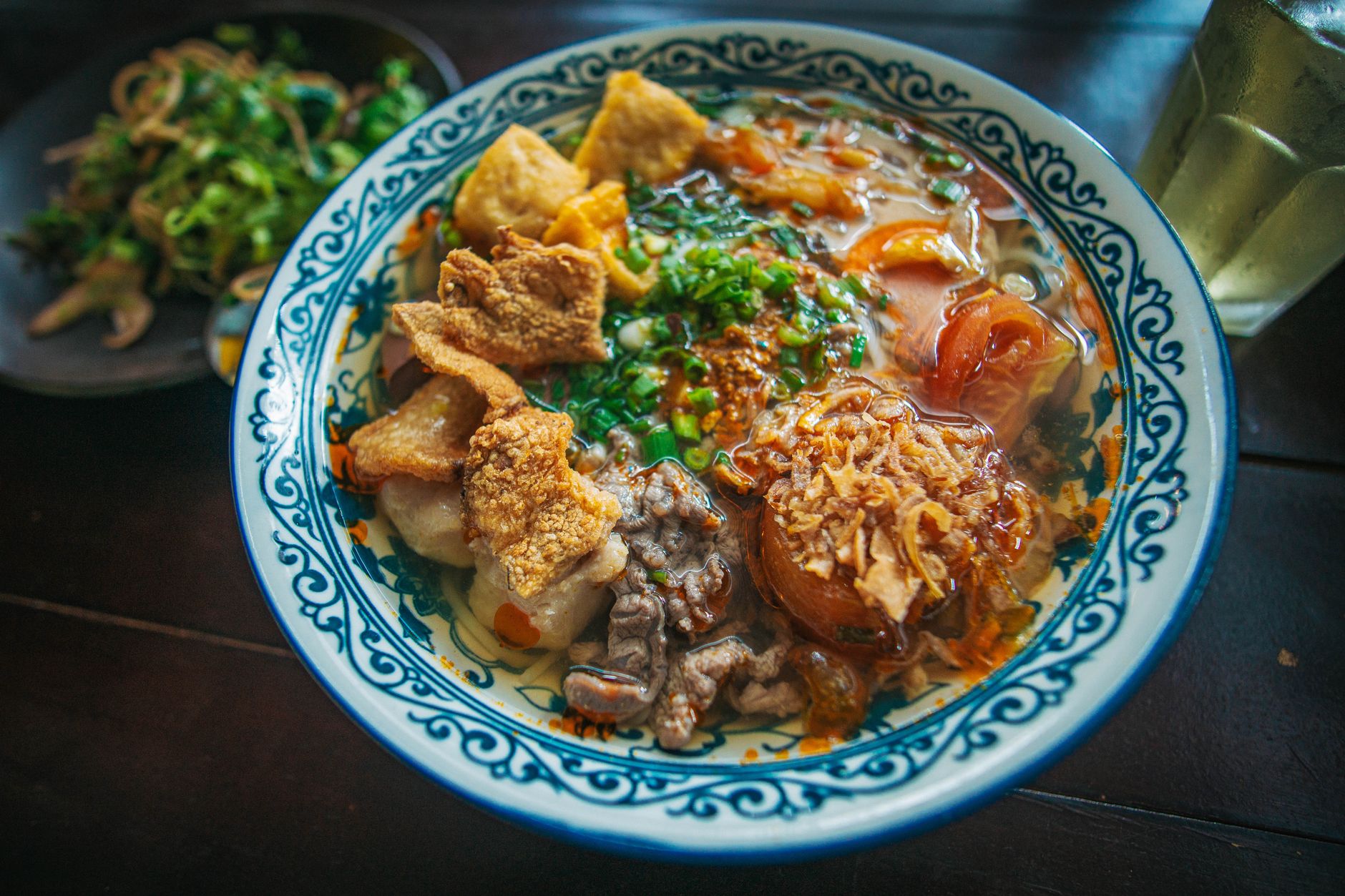
The main draw is "hu tieu (후띠우 / 粿条 / フーティウ) Nam Vang"—a clear, delicate pork broth served with tapioca noodles, thin slices of pork, shrimp, and sometimes pork liver. It's a Cambodian-origin dish, but in Saigon's Cholon it became a staple. A bowl costs 35,000–50,000 VND (about $1.50–$2). The broth is the work: it's simmered for hours with pork bones, dried shrimp, and aromatics. You drink it as much as you eat it.
"Mi vit tiem" is the other major player. Duck noodle soup. The meat is fall-apart tender, the broth rich with five-spice and duck fat. It comes with fresh noodles (or sometimes egg noodles), herbs, and a small bowl of broth on the side for dipping or pouring. Same price range. Same devotion to broth.
You'll also find dim sum-style stalls: steamed dumplings, baked buns, glutinous rice cakes wrapped in bamboo. Banh cuon (rolled rice cakes with pork and mushroom) appear here too. Most items are 10,000–20,000 VND per plate.
The rhythm is fast. People eat in 15 minutes, standing or on a stool with their bowl held close to their chin. No one lingers. Everyone knows what they're getting. The vendors barely look up.

Photo by Trần Phan Phạm Lê on Pexels
How to Navigate It
Arrive early—before 10 a.m.—if you want the full breakfast scene. By noon, many stalls are packing up or switching to lunch prep. Don't expect signage in English. Do expect a friendly nod if you smile and point at what the person next to you is eating. That's the move: mimic. If someone nearby has a steaming bowl that looks good, ask the stall owner for the same.
Bring small bills. Most vendors don't carry much change, and 500,000 VND notes will annoy them at a 40,000 VND transaction. A phone with Google Translate's camera feature is useful (point at signs; sometimes you'll get the dish name). Otherwise, embrace the blur.
The downstairs—fabrics, buttons, zippers, yarn, finished garments by the crate—is worth a walk-through if you have time. You're not shopping, but you're watching Cholon's real economy. Tailors from across the city come here. So do fashion students, garment factory owners, and small-business importers. It's a wholesale hub that supplies the rest of Saigon.

Photo by Tuan Vy on Pexels
Cho An Dong vs. Ben Thanh: Why the Difference Matters
Ben Thanh Market is old, iconic, and essential to see once. But it's been marketed to tourists for so long that it's developed a tourist-market personality. Prices are semi-fixed. Many vendors speak English or Broken English. There's a souvenir section. It's easier, and for many travelers, that's fine.
Cho An Dong has no such infrastructure. It exists for Saigonese, for the Chinese-Vietnamese community, for the trade itself. When you walk in, you're not owed English, a menu, or a smile—you earn it by being respectful and not blocking the way. That friction is real. But it's also a direct line to how Cholon has actually worked for over a century.
If you want to see Saigon through a tourist's lens, Ben Thanh is the right choice. If you want to glimpse Saigon through its own eyes—specifically, through the eyes of the Chinese-Vietnamese merchants and families who have shaped the city's food, trade, and culture—Cho An Dong is the place.
Practical Notes
Cho An Dong is at 58 An Dong, District 5 (Cholon). It's a 15-minute taxi ride from District 1, or take the bus. Go in the morning (6–10 a.m.) for the fullest scene. Bring cash in small denominations. You don't need a guide, but you do need patience and a willingness to be a little bit lost.
Last updated · May 26, 2026 · independently researched, never sponsored.