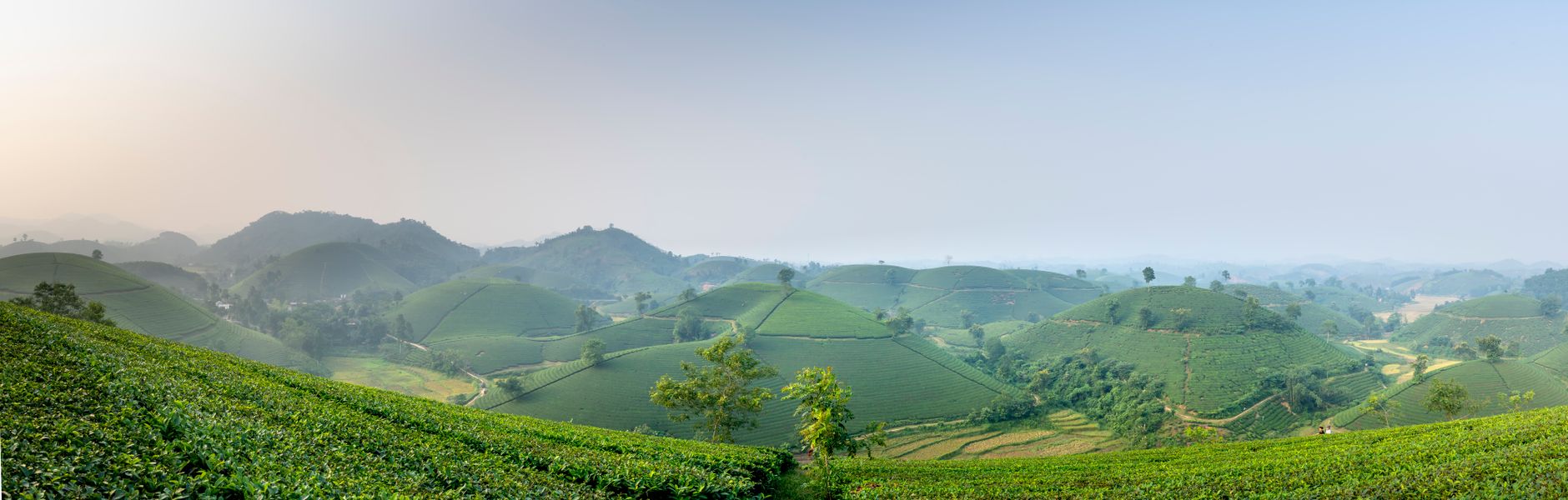
Ho Ghenh Che sits about 160 km north of Hanoi in what used to be the border zone between Thai Nguyen and Bac Kan provinces. It's a man-made reservoir surrounded by low karst hills and tea plantations — the kind of place that doesn't show up on most tourist radars, which is exactly why it's worth the trip.
What it is
Ghenh Che is a freshwater reservoir built decades ago for irrigation in the hilly midlands of the northeast. The name loosely translates to "tea rapids," a nod to the tea terraces that cascade down almost every slope in the area. Thai Nguyen province is Vietnam's tea capital, and this lake sits right in the heart of that landscape. The water is calm, dotted with small wooded islets, and ringed by a patchwork of tea gardens, bamboo groves, and thin forest. Think of it as a smaller, rougher-edged alternative to Ha Long Bay's inland cousins like Ninh Binh (닌빈 / 宁平 / ニンビン) or Ba Be Lake — fewer boats, no ticket booths, and almost no foreign visitors.
Why travelers go
Most people who make the drive come for the stillness. Ho Ghenh Che doesn't have a marquee attraction or an Instagram moment everyone's chasing. What it has is a wide green lake, good air, and a pace of life that's several notches slower than Hanoi (하노이 / 河内 / ハノイ). Photographers come for the early-morning mist that sits on the water between the islets. Cyclists like the empty roads looping around the reservoir. And anyone interested in tea culture can walk straight into working plantations and watch leaves being picked and dried the same day. It's a place for people who want to be somewhere, not just see something.
Best time to visit
The sweet spot is September through November, when the rainy season tapers off and the hills are at their greenest. Mornings are cool — sometimes down to 18-20°C — and the fog over the lake is thickest, which makes for good atmosphere and decent photos. March through May is the main tea harvest season, so if you want to see plantations at full tilt, aim for that window. December and January can be surprisingly cold and grey up here; it's not unpleasant, but the landscape loses some of its color. Avoid the peak of summer (June-August) if you don't like heat and afternoon downpours.
How to get there from Hanoi
Drive or ride. That's really the only practical way.
By motorbike: Take QL3 north from Hanoi through Thai Nguyen city, then continue toward Cho Moi (Bac Kan). The turnoff to Ho Ghenh Che is near Phu Luong district. Total distance is roughly 130-160 km depending on your route, and it takes about 3.5 to 4 hours with stops. The road is paved and in decent shape, though the last 10-15 km narrows and winds through tea hills.
By bus + xe om: Catch a bus from My Dinh bus station in Hanoi to Thai Nguyen city (about 80 km, 1.5-2 hours, around 80,000-100,000 VND). From Thai Nguyen city, you'll need to arrange a local motorbike taxi or rent a bike to cover the remaining 50-60 km north. There's no direct public transport to the lake itself.
By car: Hiring a private car from Hanoi runs about 1,500,000-2,000,000 VND for a day trip, or you can book a round-trip with overnight for roughly 2,500,000-3,000,000 VND. Worth it if you're splitting costs with a group.

Photo by Quang Nguyen Vinh on Pexels
What to do
Take a boat across the reservoir
Local fishermen offer rides in small wooden boats. There's no formal ticket counter — just ask around at the lakeshore. Expect to pay 150,000-300,000 VND for an hour or so, depending on how far you want to go. The islets in the middle of the lake are the highlight; some have tiny bamboo shelters where you can sit and do absolutely nothing.
Walk through the tea plantations
This is Thai Nguyen tea country, and the hills around Ho Ghenh Che are covered in it. You can walk between rows of tea bushes, watch workers hand-picking leaves, and buy fresh tea directly from farmers for a fraction of Hanoi shop prices. A kilo of decent green tea runs 150,000-300,000 VND here. If you're curious about how Vietnamese tea goes from leaf to cup, this is a more honest look than any curated tea tourism package.
Cycle the lake loop
The road circling the reservoir is roughly 20-25 km, mostly flat with a few short climbs. Traffic is minimal — mostly motorbikes and the occasional truck. Bring your own bike or ask at your homestay; some have basic bicycles available.
Camp or hammock by the shore
The lake's edge has several spots where locals set up hammocks and cook over small fires. If you're the type who carries a tent, this is one of the easier wild-camping spots in the north — flat ground, tree cover, and no one bothering you. Just clean up after yourself.
Visit the surrounding villages
The hamlets around the lake are predominantly Tay and Nung ethnic communities. People are friendly and generally unbothered by visitors. If someone offers you tea, sit down and drink it — it's the local custom and also some of the best green tea you'll have in Vietnam.
Where to eat nearby
Don't expect restaurants. The area around Ho Ghenh Che has small roadside "com binh dan" (everyday rice) shops in the nearest township and a few family-run kitchens closer to the lake.
Look for "ga doi" — free-range hill chicken, usually grilled or steamed with lime leaves. It's a Thai Nguyen specialty and tastes noticeably different from city chicken. A whole chicken meal runs about 250,000-350,000 VND. "Banh cuon" also shows up at morning markets in the area — the rice rolls here tend to be thicker and chewier than the Hanoi version, filled with minced pork and wood ear mushroom.
Where to stay
Accommodation is basic. There are a handful of homestays and guesthouses near the lake, mostly run by local families. Expect clean but simple rooms — a bed, a fan or basic AC, and a shared bathroom in some cases.
- Budget homestays: 200,000-400,000 VND per night. Some include dinner if you ask.
- Nicer guesthouses (closer to Phu Luong town): 400,000-600,000 VND per night with private bathroom and hot water.
- Camping: Free, but bring everything you need.
Booking platforms don't cover this area well. Your best bet is to show up and ask, or have a Vietnamese-speaking friend call ahead.

Photo by Quang Nguyen Vinh on Pexels
Practical tips locals would tell you
- Bring cash. There are no ATMs at the lake and almost nobody takes cards. Load up in Thai Nguyen city.
- Carry mosquito repellent. The lakeside gets buggy at dusk, especially in the warmer months.
- Fill your fuel tank in Phu Luong town. The last reliable gas station is there; after that, you're relying on roadside bottle sellers.
- Learn a few Vietnamese phrases. Almost no one around the lake speaks English. "Xin chao" (hello) and "Cam on" (thank you) go a long way. Pointing at food works for the rest.
Common mistakes to avoid
- Treating it as a day trip from Hanoi. You can technically do it in a day, but you'll spend most of that day in a car or on a bike. One overnight makes the trip worthwhile.
- Expecting tourist infrastructure. There are no souvenir shops, no English-language signs, no boat tour offices. That's the point, but plan accordingly.
- Skipping Thai Nguyen city entirely. On your way in or out, stop at one of the tea shops or tea houses in the city. It's worth 30 minutes to taste properly processed Thai Nguyen tea alongside what you bought from the farmers.
Practical notes
Ho Ghenh Che works best as part of a longer loop through the northeast — combine it with a ride up to Ba Be Lake or a swing through the tea country around Tan Cuong village south of Thai Nguyen city. It's not a destination that needs three days, but it rewards the kind of traveler who's comfortable with quiet, basic lodging, and no English menus.
Last updated · May 29, 2026 · independently researched, never sponsored.