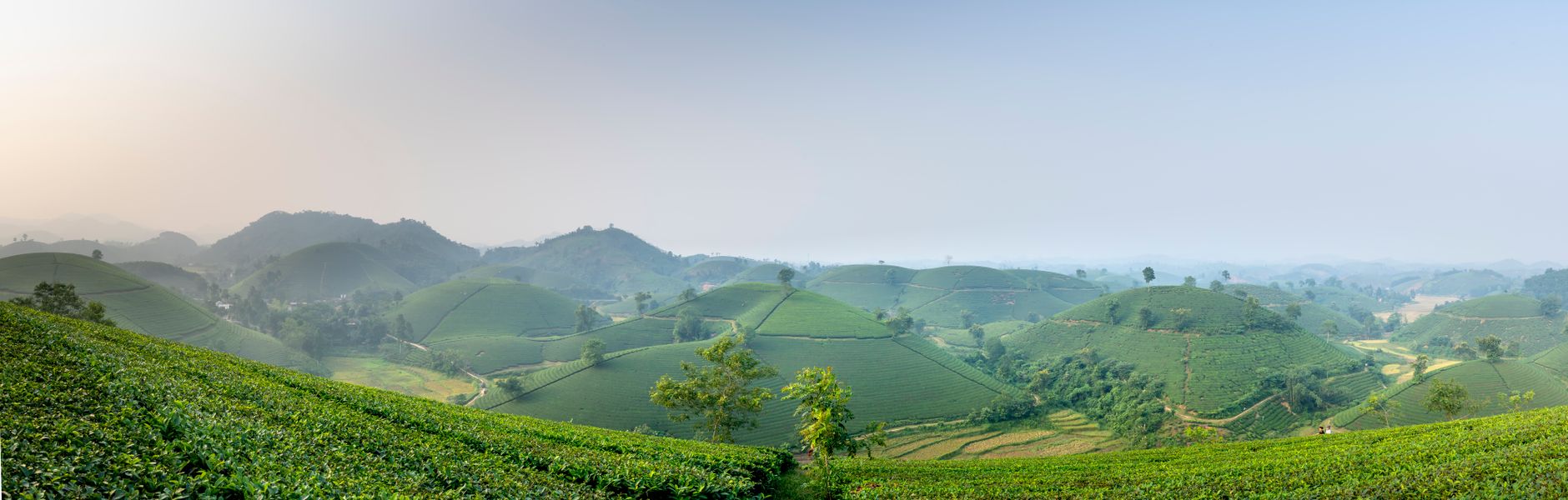
Ho Nui Coc is a 25-square-kilometer reservoir tucked into the foothills west of Thai Nguyen city. It's not on most foreign tourist itineraries, which is exactly why it's worth the trip — you get open water, forested islands, and some of the best tea country in Vietnam (베트남 / 越南 / ベトナム) without the weekend crowds that pack places closer to Hanoi.
What it is
Built in the early 1970s as an irrigation project, Ho Nui Coc (literally "Coc Mountain Lake") dams the Cong River and creates a body of water dotted with around 89 small islands. The surrounding hills are blanketed in tea plantations — Thai Nguyen province is the heartland of Vietnamese green tea production, and you'll see that everywhere here.
The lake sits about 15 km west of Thai Nguyen city center. Thai Nguyen itself is a mid-sized provincial capital that recently merged administratively with Bac Kan province, though for travelers, the city functions the same as before. The lake area has been developed with a tourism zone on its eastern shore, but most of the shoreline remains agricultural land and forest.
Why travelers go
Three reasons, mainly. First, it's close to Hanoi (하노이 / 河内 / ハノイ) — doable as a day trip or easy overnight. Second, the landscape is genuinely pleasant: calm water, green hills, no high-rises. Third, it's a gateway to Thai Nguyen's tea culture, which is a draw if you have any interest in how "che" (Vietnamese tea) gets from hillside to cup. The lake also has a local legend — a love story involving a woman named Cong and a man named Coc — that gives the place some cultural texture beyond the scenery.
If you're heading further north toward Ha Giang or Bac Kan's Ba Be Lake, Ho Nui Coc makes a logical stop to break the journey.
Best time to visit
October through April is the sweet spot. Skies are clearer, temperatures are comfortable (18–25°C most days), and the tea hills look their greenest after the autumn harvest flush. November and December can get cool — bring a light jacket for early morning boat trips.
Avoid July and August if you can. Heavy rain raises the water level and makes boat excursions less enjoyable. Weekends year-round bring domestic visitors from Hanoi, so a weekday trip means quieter trails and easier boat bookings.
How to get there from Hanoi
Thai Nguyen city is about 80 km north of Hanoi, and from there the lake is another 15 km west.
By bus: Coaches leave from My Dinh or Gia Lam bus stations in Hanoi roughly every 30 minutes. The ride to Thai Nguyen takes about 1.5–2 hours and costs 70,000–100,000 VND. From Thai Nguyen bus station, grab a local taxi or xe om (motorbike taxi) to the lake — about 40,000–60,000 VND, 20 minutes.
By motorbike: Take QL3 (National Road 3) north from Hanoi. The ride is straightforward, mostly flat, and takes around 2 hours depending on traffic getting out of the city. From Thai Nguyen, follow signs toward Khu Du Lich Ho Nui Coc along DT261.
By car: Same route. A private Grab car from Hanoi runs about 500,000–700,000 VND one way. Some travelers rent a car with driver for the day (1,200,000–1,500,000 VND round trip), which makes sense if you want to combine the lake with tea village visits.

Photo by Hồng Quang Official on Pexels
What to do
Take a boat to the islands
The main activity. Motorboats and smaller rowing boats depart from the tourism zone pier on the east shore. A motorboat for 4–6 people costs around 300,000–500,000 VND for a 1–2 hour loop, hitting two or three islands. Some islands have small temples; others are just forested hills where you can walk around for 20 minutes. The ride itself — weaving between islands with tea-covered hills in the background — is the real point.
Visit a tea village
Tan Cuong commune, about 5 km south of the lake, is the most famous tea-growing area in Thai Nguyen. You can walk through rows of tea bushes, watch leaves being hand-rolled and dried, and sit down for a tasting session. Most family operations welcome visitors without a formal booking — just show up and ask. A bag of good Tan Cuong green tea runs 150,000–400,000 VND depending on grade.
Hike around the shore
A paved road traces parts of the eastern and northern lakeshore. It's flat enough for a casual walk or bicycle ride. The 6–7 km stretch north of the tourism zone is quieter and passes through small villages and tea gardens. Rent a bicycle at one of the guesthouses near the entrance for about 50,000 VND per day.
Explore the temple complex
On one of the larger islands — often called Dao Cong (Cong Island) — there's a small temple complex tied to the lake's origin legend. It's modest compared to places like Bai Dinh, but the setting on a wooded island gives it a character that bigger sites lack.
Camp or picnic lakeside
Domestic travelers often set up picnic spreads on the grassy areas near the tourism zone. If you're into camping, a few spots along the northern shore are flat and quiet enough to pitch a tent, though there are no formal campgrounds. Bring your own gear.
Where to eat nearby
Thai Nguyen city has the widest food options, but near the lake you'll find a handful of "com binh dan" (everyday rice) spots and local restaurants.
Two things to seek out: "com lam" — sticky rice cooked inside bamboo tubes over charcoal, a mountain specialty you'll see at roadside stalls near the lake — and Thai Nguyen-style "nem chua", a fermented pork roll that's tangier and firmer than versions from Thanh Hoa. Both pair well with cold beer. For a proper meal, the restaurants clustered at the tourism zone entrance serve grilled fish pulled from the lake, usually priced by weight (around 150,000–250,000 VND per dish).
Back in Thai Nguyen city, you'll find solid "pho" and "bun cha" without much searching — the city eats like a smaller version of Hanoi.
Where to stay
Budget (300,000–500,000 VND/night): Basic guesthouses — "nha nghi" — line the road approaching the tourism zone. Clean enough, hot water, Wi-Fi. Don't expect much beyond a bed and a bathroom.
Mid-range (600,000–1,200,000 VND/night): A few resort-style properties sit on or near the lakeshore. Rooms are decent, some with lake views. The Long Quan resort complex is the most established.
Thai Nguyen city (400,000–1,000,000 VND/night): More hotel options with better restaurants nearby. Stay here if you want evening food choices and don't mind the 20-minute ride to the lake in the morning.

Photo by Hugo Heimendinger on Pexels
Practical tips locals would tell you
- Bring cash. Card payments are rare at the lake. ATMs are in Thai Nguyen city, not at the tourism zone.
- Negotiate boat prices before boarding. Agree on duration, number of island stops, and total cost. Get it on your phone screen if language is a barrier.
- Drink the tea. Seriously. Thai Nguyen green tea is considered the best in Vietnam. If someone offers you a cup — and they will — sit down and have it.
- Sunscreen and a hat. There's little shade on the boats, and the water reflects everything.
Common mistakes to avoid
- Treating it as a half-day trip from Hanoi. The travel time plus boat ride plus tea village visit fills a full day comfortably. Rushing it defeats the purpose.
- Skipping Tan Cuong. Plenty of visitors boat around the lake and leave without seeing the tea gardens. The tea culture is half the reason to come here.
- Visiting only on weekends. The tourism zone gets noisy with karaoke speakers and large groups on Saturdays and Sundays. Weekdays are a different experience entirely.
Practical notes
Ho Nui Coc works best as an overnight trip from Hanoi or a stopover heading further north. Pair it with a morning in the tea villages and you've got a day that feels genuinely different from the usual northern Vietnam circuit. No entrance fee for the lake area itself — you only pay for boats and any island temple donations.
Last updated · May 29, 2026 · independently researched, never sponsored.