What My Nghiep is and why it matters
My Nghiep is a Cham weaving village about 10 km south of Phan Rang city center, in what is now Khanh Hoa province (formerly Ninh Thuan before the 2025 administrative merge). The village has been producing handwoven brocade textiles for several hundred years, a craft tied directly to the Cham ethnic minority — descendants of the Champa kingdom that once controlled much of central Vietnam (베트남 / 越南 / ベトナム).
Unlike craft villages that have shifted entirely to machine production and tourist performances, My Nghiep still has households where women weave on traditional backstrap looms. The textiles here — heavy cotton and silk brocade with geometric patterns in deep reds, blacks, and golds — are used in Cham ceremonial dress, religious rituals, and increasingly sold to visitors and collectors.
This is not a theme park. It's a functioning village where weaving is daily work. You'll see looms set up under houses, threads drying in courtyards, and women working while keeping an eye on grandchildren. That ordinariness is exactly what makes it worth the detour.
Why travelers go
Most people visit My Nghiep as part of a day exploring the Cham cultural sites around Phan Rang — the Po Klong Garai temple towers sit just a few kilometers north, and together they make a coherent half-day loop. Textile enthusiasts come specifically for the brocade, which is genuinely handmade and priced accordingly (far cheaper than similar artisan textiles in Hoi An or Hanoi). Photographers find the village productive: the colors of dyed thread, the rhythm of the looms, and the weathered faces of veteran weavers all deliver without staging.
If you're traveling the coastal route between Nha Trang (냐짱 / 芽庄 / ニャチャン) and Mui Ne, My Nghiep is a worthwhile stop that breaks up what is otherwise a long stretch of highway with little reason to pull over.
Best time to visit
The Phan Rang area is one of the driest regions in Vietnam. October and November get the most rain, but even then it's modest compared to Da Lat or Hue. The best months are January through September — dry, hot, and reliably sunny. Mornings are the best time to catch weavers at work; by early afternoon the heat pushes people indoors.
If your timing lines up with the Kate Festival (usually in October on the Cham calendar), the village comes alive with ceremonial weaving, traditional dress, and processions at the nearby towers. It's the single best time to see the textiles in their cultural context.
How to get there
From Nha Trang, Phan Rang is about 105 km south on the QL1A highway. Options:
- Train: Thap Cham station (Phan Rang) is on the Reunification Express line. A seat from Nha Trang takes roughly 1.5 hours and costs 50,000–90,000 VND depending on class. From the station, My Nghiep is about 8 km — grab a taxi or xe om (motorbike taxi) for 40,000–60,000 VND.
- Bus: Regular buses from Nha Trang's south bus station to Phan Rang run throughout the day, around 60,000–80,000 VND, taking about 2 hours with stops.
- Motorbike: The most flexible option if you're comfortable on two wheels. The coastal highway is flat and straightforward. Rental bikes in Nha Trang run 120,000–180,000 VND per day.
From Phan Rang city center, head south on DT702 toward Ninh Phuoc district. My Nghiep is signposted. The whole village sits along a single main road, so you won't get lost.
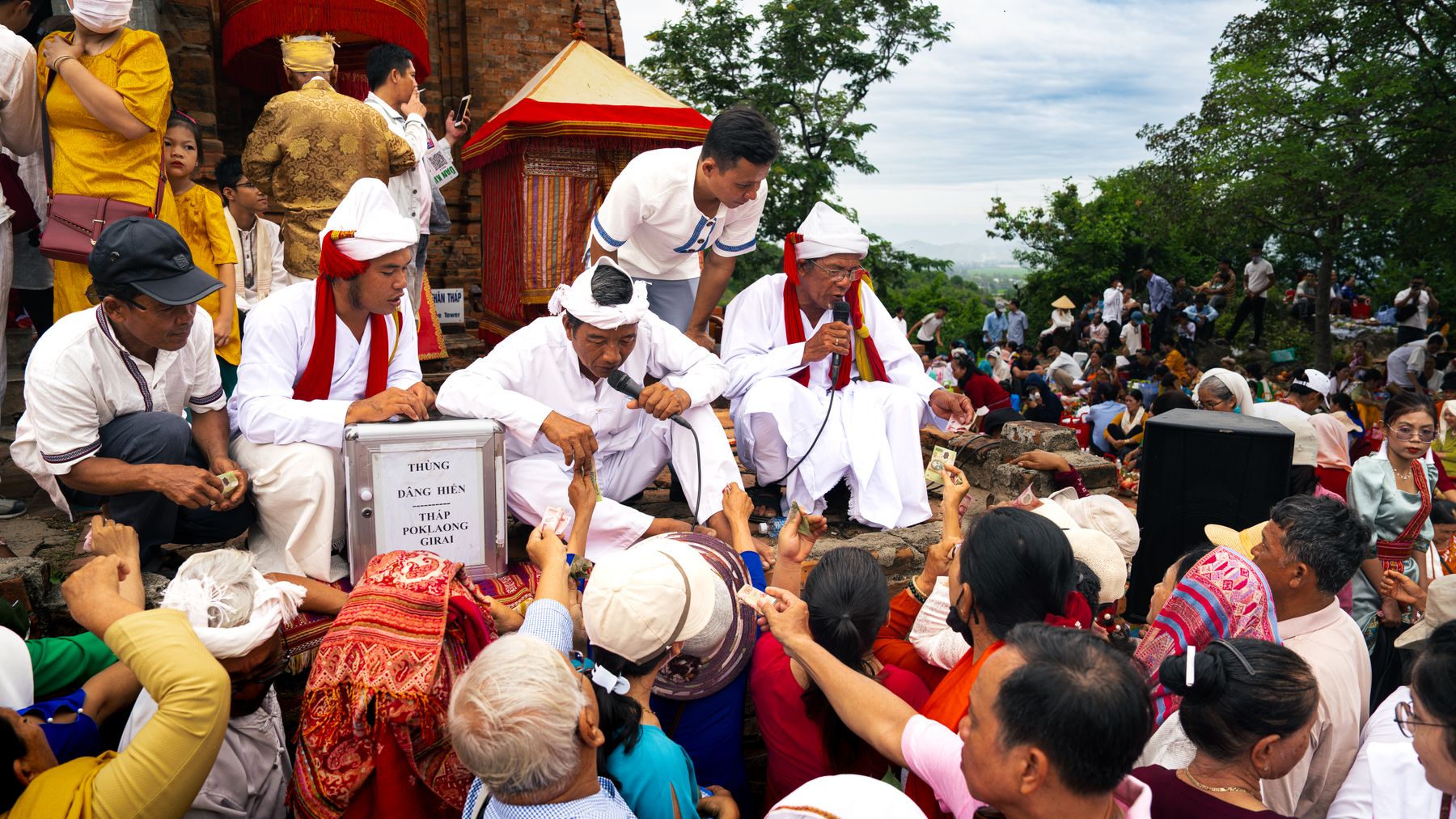
Photo by Felix Schickel on Pexels
What to do
Watch the weaving process start to finish
Don't just glance at a loom and move on. Spend time watching the full sequence: thread dyeing, pattern setup on the loom frame, and the actual weaving. The backstrap loom technique — where the weaver uses her own body weight to maintain tension — is physically demanding and produces a tighter, heavier fabric than frame looms. Some households will walk you through the steps if you show genuine interest. No ticket, no entrance fee.
Buy direct from weavers
Prices here are significantly lower than retail in tourist cities. A small brocade scarf runs 150,000–300,000 VND. Larger ceremonial-style panels or table runners go for 500,000–1,500,000 VND depending on complexity and whether silk is blended in. Bargaining is acceptable but keep it reasonable — these take days to produce. The quality difference between a 200,000 VND piece and a 700,000 VND piece is obvious once you handle both.
Visit Po Klong Garai towers
Just north of Phan Rang on a rocky hill, these 13th-century Cham temple towers are the best-preserved in the region and directly connected to the weaving tradition — textiles from My Nghiep are used in rituals here. Entry is 15,000 VND. The towers are similar in style to Po Nagar in Nha Trang but far less crowded.
Walk the village without a guide
My Nghiep doesn't need a guided tour. Walk the main road, turn into side lanes, and you'll find looms in open-front workshops and under stilted houses. A few families have set up small display areas, but most are simply working. A morning hour is enough to see everything; two hours if you're buying or photographing seriously.
Try the local Cham rice wine
Some households produce their own rice wine. If offered, accept — it's part of hospitality here. The Cham version tends to be lighter and slightly sweeter than Kinh-style "ruou."
Where to eat nearby
Phan Rang is known for grilled rice paper — "banh trang nuong" — crispy sheets topped with egg, dried shrimp, scallions, and chili sauce. Vendors cluster around the Phan Rang central market area. A portion runs 15,000–25,000 VND.
Also look for "bun ca" (fish noodle soup), a Phan Rang specialty that's richer and more savory than versions elsewhere. Small shops along Thong Nhat street near the market serve solid bowls for 30,000–40,000 VND.
Where to stay
Phan Rang has a handful of guesthouses and mini-hotels. Budget rooms go for 250,000–400,000 VND per night — basic but clean. For more comfort, TTC Hotel Ninh Thuan or similar mid-range options near the beach at Ninh Chu run 600,000–1,200,000 VND and give you a seaside base. There's no accommodation in My Nghiep village itself.
If you're just passing through between Nha Trang and Mui Ne, you don't need to overnight — the village and Po Klong Garai together fit into a half-day stop.

Photo by Hac Hai on Pexels
Practical tips locals would tell you
- Arrive before 10 a.m. if you want to see active weaving. By midday, many weavers break for lunch and rest.
- Bring cash. There are no ATMs in the village and no one takes cards.
- Ask before photographing weavers up close. Most are fine with it, but asking first changes the interaction from extractive to respectful.
- If you ride a motorbike, fill up in Phan Rang — fuel stations thin out heading south toward Ninh Phuoc.
Mistakes to avoid
- Rushing through. People drive in, snap three photos of a loom, and leave. The craft only makes sense when you slow down and watch the rhythm of production.
- Comparing prices to factory textiles. A handwoven brocade panel is not overpriced at 500,000 VND — it took someone days. Haggling it down to nothing is missing the point.
- Skipping Po Klong Garai. The towers and the village are two halves of the same story. Seeing one without the other leaves a gap.
- Visiting on a Sunday or holiday without checking. Most weavers work their own schedules. Major holidays mean quiet looms.
Practical notes
My Nghiep pairs naturally with a Nha Trang-to-Mui Ne road trip or a dedicated day out from Nha Trang. It's one of the few places in central Vietnam where a traditional craft is still practiced in an unperformed, everyday way. Budget two to three hours for the village and towers combined, bring small bills, and leave room in your bag for brocade.
Last updated · May 29, 2026 · independently researched, never sponsored.