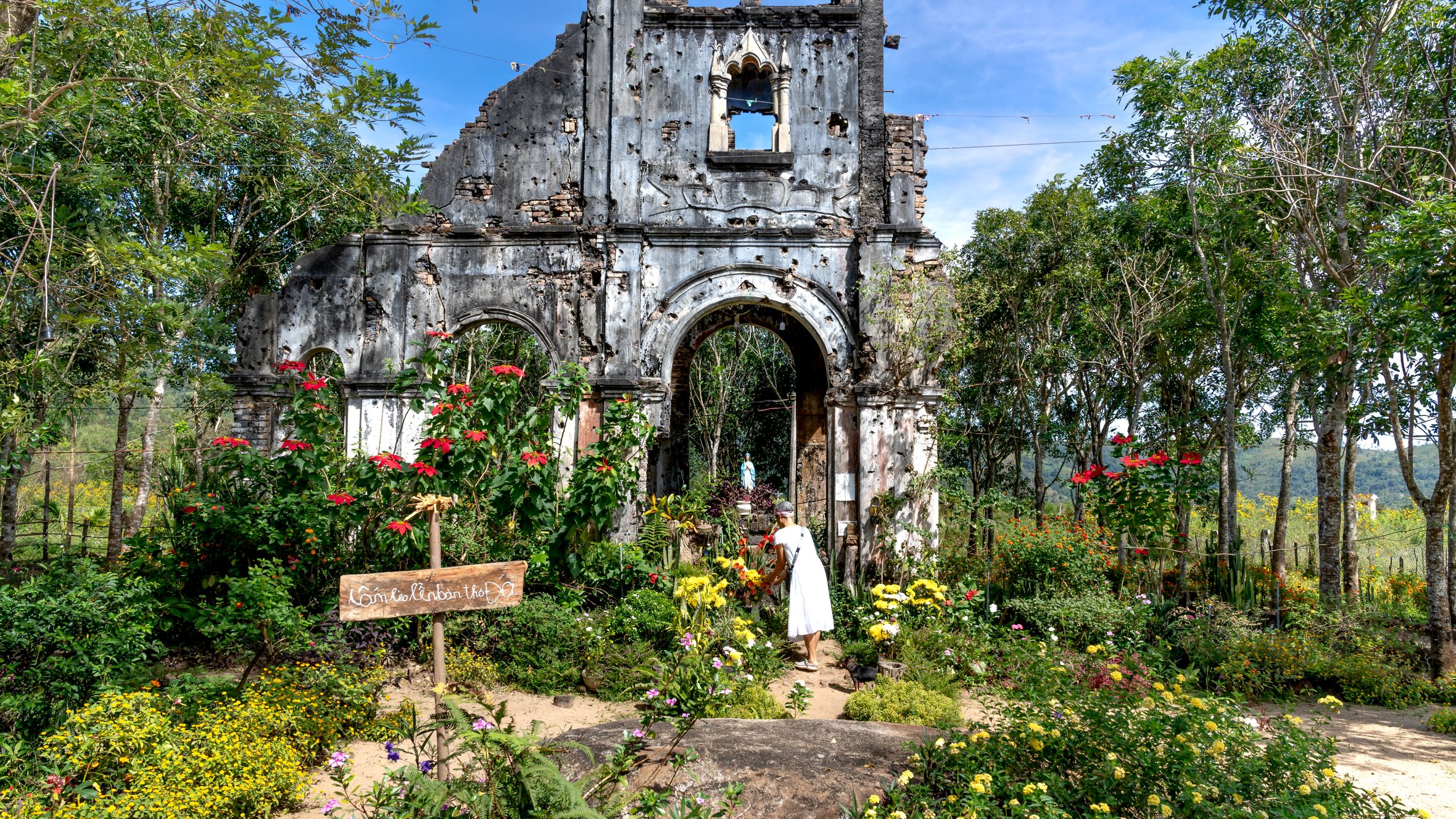
The stone church at Tam Dao sits at roughly 900 meters elevation on the edge of a mountain town that most visitors associate with weekend escapes from Hanoi. But this particular ruin — a French-colonial chapel built from local stone — is worth the detour on its own terms, especially if you're drawn to places where the forest is slowly winning a quiet argument with architecture.
What it is and how it got here
Nha Tho Da Tam Dao (literally "Tam Dao Stone Church") is the shell of a Catholic chapel constructed by French colonists in the early 1900s, during the same period they developed Tam Dao as a hill station. The church was part of a larger complex of villas, administrative buildings, and holiday infrastructure the French built to escape the lowland heat. Most of those structures were destroyed during wartime or simply abandoned to the elements. The stone church partially survived — its walls, arched window frames, and sections of the facade remain standing, wrapped in moss and tree roots.
The site sits in what is now Phu Tho province territory (following the administrative merger of the former Vinh Phuc areas around Tam Dao). It's not a functioning church. It's an open ruin, free to visit, with no ticket booth or formal hours.
Why travelers go
The appeal is straightforward: it's a genuinely atmospheric ruin in a mountain forest, and it takes about 10 minutes of walking off the main Tam Dao town road to reach. The stone walls have been colonized by ferns, lichen, and creeping fig roots that split the mortar lines. On foggy mornings — which is most mornings between October and March — the whole scene looks like something from a different century.
Photographers and couples come here early, before the day-trippers from Hanoi (하노이 / 河内 / ハノイ) arrive. It's also a natural stop if you're already visiting Tam Dao for the cooler air, the national park trails, or the weekend food scene.
Best time to visit
October through March is the sweet spot. Tam Dao's elevation means fog rolls in regularly during these months, and temperatures sit between 10-18°C. The mist makes the ruins more photogenic and the forest quieter. Weekdays are noticeably less crowded than weekends.
April through June is warmer but still pleasant compared to the plains below. Avoid major holiday weekends — especially around Hung Kings Festival in the lunar third month — when the roads to Tam Dao get packed.
July through September brings heavy rain. The trails around the church get slippery, and landslide risks increase on the mountain road. You can still visit, but plan for wet conditions.
How to get there from Hanoi
Tam Dao is about 85 km northwest of Hanoi, a drive of roughly 2 to 2.5 hours depending on traffic.
- Motorbike: The most common option for independent travelers. Head out on the Noi Bai expressway toward Vinh Yen, then follow provincial road 2B up the mountain. The last 20 km is a winding climb — enjoyable on a clear day, nerve-racking in fog. Fuel up in Vinh Yen.
- Private car / Grab: A Grab car from central Hanoi runs 600,000-900,000 VND one way. Book a round-trip with wait time if you can negotiate it.
- Bus: Catch a bus from My Dinh station to Vinh Yen (around 70,000 VND, 1.5 hours), then hire a local xe om or taxi up the mountain (about 150,000-200,000 VND). No direct public bus goes all the way to Tam Dao town.
Once in Tam Dao town, the stone church is roughly 1.5 km from the main square. Walk downhill past the old villa ruins along a partially paved path. Locals can point you in the right direction — ask for "nha tho da."

Photo by Tan Dao on Pexels
What to do
Walk the ruins slowly
The church itself takes maybe 15 minutes to explore if you're just snapping photos. But slow down. Walk around the back walls where the tree roots are thickest. Look for the remaining arched window frames — they frame the forest behind them in a way that rewards patience. Early morning, before 8 AM, you'll likely have the place to yourself on weekdays.
Explore the surrounding French villa ruins
The church isn't the only colonial relic. Within a 1 km radius, you'll find the crumbling foundations and partial walls of several French-era villas scattered through the forest. None are signposted well. Just follow the stone paths that branch off the main trail. These are even quieter than the church and give a fuller picture of what Tam Dao looked like as a hill station a century ago.
Hike in Tam Dao National Park
The national park entrance is a short drive from town. Trails range from easy 2 km loops to a more demanding climb toward the Tam Dao peaks (Thien Thi, Thach Ban, Phu Nghia), which top out around 1,400 meters. You'll need a local guide for the longer routes — arrange one at the park gate for around 300,000-500,000 VND per group.
Watch the cloud inversions
If you stay overnight and wake up early, the viewpoints along the main road above town sometimes offer cloud inversions — where the valley below fills with fog while you stand above it in sunlight. No guarantee, but October through December gives you the best odds.
Where to eat nearby
Tam Dao town has a strip of restaurants along the main road, mostly catering to Hanoi weekenders. Two things to seek out:
- "Su su" (chayote) dishes: Tam Dao is known for chayote, grown on the mountain slopes. You'll find it stir-fried, in soup, and even the young shoots served as greens. Simple, fresh, and specific to the area. A plate runs 40,000-60,000 VND.
- Grilled stream fish and mountain chicken: Several restaurants along the main drag serve locally raised chicken ("ga doi") and small fish grilled over charcoal. Pair with rice and a cold Hanoi beer. A full meal for two runs 250,000-400,000 VND.
If you're heading back toward Hanoi and want something more refined, Vinh Yen town has decent "pho" and "bun cha" spots that cater to locals rather than tourists.
Where to stay
- Budget: Guesthouses and homestays in Tam Dao town start around 300,000-500,000 VND per night. Basic but clean. Most have hot water, which you'll want.
- Mid-range: A handful of hotels along the main road offer better rooms with mountain-view balconies for 600,000-1,200,000 VND. Book ahead on weekends.
- Higher-end: A few newer resorts on the outskirts of town charge 1,500,000-3,000,000 VND. These tend to fill up on holiday weekends, so reserve early around Tet or national holidays.
Photo by Tuan Vy on Pexels
Practical tips locals would tell you
- Bring a light jacket even in summer. Evenings at 900 meters get cool, and the fog carries real moisture.
- Wear shoes with grip. The path to the church and surrounding ruins gets mossy and slick, especially after rain. Flip-flops are a bad idea.
- Carry cash. ATMs exist in Vinh Yen but are unreliable in Tam Dao town itself. Most guesthouses and small restaurants are cash-only.
- Start early. Tour groups from Hanoi arrive mid-morning on weekends. If you want the ruins to yourself, get there by 7 AM.
Common mistakes to avoid
- Treating it as a day trip and rushing. You can technically do Tam Dao in a day from Hanoi, but the mountain is better with an overnight stay. The early morning fog is half the experience.
- Driving the mountain road at night. The last 20 km climb has sharp switchbacks, limited guardrails, and frequent fog. If you arrive after dark, take it very slowly.
- Expecting a polished tourist site. There are no guided tours, audio guides, or information boards at the church. It's a ruin in a forest. That's the point.
Practical notes
Nha Tho Da Tam Dao is free to visit and open year-round. Budget roughly 1,500,000-2,000,000 VND per person for a weekend trip from Hanoi including transport, one night's accommodation, and meals. The ruins pair naturally with a broader exploration of Tam Dao's trails and the wider Phu Tho region — which also happens to be home to the Hung Kings Temple complex, a significant cultural site about 50 km to the west.
Last updated · May 26, 2026 · independently researched, never sponsored.