What Phu Day is and why it matters
Phu Day is a complex of roughly 20 temples and shrines spread across Vu Ban district, about 15 km southeast of the old Nam Dinh city center — now part of the expanded Ninh Binh (닌빈 / 宁平 / ニンビン) administrative region. The complex is the spiritual heart of "Dao Mau" (Mother Goddess worship), a distinctly Vietnamese folk religion that UNESCO recognized as intangible cultural heritage in 2016.
The central temple, Phu Giay, is dedicated to Lieu Hanh — one of Vietnam (베트남 / 越南 / ベトナム)'s "Four Immortals" and the most important female deity in the Vietnamese pantheon. The site dates back to the 16th century, though most structures you see today were rebuilt or restored during the Nguyen dynasty period. Unlike the tourist-polished temples around Ninh Binh's Tam Coc area, Phu Day still operates primarily as an active worship site. You'll see more incense smoke than selfie sticks.
Why travelers go
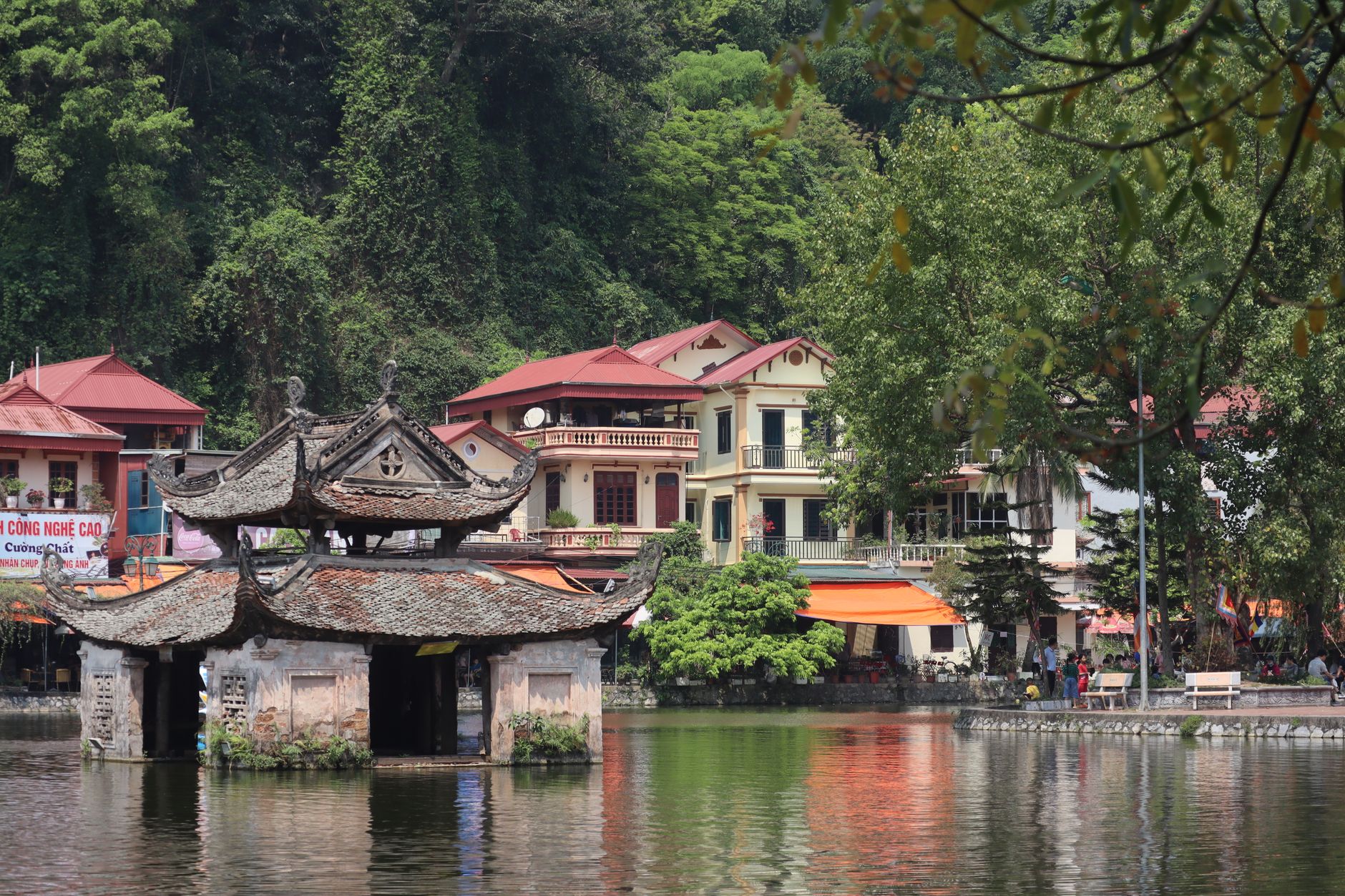
Three reasons. First, the "len dong" spirit mediumship ceremonies — trance rituals where practitioners channel deities through costume changes, dance, and music. It's theatrical, loud, colorful, and genuinely unlike anything else you'll encounter in Vietnam. Second, the architecture itself: ornate wood carvings, dragon-wrapped pillars, and courtyards designed for procession rather than contemplation. Third, it's a window into living Vietnamese spirituality that doesn't require a guide to explain — the energy is self-evident.
For anyone interested in Vietnamese folk religion beyond the standard pagoda visit, Phu Day is the real thing.
Best time to visit
The Phu Day Festival runs from the 1st to the 10th of the third lunar month (usually March or early April). The main ceremony falls on the 3rd day. During festival time, thousands of devotees arrive for "len dong" ceremonies, processions, and offerings. It's crowded, smoky, and intense — exactly what you want if you're here for the cultural experience.
Outside festival season, September through November offers cooler weather and near-empty temples. You'll miss the ceremonies but gain the freedom to explore slowly. Avoid July and August — the heat in the Red River Delta is oppressive and the complex offers minimal shade.
How to get there
From Ninh Binh city center, Phu Day is about 30 km east. A Grab car runs 180,000–220,000 VND one way, taking roughly 40 minutes on provincial roads. There's no direct public bus, but you can take a local bus toward Nam Dinh and ask to be dropped at the Vu Ban junction, then grab a xe om (motorbike taxi) for the last 5 km — total cost under 80,000 VND but requiring some Vietnamese language skills or patience.
If you're coming from Hanoi, the most direct route is the Hanoi–Ninh Binh expressway south, then cutting east on DT477. Total drive: about 2 hours, 110 km. A day trip from Hanoi is feasible if you leave by 7 AM.

Photo by TBD Tuyên on Pexels
What to do
Watch a len dong ceremony
During festival time, ceremonies happen continuously across multiple temples. Outside the festival, they're less predictable but still occur — particularly on the 1st and 15th of each lunar month. Ask at the main Phu Giay temple if any are scheduled. Sit quietly in the back. Photography is generally tolerated but don't use flash.
Explore the full complex on foot
Most visitors only see Phu Giay (the main temple). Walk the full circuit — Phu Van Cat, Phu Bong, and the smaller shrines scattered through the surrounding village. The 3 km loop through rice paddies connecting the temples is flat and easy. Each shrine has slightly different architectural details and deity focus.
Visit the Tomb of Lieu Hanh
About 1 km from the main temple, this is where the mythological origin story of the goddess is grounded. Smaller, quieter, and usually empty of tourists. The surrounding garden is well-maintained.
Check the local market
The village market near the temple entrance sells votive paper goods — elaborate paper houses, cars, phones, and clothing meant to be burned as offerings. The craftsmanship is remarkable even if you're not buying. It's a cottage industry unique to this area.
Attend a "ca tru" or "chau van" music performance
Chau van is the musical tradition tied directly to Mother Goddess worship — rhythmic drumming and singing that accompanies len dong rituals. During festival time, informal performances happen throughout the complex. Ca tru, the older ceremonial singing tradition, occasionally appears at cultural events here too.
Where to eat nearby
The area around Phu Day isn't a food destination, but two things are worth seeking. First, "banh cuon" — the thin steamed rice rolls here are made fresh at small stalls near the temple gate, filled with minced pork and wood ear mushroom, served with a dipping sauce heavier on fish sauce than the Hanoi style. Expect 25,000–35,000 VND per plate.
Second, "pho" in this part of the Red River Delta tends toward a clearer, lighter broth than Hanoi's versions — less fatty, more star anise forward. The small shops along the main road into Vu Ban serve solid bowls for 35,000–45,000 VND.
Where to stay
Phu Day itself has no hotels aimed at foreign travelers. Your best options:
- Ninh Binh city (30 km west): Plenty of guesthouses and hotels from 300,000–800,000 VND/night. This is the logical base if combining Phu Day with Tam Coc, Trang An, or Bai Dinh.
- Nam Dinh city (15 km northwest): A few business hotels in the 400,000–600,000 VND range. Less tourist infrastructure but closer to Phu Day.
- Homestays: A couple of local homestays have appeared in Vu Ban district — check booking apps, but manage expectations on English-language service.

Photo by Karolina on Pexels
Practical tips locals would tell you
- Dress modestly. Covered shoulders and knees — this is an active worship site, not a museum. You'll get looks otherwise.
- Bring cash. There are no ATMs at the complex and card payment doesn't exist here.
- Remove shoes before entering any temple building. Look for the shoe racks.
- If you want to make an offering, buy incense and votive items from the stalls outside — don't bring your own from elsewhere, as it's considered inappropriate.
- The complex is free to enter. No ticket booth, no fees.
Common mistakes to avoid
- Only visiting Phu Giay: The main temple is impressive but represents maybe 20% of what's here. Budget at least 2–3 hours for the full complex.
- Coming midday: Temples are most active in the morning (before 10 AM) when worshippers arrive. By noon, many shrines are quiet and partially closed.
- Expecting English signage: There is none. Download Vietnamese offline on Google Translate before you arrive.
- Treating it like a tourist attraction: This is a living religious site. People are praying, making offerings, sometimes crying. Be respectful with cameras and keep your voice down inside temple halls.
Practical notes
Phu Day pairs naturally with a broader Ninh Binh itinerary — hit Tam Coc or Trang An in the morning, then drive east to Phu Day in the afternoon. For the festival experience, book accommodation in Ninh Binh at least two weeks ahead as the region fills up during the third lunar month. Bring a rain jacket in spring — Delta weather is unpredictable.
Last updated · May 29, 2026 · independently researched, never sponsored.