Twice a day, a commuter train squeezes through a corridor barely wider than itself, and the people living in the narrow houses on either side fold up their chairs and pull in their laundry like it's nothing. That's Train Street — Pho Duong Tau — and it's one of the most genuinely unusual things you'll see in Hanoi.
What it is and how it got here
Train Street is a roughly 500-meter stretch of residential alley that runs along the rail tracks between Le Duan and Kham Thien streets in Hanoi (하노이 / 河内 / ハノイ)'s Old Quarter area. The Hanoi–Hai Phong and Hanoi–Lao Cai railway lines have run through here since the French colonial period — the tracks were laid in the early 1900s, and people built homes alongside them over the decades that followed. The result is a living corridor where daily life happens within arm's reach of a functioning railway.
For years it was just a neighborhood. Around 2018, cafes started opening along the tracks, Instagram posts went viral, and suddenly Train Street became one of Hanoi's most-visited spots. Authorities have periodically shut down access due to safety concerns — people were literally standing on the tracks for selfies as trains approached — so the situation changes. More on that below.
Why travelers go
Forget the social media hype for a second. The actual draw is watching a neighborhood that has adapted to something absurd. Motorbikes parked centimeters from the rail. Plants growing between the sleepers. Kids doing homework at tables that get dragged inside twice daily. It's a functioning residential street that happens to have a train running through it, and there's nothing else quite like it in Southeast Asia.
It's also a genuinely interesting lens into how Hanoi works — the density, the improvisation, the way people coexist with infrastructure that would be fenced off in most countries.
Best time to visit
Time of year: October through December is ideal. The heat and humidity have dropped, rain is less frequent, and the light in the late afternoon is good for photos. January and February work too, though if your visit coincides with Tet, the street takes on a festive atmosphere with red decorations — but some cafes may close for the holiday.
Avoid June through August if you can. The heat is oppressive, the narrow corridor traps humidity, and afternoon downpours can make the tracks slippery.
Time of day: The trains typically pass through around 3:00–3:30 PM and again around 7:00–7:30 PM, though schedules shift. The afternoon pass is easier to see clearly; the evening one has more atmosphere with the cafe lights. Arrive at least 30 minutes early to get a spot and settle in.
How to get there
From Hoan Kiem Lake (the center of Hanoi's Old Quarter), Train Street is about 1.5 km southwest — a 20-minute walk or a 5-minute Grab ride costing roughly 15,000–25,000 VND.
The main entry point that most visitors use is off Tran Phu Street, near the intersection with Phung Hung. Look for a narrow opening between houses — you'll likely see other visitors heading in. A second access point exists off Kham Thien Street to the south.
If you're coming from further out — say, West Lake or the airport area — a Grab car runs 60,000–100,000 VND depending on traffic.
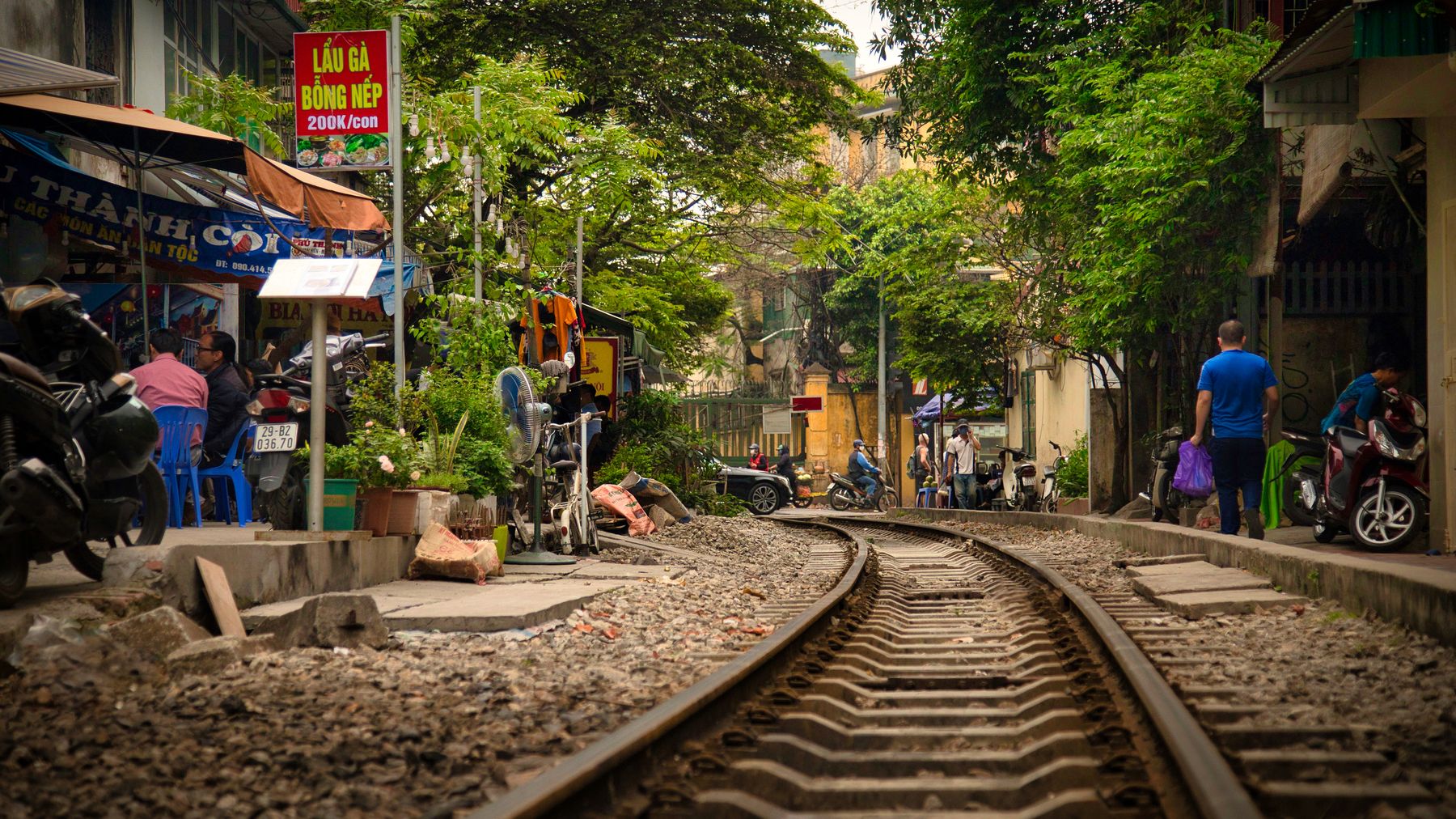
Photo by Koen Swiers on Pexels
What to do
Grab a drink at a trackside cafe
Several small cafes operate right along the rails. Order a "ca phe sua da" (iced milk coffee) or an egg coffee — Hanoi's signature drink — and wait for the train. Prices are tourist-adjusted but still reasonable: 35,000–60,000 VND for a coffee. The cafes on the northern section near Tran Phu tend to be more established.
Watch the train pass
This is the main event. When the horn sounds, cafe staff will pull tables and chairs flush against the walls. The train crawls through at about 15–20 km/h, close enough to touch (don't). The whole thing takes maybe 60 seconds, and then life resumes. Stay aware — the tracks are not fenced and there's no platform.
Walk the full stretch
Most visitors cluster near the cafes at the northern end. If access permits, walk the full 500 meters south toward Kham Thien. The southern section is more residential, less touristy, and gives you a better sense of everyday life along the tracks.
Explore Phung Hung Street murals
Just outside the Train Street entrance on Phung Hung, a series of murals painted on the arches beneath the railway viaduct depict old Hanoi life. They're worth a slow walk — the art is well done, and the street connects you back toward Dong Xuan Market and the deeper Old Quarter.
Photograph the details
Forget the wide-angle train shot everyone else is getting. The interesting photos here are the details: the potted plants on the rails, the laundry lines strung between houses, the shrine tucked into a wall niche three feet from the track. A 35mm or 50mm lens works better than a wide angle.
Where to eat nearby
You're in Hanoi — eating well within walking distance is guaranteed.
Head to Kham Thien Street (south end of Train Street) for "bun cha" — grilled pork patties with rice noodles and dipping broth. There are a dozen places along this stretch; look for the ones with charcoal grills smoking on the sidewalk. A plate runs 40,000–55,000 VND.
For something different, walk 10 minutes northeast to the Old Quarter for "pho (쌀국수 / 越南河粉 / フォー)" — the real reason half the world knows Vietnamese food. Pho Bat Dan at 49 Bat Dan Street still draws a line every morning. Go before 8:30 AM if you want to combine a bowl with an early Train Street walk.
Where to stay
The Old Quarter is the natural base, and it's walking distance from Train Street.
- Budget: Hostels and guesthouses around Luong Ngoc Quyen and Ma May streets run 150,000–350,000 VND/night for a dorm bed or basic private room.
- Mid-range: Boutique hotels in the Hoan Kiem area go for 800,000–1,500,000 VND/night. Plenty of options on Hang Bong and Hang Gai streets.
- Splurge: The Sofitel Legend Metropole on Ngo Quyen Street — one of Hanoi's colonial-era landmarks — starts around 5,000,000 VND/night.

Photo by hoang anh on Pexels
Practical tips locals would tell you
- Check current access rules before you go. Hanoi authorities have repeatedly closed Train Street to tourists and then quietly reopened it. Cafe operators sometimes manage access through their storefronts. Ask your hotel the morning of your visit — the situation is fluid.
- Don't stand on the tracks when a train is coming. This sounds obvious, but it's the exact reason authorities keep shutting the street down. Step fully against the wall.
- Bring cash. Most trackside cafes don't take cards. ATMs are plentiful along Hang Bai Street, a 10-minute walk east.
- Skip weekends if possible. The corridor is narrow, and weekend crowds make it cramped. A weekday afternoon is far more pleasant.
Common mistakes to avoid
- Showing up without checking the train schedule. The trains don't run constantly — if you arrive at the wrong time, you'll sit in a narrow alley drinking overpriced coffee with nothing happening. Confirm times with your cafe or hotel.
- Only visiting the north entrance. The most photographed section is near Tran Phu, but it's also the most crowded. The southern stretch has its own character.
- Treating it like a theme park. People live here. Don't peer into homes, don't block doorways, and don't leave trash on the tracks. The residents tolerate tourists, but that goodwill has limits — and it's the main reason access keeps getting restricted.
Practical notes
Train Street is free to walk through when open, though you'll likely buy a drink at a cafe to justify sitting there. Budget 60–90 minutes for a relaxed visit including the train pass. Combine it with a morning walk through Hanoi's Old Quarter and Long Bien Bridge for a solid half-day on foot.
Last updated · May 26, 2026 · independently researched, never sponsored.