Cot Co Ha Noi — the Flag Tower of Hanoi — is one of those landmarks locals point to with quiet pride. Built in 1812 during the Nguyen Dynasty, it's one of the rare original structures of the Imperial Citadel Thang Long complex that wasn't torn down during the French colonial period. At 33 meters tall, it's modest by modern standards, but it anchors a part of Hanoi that rewards a slow, deliberate visit.
What it is and why it matters
The tower was constructed under Emperor Gia Long as a military observation post, part of the original Thang Long citadel fortifications. It has three tiers — each with its own staircase — topped by an octagonal watchtower with narrow windows oriented to the eight compass points. The Vietnamese flag has flown from its peak since October 1954, and for many Hanoians the tower carries weight as a symbol of the city's continuity through centuries of change.
Today, the Flag Tower sits within the grounds of the Vietnam (베트남 / 越南 / ベトナム) Military History Museum at 28A Dien Bien Phu Street, Ba Dinh District. It's sandwiched between the citadel site to the north and Lenin Park to the east — a pocket of old Hanoi surrounded by government buildings and wide, tree-lined boulevards.
Why travelers go
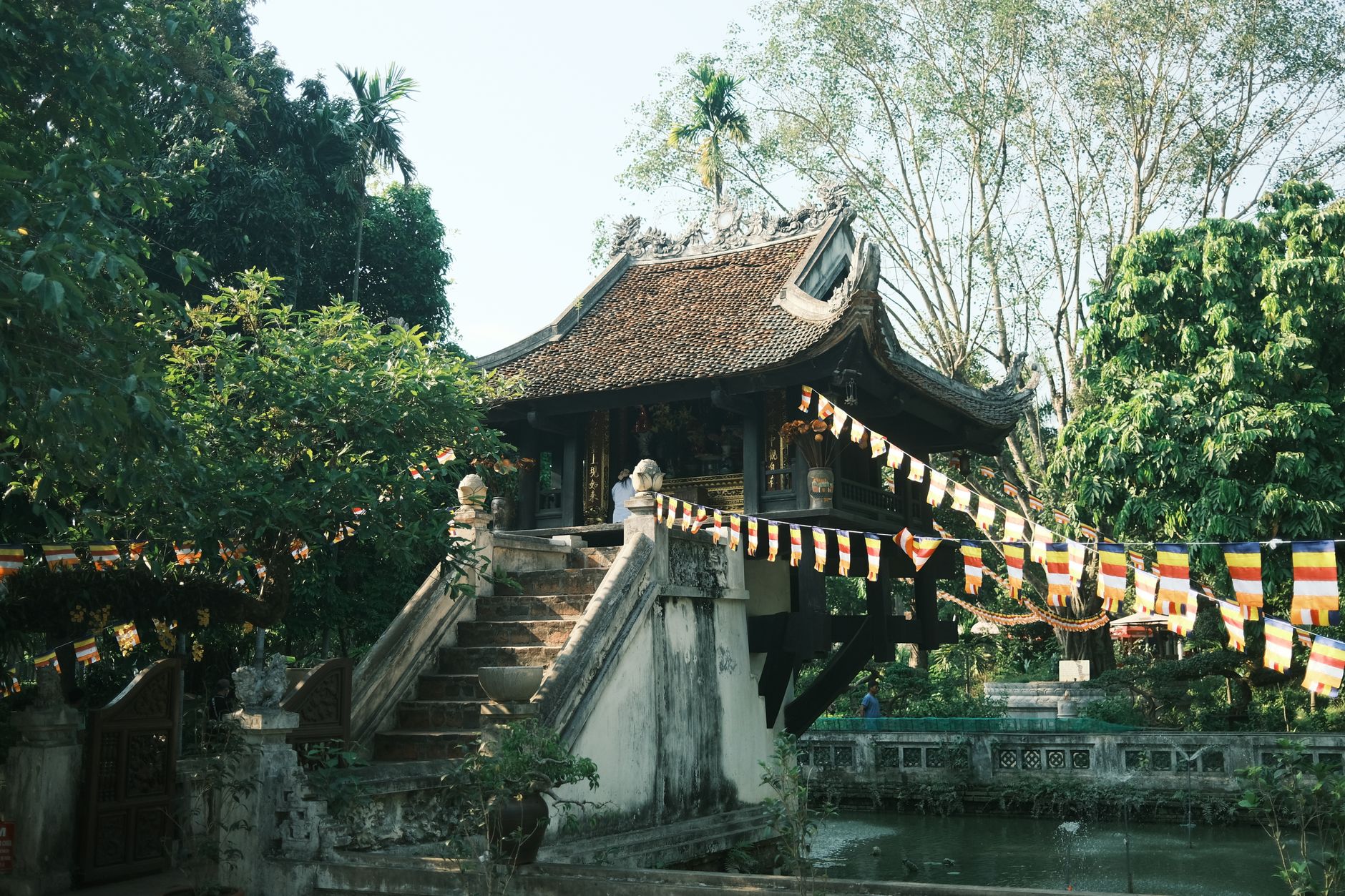
Most visitors come because they're already in the Ba Dinh area visiting Ho Chi Minh (호치민 / 胡志明 / ホーチミン)'s Mausoleum or the One Pillar Pagoda, and the Flag Tower is a 10-minute walk south. But it's worth a deliberate stop, not just a passing glance. The tower is the best-preserved piece of early 19th-century military architecture in Hanoi. Climbing to the top — when access is open — gives you a grounded view of the city's layered history: ancient citadel walls below, French-era buildings across the street, Soviet-influenced blocks in the middle distance.
The surrounding museum grounds also display decommissioned aircraft, tanks, and artillery, which adds context if you're interested in 20th-century history.
Best time to visit
October through December is ideal. The air is cool and dry, usually 18–25°C, and the light is soft — good for photography. January and February work too, though it can dip to 10–12°C and get drizzly. Avoid June through August if you dislike heat; the combination of 35°C+ temperatures and climbing narrow stone stairs is genuinely unpleasant.
Weekday mornings (8:00–9:30 AM) are quietest. Weekend mornings draw school groups and domestic tourists, especially around national holidays. The area around the tower gets particularly busy during Tet and on National Day (September 2).
How to get there
From Hoan Kiem Lake — the default reference point for most Hanoi visitors — the Flag Tower is about 2.5 km west.
- Grab/taxi: 15–20 minutes depending on traffic, roughly 25,000–40,000 VND.
- Bus: Route 09 from Hang Bai Street runs along Dien Bien Phu and drops you within 200 meters. Fare is 8,000 VND.
- Walking: A pleasant 30-minute walk west through the French Quarter along Tran Phu or Dien Bien Phu streets. You'll pass the Temple of Literature about halfway — easy to combine both in one morning.
- Motorbike: If you're renting, there's parking on the museum grounds for around 10,000 VND.

Photo by XT7 Core on Pexels
What to do
Climb the tower itself
When the interior staircase is open, you ascend through three levels via 54 stone steps. The windows at the top frame the city in narrow slices — it's a more interesting perspective than any rooftop bar. Check at the museum entrance whether the tower is open that day; access is occasionally restricted for maintenance.
Walk the museum grounds
The Vietnam Military History Museum (40,000 VND entry, extra 30,000 VND for camera) surrounds the tower's base. Even if military hardware isn't your thing, the grounds are well-kept and the outdoor exhibits — including a reconstructed MiG-21 — provide scale next to the 200-year-old tower. Budget about 60–90 minutes for both the tower and museum.
Visit the Citadel site next door
The Imperial Citadel Thang Long, a UNESCO World Heritage Site, is directly adjacent to the north. A combined visit makes sense — you're walking the same stretch of Hanoi's historical core. The citadel's archaeological site shows layers of construction spanning roughly a thousand years. Entry is 30,000 VND.
Sit in Lenin Park
Across Dien Bien Phu Street, this park (officially called Thong Nhat Park by some maps, but locals around Ba Dinh still call the northern section Lenin Park) is where Hanoians jog, practice tai chi, and drink "ca phe sua da" on tiny plastic chairs. A good place to decompress after the museum.
Combine with the Temple of Literature
Van Mieu is only 800 meters south on Quoc Tu Giam Street. Walking between the two takes about 10 minutes and keeps you in the same historical corridor of western Hanoi.
Where to eat nearby
The Ba Dinh area isn't a street food hotspot like the Old Quarter, but you won't go hungry.
- "Bun cha" on Nguyen Tri Phuong Street, about 500 meters south of the museum. Several small shops serve the Hanoi classic — grilled pork patties with rice noodles and dipping broth — for 40,000–55,000 VND. No English menus, but pointing works fine.
- "Pho" on Giang Vo Street heading toward the lake. A few longstanding morning-only shops do solid bowls of beef pho for 45,000–60,000 VND. Get there before 9:30 AM or they'll be winding down.
For egg coffee, you're better off heading back toward Hoan Kiem — the Ba Dinh neighborhood doesn't really do the tourist cafe thing.
Where to stay
Most travelers base themselves in the Old Quarter or around Hoan Kiem Lake, which is the practical choice — the Flag Tower is an easy day-trip from there.
- Budget: Old Quarter hostels and guesthouses run 200,000–400,000 VND/night for a private room.
- Mid-range: Hotels around Hoan Kiem Lake go for 800,000–1,500,000 VND/night, with reliable air conditioning and breakfast.
- Higher-end: Several international-brand hotels sit along Ly Thuong Kiet Street, closer to the Ba Dinh district, from 2,500,000 VND/night up.
Staying in Ba Dinh itself is quieter and more residential — fewer restaurant options at night, but convenient if you plan to spend a full day on the citadel, museum, and mausoleum circuit.
Photo by Dang Hong on Pexels
Practical tips locals would tell you
- Bring water. There's no cafe or drink stand inside the museum grounds, and the nearest convenience store is a short walk out on Dien Bien Phu.
- Wear shoes you can climb in. The tower stairs are stone, uneven, and narrow.
- The museum is closed on Mondays and Fridays. The tower follows the same schedule. Don't show up on those days.
- If you want a photo of the tower without crowds, arrive right at opening (8:00 AM) on a Tuesday or Wednesday.
Common mistakes to avoid
- Rushing through on the way to the mausoleum. The Flag Tower and the museum deserve at least an hour. Treating it as a 5-minute photo stop wastes the visit.
- Skipping the citadel next door. The two sites are connected historically and physically. Doing one without the other is like visiting half a story.
- Coming in the afternoon heat (May–September). The museum grounds have limited shade, and the tower's interior gets stuffy. Morning visits only in summer.
- Not bringing small bills. Ticket counters and parking attendants deal in cash and rarely have change for 500,000 VND notes.
Practical notes
Cot Co Ha Noi is open Tuesday–Sunday, 8:00 AM–11:30 AM and 1:00 PM–4:30 PM. Combined with the Temple of Literature and a bowl of bun cha, it makes a solid half-day loop through western Hanoi — the part of the city that most visitors skip in favor of the Old Quarter, but probably shouldn't.
Last updated · May 29, 2026 · independently researched, never sponsored.