What Trang Co Bu Lach Actually Is
Trang co Bu Lach is a rolling grassland plateau sitting at around 700-750 meters elevation in the former Bu Dang district of what was Binh Phuoc province, now part of the expanded Dong Nai province after Vietnam (베트남 / 越南 / ベトナム)'s 2025 administrative merger. The name translates roughly to "Bu Lach grass field" — and that's exactly what you get: around 2,000 hectares of open, wind-swept savanna that looks nothing like the dense jungle or rice paddies most people associate with southern Vietnam.
The landscape is sometimes compared to the Central Highlands (중부 고원 / 中部高原 / 中部高原) around Da Lat, but flatter and wilder. Pine trees dot the edges, termite mounds punctuate the grass, and during the right season the whole thing turns an almost electric shade of green. The area has been used as grazing land by local communities for generations, and cattle still wander freely across much of it.
Why Travelers Go
People come here for the space. Southern Vietnam is crowded — Saigon sprawls, the Mekong is dense with settlement, and even beach towns pack tight. Trang co Bu Lach is the opposite. You can stand in the middle of the grassland and see nothing but rolling green and sky in every direction. It's become popular with photographers, camping groups, and motorcyclists who ride up from Saigon for a weekend.
There's no entrance fee, no ticket booth, no roped-off viewing platforms. It's just open land. That rawness is the draw — and also why you need to plan a bit before showing up.
Best Time to Visit
The grassland has two distinct faces depending on the season:
- October to December is the sweet spot. The wet season is winding down, the grass is tall and green, and the light in the late afternoon turns the whole plateau golden. Temperatures hover around 22-26°C, comfortable for walking and camping.
- January to March is drier. The grass turns yellow-brown, which has its own stark beauty — think African savanna vibes. Less photogenic for green-landscape shots but good for camping since rain is rare.
- April to June gets hot and the grass is short from dry-season burns. Skip it unless you specifically want empty solitude.
- July to September brings heavy rain. The roads in can get muddy and slippery, especially the last few kilometers of dirt track.
How to Get There
The grassland is roughly 180 km north of Saigon — about 4 to 4.5 hours by motorbike or car, depending on traffic getting out of the city.
From Saigon
By motorbike: Take the DT741 highway north through Binh Duong and into the former Binh Phuoc area. From Dong Xoai town, continue north on DT741 toward Bu Dang, then follow local signs to Bu Lach. The last 5-7 km is a red dirt road — manageable on a semi-automatic but easier on a manual bike. Total fuel cost roughly 150,000-200,000 VND round trip on a 125cc bike.
By car: Same route, but the final dirt section can be rough for low-clearance sedans after rain. An SUV or crossover handles it fine. No public bus goes directly to the grassland — you'd need to get to Dong Xoai (buses from Saigon's Mien Dong bus station, around 120,000-150,000 VND, 3 hours) and then hire a local "xe om" (motorbike taxi) for the remaining 50 km, which would run about 200,000-300,000 VND one way.
Organized tours from Saigon exist but are infrequent. Most visitors self-drive.

Photo by Quang Nguyen Vinh on Pexels
What to Do
Walk the Plateau at Golden Hour
The grassland is best experienced on foot in the hour before sunset. The light rakes across the termite mounds and pine stands, and the wind picks up. Head toward the higher ground on the eastern side for wider views. Give yourself at least 45 minutes of wandering.
Camp Overnight
This is the main reason weekend groups come up from Saigon. There are no formal campsites — you pitch a tent wherever looks good. Flat ground is easy to find. Bring everything you need: tent, sleeping bag (nights can drop to 18°C), water, food, and a headlamp. No fires on the grassland itself — use a portable stove away from dry grass.
Ride the Dirt Tracks
The network of red laterite roads around the grassland is genuinely fun on a motorbike. They wind through cashew plantations and small S'tieng ethnic minority settlements. Don't rush — the roads are loose in dry weather and slick when wet.
Visit the Surrounding Cashew and Coffee Farms
The former Binh Phuoc area is one of Vietnam's biggest cashew-producing regions. You'll pass through kilometers of cashew plantations on the way in. Some local families sell fresh roasted cashews by the roadside for 80,000-120,000 VND per kilogram — significantly cheaper than Saigon prices. Vietnamese coffee plantations also appear at higher elevations.
Photograph the Cattle Herds
Local herders bring cattle onto the grassland most mornings. The image of cows grazing across an open highland plateau with mist still hanging low is the signature shot of this place. Be there before 7:00 AM.
Where to Eat Nearby
There are no restaurants at the grassland itself. The nearest food options are in Bu Dang town, about 15 km south.
- "Com tam" (broken rice) stalls along the main road in Bu Dang serve solid plates for 35,000-50,000 VND. Look for the ones with locals parked outside.
- Grilled chicken with pepper salt is a regional favorite — the black pepper from this area is well-known across Vietnam. A half chicken runs about 120,000-150,000 VND at local "quan nhau" (drinking-food spots) in town.
If you're camping, bring your own supplies from Dong Xoai, which has proper markets and convenience stores.
Where to Stay
No hotels exist at the grassland — that's part of the appeal.
- Camping on-site: Free. Bring your own gear.
- Guesthouses in Bu Dang town: Basic "nha nghi" rooms for 200,000-350,000 VND per night. Don't expect much beyond a bed, fan or AC, and a bathroom. Clean enough.
- Hotels in Dong Xoai: More options, including a few mid-range places in the 400,000-700,000 VND range with proper amenities. Dong Xoai is about an hour's ride from the grassland, so this only works if you're passing through.
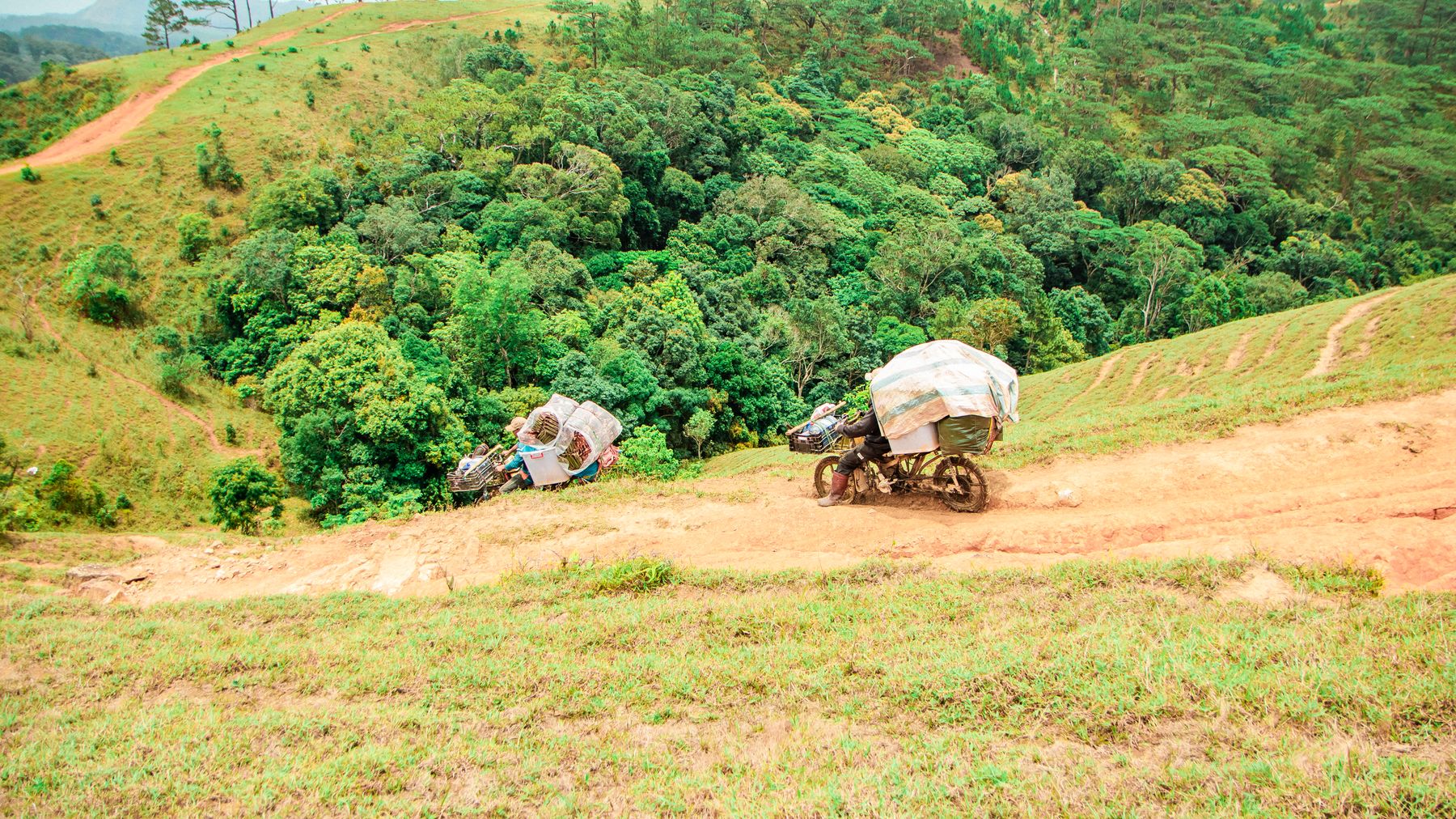
Photo by Tường Chopper on Pexels
Practical Tips Locals Would Tell You
- Bring sunscreen and a hat. There's almost no shade on the open grassland, and the elevation doesn't spare you from UV.
- Carry at least 3 liters of water per person if you're spending a full day. Zero shops out there.
- Download offline maps before you go. Phone signal is patchy on the plateau and nonexistent in some low spots.
- Wear long pants and closed shoes if walking through tall grass — ticks and ants are common, and the grass edges can cut exposed skin.
- Fuel up in Dong Xoai. There are a few small gas stations closer to Bu Dang, but they sometimes run dry or close early.
Common Mistakes to Avoid
- Arriving midday. The grassland under noon sun is flat, harsh, and uninteresting. Morning and late afternoon are when this place comes alive.
- Underestimating the dirt road. After rain, the final stretch turns into a mud track. If you're on a scooter with smooth tires, you'll struggle. Check weather before committing.
- Leaving trash behind. There's no cleanup crew. This place stays beautiful only because most visitors pack out what they bring in. Don't be the exception.
- Expecting infrastructure. No toilets, no water taps, no power outlets, no phone charging. Plan for full self-sufficiency if you're camping.
Practical Notes
Trang co Bu Lach works best as a weekend trip from Saigon — ride up Saturday morning, camp one night, ride back Sunday. Combine it with a stop in Dong Xoai for supplies and a bowl of "pho" or "banh mi" before hitting the road north. It's not a place with a checklist of attractions; it's a place where the absence of all that is the whole point.
Last updated · May 29, 2026 · independently researched, never sponsored.