What it is
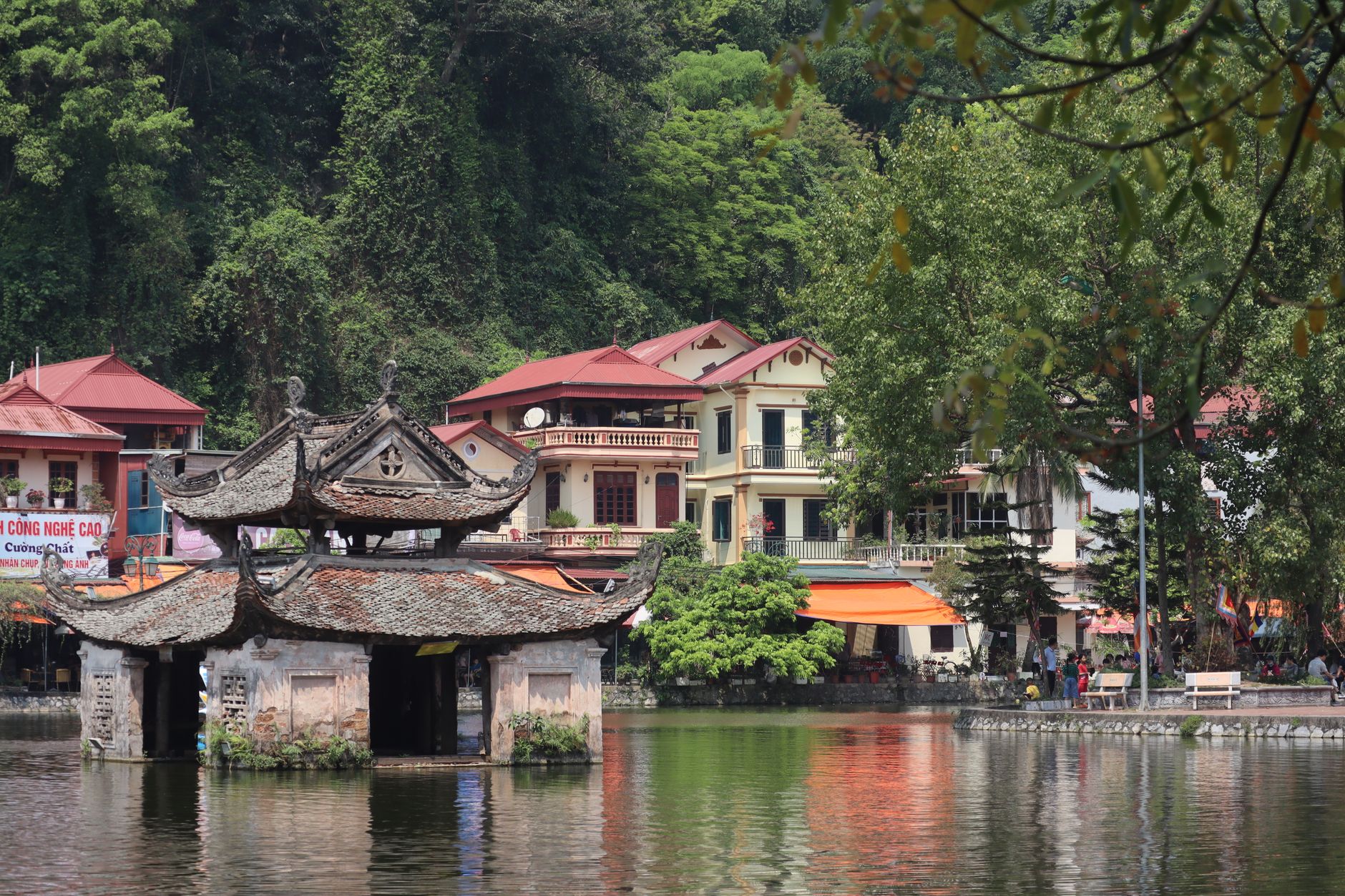
Chua Ba Danh is a 900-year-old Buddhist pagoda perched on Ngoc mountain, surrounded by the Day River and flat paddies. The Vietnamese have a saying — "vang nhu chua Ba Danh" (deserted like Ba Danh pagoda) — and the place lives up to it. Even on weekends, you might share the grounds with a handful of incense-selling aunties and nobody else.
The pagoda dates to the Ly Dynasty (roughly 11th-12th century), though most of the current wooden structures are later restorations from the Le and Nguyen periods. It's dedicated to the worship of "Man Nuong," a female Buddhist figure tied to the region's spiritual traditions. The complex includes the main worship hall, a bell tower, and a "tam quan" gate facing the river — all compact enough to walk in twenty minutes, but layered with enough carved detail to reward a slower look.
Following Vietnam's recent administrative reorganization, the area formerly in Ha Nam province now falls under the expanded Ninh Binh (닌빈 / 宁平 / ニンビン) jurisdiction, making it easier to fold into a broader Ninh Binh trip.
Why travelers go
Honestly, most foreign travelers don't — and that's the draw. Chua Ba Danh is the antithesis of crowded tourism sites. There's no ticket queue, no loudspeaker commentary, no golf-cart shuttles. You come here for the architecture, the silence, and the river scenery. The pagoda's hilltop position gives a modest but satisfying view over the Day River bend and the surrounding fields, especially when the rice is young and green (May-June) or golden before harvest (September-October).
It also works as a palate cleanser if you've been doing the Ninh Binh circuit — Tam Coc, Hoa Lu, Bai Dinh — and want somewhere with zero tourist infrastructure. No souvenir gauntlet. No drone-flying influencers. Just old wood, incense smoke, and river wind.
Best time to visit
The pagoda holds its annual festival on the 10th day of the second lunar month (usually March), which bringsثllocal pilgrims and folk performances. Worth timing if you want atmosphere, though it's the one day the "deserted pagoda" reputation doesn't hold.
For photography and comfortable weather: March through May or September through November. Summer (June-August) is hot and humid with occasional heavy rain that makes the stone steps slippery. Winter (December-February) is grey and drizzly — atmospheric in its way, but dress for it.
How to get there
From Ninh Binh city center, Chua Ba Danh is about 25 km northwest — roughly 35-40 minutes by motorbike or car.
- Motorbike rental in Ninh Binh town runs 120,000-150,000 VND/day. Head north on QL1A, then cut west toward Kim Bang. Google Maps handles the route fine.
- Grab car from Ninh Binh: expect 180,000-250,000 VND one way. Availability can be spotty for the return — consider asking the driver to wait (negotiate a round-trip fee of around 400,000-500,000 VND).
- From Hanoi (about 75 km): take a bus from Giap Bat station to Phu Ly town (60,000-80,000 VND, ~1.5 hours), then a local xe om or taxi the remaining 8 km to the pagoda. Alternatively, rent a motorbike in Hanoi and make it a day trip combined with other Ninh Binh stops.
There's no public bus that drops you at the pagoda gate. Last-mile transport is always motorbike or private vehicle.

Photo by Hugo Guillemard on Pexels
What to do
Walk the pagoda complex
The main hall houses old wooden statues — some dating back several centuries — including a set of "arhat" figures with expressive, individualized faces. Look up at the roof beams for dragon carvings. The bell tower is climbable; the view from the top across the river is the best angle on the grounds.
Cross to Ngoc island by boat
Local boatmen offer short rides (30,000-50,000 VND per person) across a narrow stretch of the Day River to the small island facing the pagoda. There's a secondary shrine here and a walking path through bamboo groves. The whole loop takes 20 minutes.
Walk the river dyke
A packed-earth path runs along the Day River for a couple of kilometers in each direction from the pagoda. Morning light here is excellent, and you'll pass vegetable plots, water buffalo, and fish traps — the kind of rural scenery that's getting harder to find near major tourist zones.
Photograph the tam quan gate
The three-arched entrance gate sits right at the river's edge, framed by banyan trees. It's the most photogenic element of the complex, especially in soft morning light or when low fog sits on the water.
Sit and do nothing
Seriously. The courtyard benches under the frangipani trees are there for a reason. Bring a book, drink the free tea if offered by the pagoda caretakers, and let the place do what it's famous for — be quiet.
Where to eat nearby
The immediate area doesn't have tourist restaurants. Your best bet:
- "[Bun cha](/posts/bun-cha-hanoi (하노이 / 河内 / ハノイ)-grilled-pork-noodles)" stalls in Kim Bang town (5 km away): grilled pork patties with rice noodles and herb plate, 35,000-45,000 VND. Simple but solid.
- Com binh dan (rice plate shops) along the main road serve whatever's fresh that day — expect catfish, morning glory, tofu, pork — for 30,000-50,000 VND per plate.
If you're heading back to Ninh Binh city, hold out for "com tam" or goat meat ("de tai chanh"), which the province is known for.
Where to stay
Chua Ba Danh doesn't warrant an overnight stay by itself — most visitors fold it into a Ninh Binh-based trip.
- Budget homestays in Tam Coc/Ninh Binh: 200,000-400,000 VND/night. Basic rooms, friendly hosts, bicycle loans.
- Mid-range hotels in Ninh Binh city: 500,000-900,000 VND/night. Air conditioning, hot water, breakfast included.
- Ninh Binh Hidden Charm / Tam Coc Garden tier: 1,200,000-2,500,000 VND/night. Pool, garden, the works.

Photo by Flavio Vallone on Pexels
Practical tips locals would tell you
- Dress modestly — shoulders and knees covered. The caretakers won't say anything, but you'll feel conspicuous in shorts.
- Bring cash. There's no ATM at the pagoda and no card machines anywhere nearby.
- The pagoda is free to enter. Donations are welcome but not pressured.
- Mosquito repellent is useful, especially near the river in late afternoon.
- If you're combining this with Ninh Binh sightseeing, do Chua Ba Danh in the morning (it opens at dawn) and head to Tam Coc or Hoa Lu afterward.
Common mistakes to avoid
- Coming on a tour bus itinerary: the pagoda is small. If you arrive with 40 people, you've ruined the one thing it offers — solitude.
- Skipping it because it's "just a pagoda": Vietnam has thousands of pagodas. This one earns its visit through setting and atmosphere, not size or gold leaf.
- Not checking festival dates: if you want quiet, avoid the lunar festival day. If you want to see folk rituals and crowds, plan for it specifically.
- Wearing slippery shoes: the stone steps to the hilltop are worn smooth and can be treacherous after rain. Trainers or sandals with grip.
Practical notes
Chua Ba Danh pairs well with a broader Ninh Binh itinerary — hit it on the way to or from Hoa Lu, or as a morning stop before a Tam Coc boat ride. Budget 1-2 hours for the pagoda and river walk. It's a small place that rewards patience over speed.
Last updated · May 26, 2026 · independently researched, never sponsored.