
What it is
Chua Giac Lam sits on Lac Long Quan Street in Tan Binh District, about 6 km northwest of central Saigon. Built in 1744, it holds the distinction of being the oldest Buddhist pagoda in the city — older than Saigon's colonial buildings, older than Ben Thanh Market, older than pretty much any structure tourists typically visit here. The Vietnamese government classified it as a national historical-cultural relic in 1988, and it's been in continuous use as a place of worship for nearly three centuries.
Unlike the heavily touristed Jade Emperor Pagoda or the photogenic Vinh Nghiem Pagoda, Giac Lam doesn't appear on most itineraries. That's partly why it's worth going. The compound feels lived-in rather than curated — monks go about their routines, neighborhood locals stop in to pray, and the grounds are quiet even on weekends.
Why travelers go
Three reasons, mainly. First, the architecture. Giac Lam preserves a style of southern Vietnamese Buddhist design that's become rare: low wooden halls, dark-lacquered columns, and over 100 statues of various Buddhas and bodhisattvas arranged across multiple altar rooms. The main hall has no flashy renovation — it's dim, dense with incense smoke, and genuinely atmospheric.
Second, the "Bodhi tree" in the courtyard. Grown from a cutting of the tree at the Mahabodhi Temple in Bodh Gaya, India, it was gifted in 1953. It's now enormous, shading much of the front courtyard.
Third, the seven-story stupa at the rear of the compound. Built in 1970, it holds relics and offers a view over the neighboring rooftops from its upper levels — a useful reminder that Saigon (사이공 / 西贡 / サイゴン) extends far beyond District 1.
Best time to visit
Giac Lam is open daily, roughly 6:00–11:30 and 14:00–21:00. The best months are December through March, when Saigon's humidity drops slightly and afternoon downpours are less frequent.
For atmosphere, visit during Tet or on the 1st and 15th of the lunar month, when locals come to offer incense and fruit. The pagoda gets busier but not overwhelmed — nothing like the crowds at Bai Dinh up north. Early morning (before 8:00) on a weekday is the quietest window if you want photos without people in every frame.
How to get there
From the backpacker area around Bui Vien (District 1), Giac Lam is about 6 km by road. A Grab bike takes 15–20 minutes and costs roughly 25,000–35,000 VND. A Grab car runs 50,000–70,000 VND depending on traffic, which in this part of the city can be thick during morning and evening rush hours.
If you're coming from the Ben Thanh area, you can also catch bus route 65 heading toward Tan Binh — the stop is on Lac Long Quan, a short walk from the pagoda entrance. Fare is 6,000 VND. The ride takes 30–45 minutes depending on when you go.
The pagoda address is 118 Lac Long Quan, Ward 10, Tan Binh District. Tell your driver "Chua Giac Lam, Lac Long Quan" and they'll know it.
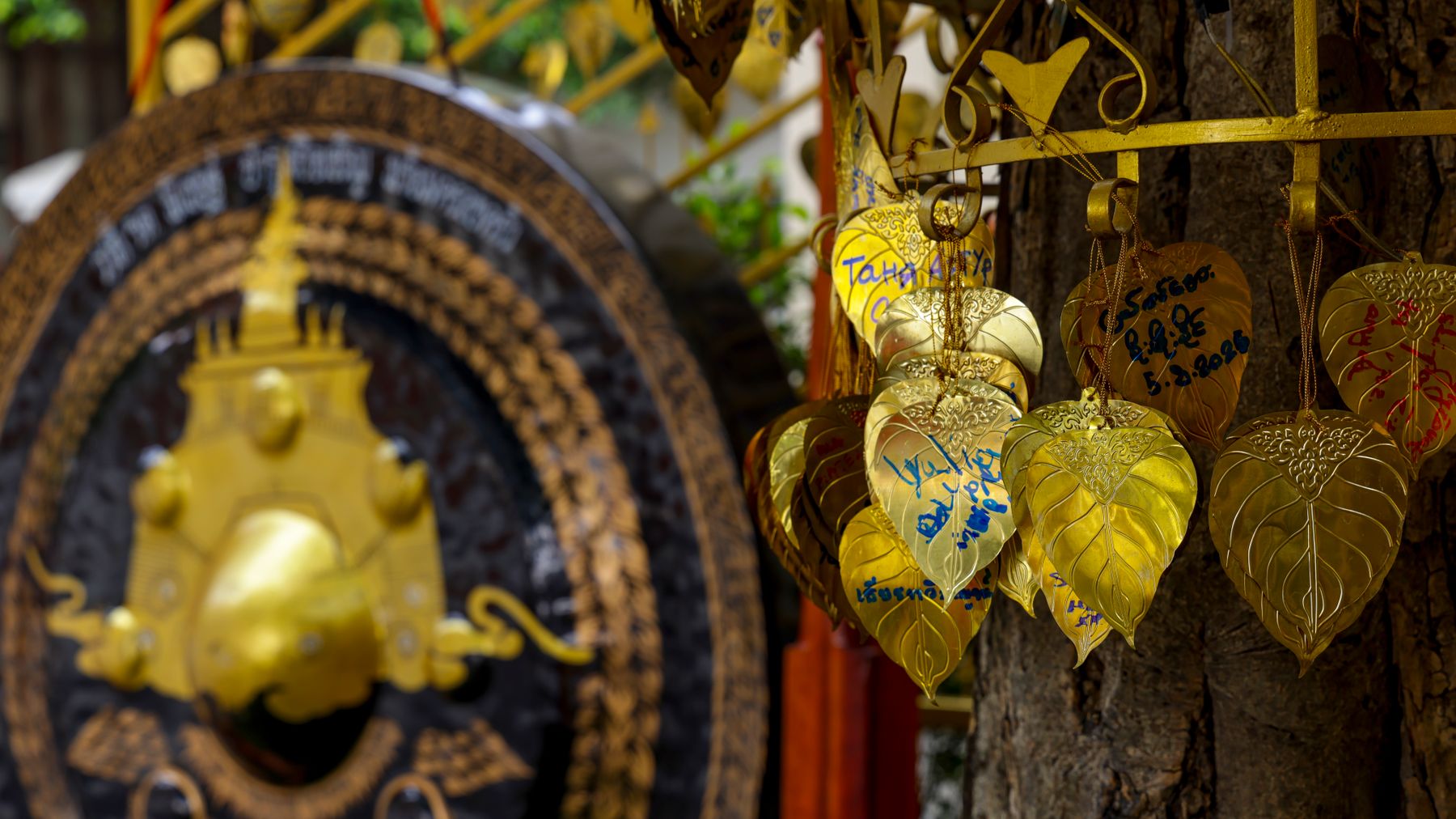
Photo by Frank van Dijk on Pexels
What to do
Walk the main worship hall
The interior is arranged with rows of wooden pillars and multiple altar platforms. Over 100 statues fill the space — some gilded, some dark wood, ranging from small figurines to life-sized seated Buddhas. Look up: the ceiling is hung with painted glass lanterns and coiled incense spirals. Give your eyes a few minutes to adjust to the low light.
Read the ancestor tablets
Along the walls, hundreds of wooden tablets and photographs commemorate the deceased. Some date back over a century. It's a working memorial, not a museum exhibit — families still add new tablets.
Visit the seven-story stupa
At the rear of the compound, the stupa ("bao thap") rises above the tree canopy. You can walk up the internal staircase. Each level holds small shrines. The top level has open windows facing every direction.
Sit in the courtyard
The Bodhi tree and surrounding garden have benches. After the intensity of Saigon traffic, ten minutes here with the sound of wind chimes and the smell of incense is genuinely restorative. Monks sometimes practice walking meditation in the early morning.
Check the side halls
Smaller rooms off the main hall contain additional statues, ceremonial objects, and calligraphy panels. Most visitors skip these, but they hold some of the oldest pieces in the compound.
Where to eat nearby
Lac Long Quan and the surrounding streets in Tan Binh aren't a major food destination, but you won't go hungry.
For a proper bowl of "hu tieu", head to one of the sidewalk stalls along Lac Long Quan — the pork-and-prawn version with clear broth is the southern standard, usually 40,000–55,000 VND. There's a cluster of vendors within a 5-minute walk south of the pagoda.
If you want "com tam" (broken rice), Tan Binh has dozens of places serving it with grilled pork chop, egg, and fish sauce. Look for any shop with a charcoal grill out front and a queue of motorbike drivers — that's your quality signal. Plates run 35,000–50,000 VND.
For vietnamese coffee after your visit, the cafes along Lac Long Quan serve standard "ca phe sua da (연유커피 / 越南冰咖啡 / ベトナムアイスコーヒー)" for 20,000–30,000 VND. Nothing fancy, but cold and strong.
Where to stay
Most travelers stay in District 1 or District 3 and visit Giac Lam as a half-day trip, which makes the most sense logistically. Budget guesthouses in the Bui Vien area start around 250,000–400,000 VND/night. Mid-range hotels in District 1 or District 3 run 600,000–1,200,000 VND. If you specifically want to stay near Tan Binh — say, if you have an early flight out of Tan Son Nhat Airport, which is in the same district — there are basic hotels along Cong Hoa Street from 350,000 VND.

Photo by Phuongduy Le on Pexels
Practical tips locals would tell you
- Dress modestly. Shoulders and knees covered. This is an active place of worship, not a tourist attraction with a dress code sign — but monks and regular visitors notice.
- Remove shoes before entering the main hall. There's usually a rack or mat near the entrance.
- Incense is free at the offering table near the entrance. You can light a few sticks and place them in the large outdoor urn. No donation is required, though there's a box if you'd like to contribute.
- Photography is generally fine in the courtyard and exterior areas. Inside the main hall, keep your phone on silent, don't use flash, and don't pose in front of altars. Read the room — if a ceremony is happening, put the camera away.
- Combine the visit with nearby spots. The Jade Emperor Pagoda (District 1) and Vinh Nghiem Pagoda (District 3) make a good pagoda circuit if you're interested in comparing styles across different eras.
Common mistakes to avoid
Arriving during the midday closure (roughly 11:30–14:00) and finding the gates shut. Plan around it.
Rushing through in 15 minutes. The compound rewards slow looking — details in the carvings, the layered altars, the quiet corners. Give it at least 45 minutes.
Expecting English signage or guided tours. There's minimal English explanation inside. Read up before you go, or you'll miss the context behind what you're seeing.
Practical notes
Giac Lam is free to enter. The pagoda is a 20-minute ride from central Saigon and pairs well with a morning in Tan Binh before heading back downtown for lunch. It's one of those places that rewards the small effort of getting outside the tourist core — real, unpolished, and still doing exactly what it was built to do in 1744.
Last updated · May 26, 2026 · independently researched, never sponsored.








