Khanh Hoa is a coastal province in south-central Vietnam, bordered by Dak Lak to the northwest, Lam Dong to the southwest, and the sea to the east. In June 2025, it merged with Ninh Thuan, expanding to 11,911 km² and a population of 1.88 million people. For travelers, the province is synonymous with Nha Trang (냐짱 / 芽庄 / ニャチャン)'s beaches and Cam Ranh's international access — but the real depth lies inland and in lesser-known communities.
If you only know Khanh Hoa from package-tour brochures advertising beachfront resorts, you are seeing maybe 10% of what this province offers. From Cham tower complexes to highland waterfalls, from fish-sauce factories to one of Vietnam (베트남 / 越南 / ベトナム)'s best "bun ca" (fish noodle soup) scenes, the province rewards anyone willing to wander past the resort strip.
The Landscape
Khanh Hoa's terrain swings between extremes. Vonh Phu Mountain, the highest point at 2,051 meters, towers on the Dak Lak border and anchors the western rim. Lowland plains sprawl around Ninh Hoa to the north, where agriculture still dominates. More than half the province is forested — a fact that shapes both ecology and local livelihoods. The coastline offers the obvious draw, but trekking into the interior reveals limestone karsts and mountain streams that rival the beaches.
The coast itself stretches roughly 385 km if you count the bays and inlets. Doc Let beach, about 50 km north of Nha Trang city center, is a long, quiet stretch of sand where weekend crowds thin out dramatically compared to the main Tran Phu strip. Dai Lanh beach, near the border with Phu Yen province, is the easternmost point of mainland Vietnam — the first place in the country to see sunrise. Cam Ranh Bay, once primarily a military port, now hosts a cluster of mid-range and upscale resorts on a narrow peninsula separating the bay from the open sea.
Nha Trang and Urban Life
Nha Trang is the second-largest industrial hub in the region, and it shows — not in a grim way, but in density and forward momentum. As of 2007, Khanh Hoa's urban population stood at 466,500 (40.7% of the total), the highest urbanization rate on the south-central coast at that time. The average growth rate hovered around 1.26% annually, though urban areas grew faster at 2.24%, which tells you where investment and migration are flowing.
The city itself is the draw for most visitors: seafood restaurants clustered along Tran Phu Boulevard, beach vendors, nightlife, and a working port that never sleeps. Cam Ranh International Airport, in the southern part of the province, is Vietnam's fourth busiest and the primary entry point for foreign tourists flying into the region.
For orientation: Tran Phu Boulevard runs parallel to the beach for about 7 km and serves as the tourist spine. Most hotels, booking offices, and dive shops sit within two blocks of this road. The backpacker cluster gravitates toward Hung Vuong and Biet Thu streets, where a bed in a hostel dorm runs 150,000–250,000 VND per night. Mid-range hotels on side streets off Tran Phu charge 500,000–900,000 VND. The beachfront five-stars start around 2,500,000 VND and climb steeply from there.
Nha Trang's night market, near the Tran Phu / Ly Tu Trong intersection, opens around 18:00 and runs until roughly 22:00. Expect grilled squid (50,000–80,000 VND per plate), coconut ice cream (30,000 VND), and rows of souvenir stalls. It is touristy, yes — but the squid vendors near the market's south end are legitimately good.

Photo by Quang Nguyen Vinh on Pexels
What to Eat in Khanh Hoa
Khanh Hoa's food identity leans heavily on seafood, but there are regional dishes you will not find done the same way elsewhere.
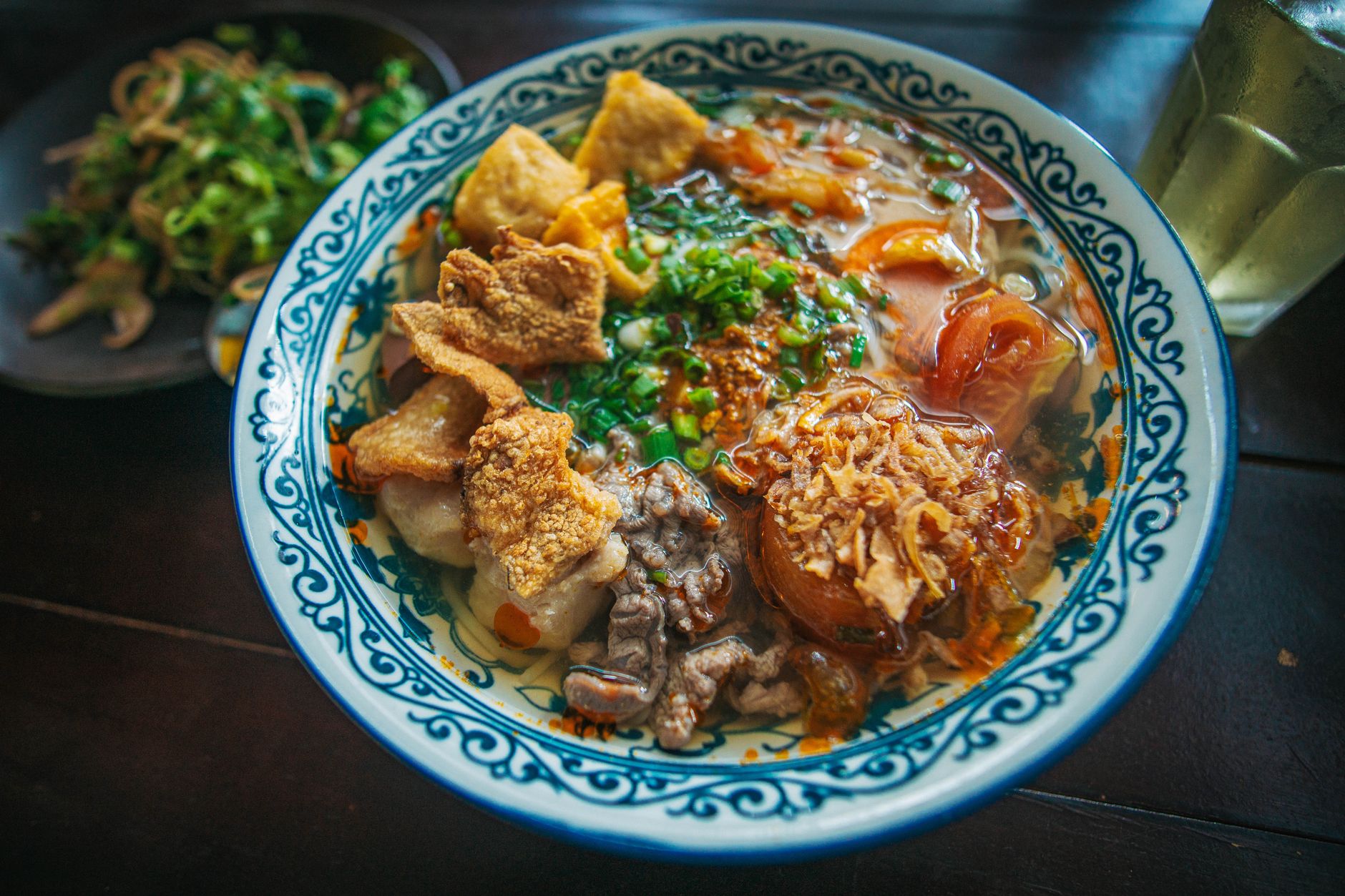
"Bun ca" (fish noodle soup) is the local breakfast staple. Unlike the Hanoi version, Nha Trang's "bun ca" uses a jellyfish-and-fish broth, sometimes thickened with tamarind paste, and tops it with mackerel or tuna chunks, herbs, and a scoop of "cha ca" (fried fish cake). A bowl costs 30,000–45,000 VND at most street stalls. Quan Bun Ca 67 Yersin on Yersin Street is a reliable spot, open from about 06:00 to 09:00 — get there early.
"Banh canh" — thick tapioca-and-rice-flour noodles in a pork-bone or fish broth — is everywhere in the province. Khanh Hoa's version often includes crab or shrimp. A bowl runs 35,000–55,000 VND.
"Nem nuong" (grilled pork sausage) from Ninh Hoa, the town about 30 km north of Nha Trang, has a reputation across all of Vietnam. The sausage is wrapped in rice paper with herbs, pickled vegetables, and a fermented bean dipping sauce. Ninh Hoa locals will argue over which shop is best; the name you hear most often is Dang Van Quyen on Tran Quang Dieu Street in Ninh Hoa town. A serving for two people costs roughly 80,000–120,000 VND.
For familiar dishes done well: "pho" shops are plentiful but unremarkable here — this is not pho country. "Banh mi" carts along Nguyen Thi Minh Khai Street serve decent sandwiches for 15,000–25,000 VND. If you want "com tam" (broken rice), the stalls near Cho Dam (Dam Market) in central Nha Trang are solid and cheap, around 35,000–50,000 VND per plate.
Khanh Hoa is also one of Vietnam's biggest producers of fish sauce ("nuoc mam"). The factories are concentrated around Vinh Luong ward in northern Nha Trang. Some accept walk-in visitors — ask your hotel to call ahead. The smell is powerful, but the product is foundational to Vietnamese cooking.
Cham Culture and Heritage
What sets Khanh Hoa apart is the presence of Cham communities with deep roots. Multiple villages retain traditional Cham names and practice distinct customs — a living thread of a pre-Vietnamese civilization still visible on modern maps. Bau Truc, My Nghiep, Chung My, Huu Duc, and Phuot The are some of the better-known settlements. These villages are scattered across Thuan Nam, Ninh Phuoc, Ninh Son, Phan Rang–Thap Cham, Ninh Hai, and Thuan Bac districts.
Visiting a Cham village offers a different pace from Nha Trang tourism. You'll encounter traditional architecture, artisan crafts, and cuisine that diverges from ethnic-Vietnamese norms. It's accessible but still off most tourist radars.
The Po Nagar Cham Towers, on a hill at the mouth of the Cai River in Nha Trang, are the province's most visited Cham site. Built between the 7th and 12th centuries, the complex still functions as a place of worship — both for Cham people and for Vietnamese Buddhists who have adopted the site. Entry is 22,000 VND. The main tower (Thap Ba) is the best preserved. Visit before 08:00 or after 15:00 to avoid tour-bus crowds.
Bau Truc village, now part of the merged province, is famous for pottery made entirely by hand without a wheel — one of the oldest pottery traditions in Southeast Asia. Potters here shape clay using a paddle-and-anvil technique, fire it in open pits, and sell finished pieces for 50,000–300,000 VND depending on size. It is about 7 km south of Phan Rang–Thap Cham city and reachable by motorbike in 15 minutes.
If you are interested in Cham heritage more broadly, the towers at Hue (specifically the My Son sanctuary near Hoi An) offer a complementary experience and are often visited on the same trip through central Vietnam.

Photo by ㅤ quang vinh ㅤ on Pexels
Economy: Fishing, Farming, and Food
Khanh Hoa's economy is dominated by fishing and industrial food production. In 2007, the province exported $503.3 million in goods (mainly seafood) against $222.5 million in imports — a healthy trade surplus. Rice output that year was 188,500 tons, but sugarcane (738,200 tons, 4.25% of Vietnam's national total) and cashew nuts (5,238 tons) are the real agricultural stories. Fish, however, outweighs all agriculture combined — shrimp farms and fish sauce factories are ubiquitous.
Food processing plants, beverage production, and textile mills dot the province. The historic Russian naval base at Cam Ranh, though reduced in scale, still anchors roughly 30 factories. For food lovers, this infrastructure means Khanh Hoa supplies much of Vietnam's seafood and shrimp paste that finds its way into restaurants nationwide.
Tourism has overtaken many of these sectors in revenue terms since those 2007 figures. Vinpearl's theme park and resort complex on Hon Tre island — reachable by a 3,320-meter cable car from the mainland (one of the longest overwater cable cars in the world) — draws millions of domestic visitors annually. Whether that appeals to you or not, it has reshaped the province's economy and employment patterns.
Getting There and Moving Around
Khanh Hoa sits squarely on Vietnam's main north-south artery. National Road 1 and the North–South Railway both cut through the province, making it a natural waypoint between Hanoi and Ho Chi Minh City. Cam Ranh International Airport offers direct flights from Bangkok, Seoul, Singapore, and other regional hubs — critical for tourists who don't want a 12-hour bus ride. Once you arrive, local buses and motorbike taxis get you to Nha Trang (about 35 km from Cam Ranh, roughly 45 minutes by taxi) or inland towns like Phan Rang–Thap Cham.
From Nha Trang, Da Lat is about 135 km west through Khanh Vinh district — a winding mountain road that takes 3–4 hours by bus or private car. The scenery along National Road 27C is genuinely worth the drive. Da Nang is roughly 530 km north, reachable by train in about 8–10 hours or by a short domestic flight. Heading south, Ho Chi Minh City is about 430 km, or 7–8 hours by sleeper bus.
Within Nha Trang city, Grab (the local ride-hailing app) is the easiest way to move. A Grab bike across town costs 15,000–30,000 VND; a Grab car from the airport to central Nha Trang is around 250,000–350,000 VND. Renting a motorbike from shops near the backpacker area costs 120,000–150,000 VND per day — make sure brakes and lights work before you ride off.
The province's position on Vietnam's coast and its connection to key transport arteries make it logistically simple to visit — a quality often overlooked when travel guides fixate on remoteness. Sometimes being on the main road is the point.
Common Mistakes Visitors Make
- Only staying on Tran Phu Boulevard. The beach strip is fine, but the real food and local atmosphere are in the neighborhoods behind the tourist zone — Phuong Son, Phuoc Hai, and the streets around Cho Dam market.
- Skipping Ninh Hoa. The "nem nuong" there is a different class from what tourist restaurants in Nha Trang serve. It is a 30-minute ride north and worth the trip.
- Taking boat tours without checking the operator. Nha Trang's bay island-hopping tours are famous — and famously boozy. Some operators are essentially floating drinking parties. If you want snorkeling and quiet beaches, ask specifically for that and read recent reviews.
- Assuming Cam Ranh airport is in Nha Trang. It is 35 km south. Budget for a taxi or pre-book a shuttle. Arriving at midnight with no transport arranged is a common headache.
- Ignoring the Cham towers. Po Nagar is a 10-minute ride from central Nha Trang. It takes 30–45 minutes to visit. There is no good reason to skip it.
- Drinking tap water. This applies across Vietnam, but Khanh Hoa's municipal water is not potable. Bottled water costs 5,000–10,000 VND at any convenience store.
Quick Reference
- Province capital: Nha Trang
- Area (post-2025 merger): 11,911 km²
- Population: ~1.88 million
- Airport: Cam Ranh International (CXR), 35 km south of Nha Trang
- Train station: Nha Trang (Ga Nha Trang), on the North–South Railway, Thai Nguyen Street
- Key distances: Da Lat 135 km west | Ho Chi Minh City 430 km south | Da Nang 530 km north
- Currency: Vietnamese Dong (VND). ATMs are plentiful on Tran Phu and near Cho Dam market. Most tourist-facing businesses accept cards; street stalls are cash only.
- Language tip: "Bao nhieu tien?" means "How much?" — the most useful phrase in any market.
- Best months to visit: February through September (dry season). October through January sees monsoon rains, occasionally heavy enough to flood low-lying streets.
- Average meal cost (street food): 30,000–60,000 VND
- Average meal cost (mid-range restaurant): 150,000–300,000 VND per person
Frequently Asked Questions
How much does accommodation cost in Nha Trang for budget travelers?
A hostel dorm bed in Nha Trang runs 150,000-250,000 VND per night, concentrated around Hung Vuong and Biet Thu streets. Mid-range hotels on side streets off Tran Phu Boulevard charge 500,000-900,000 VND. Beachfront five-star hotels start around 2,500,000 VND. Tran Phu Boulevard itself spans about 7 km parallel to the beach and holds most hotels, dive shops, and booking offices within two blocks.
What airport do international tourists use to reach Khanh Hoa Province?
Cam Ranh International Airport, located in the southern part of Khanh Hoa Province, is the primary entry point for foreign tourists flying into the region. It ranks as Vietnam's fourth busiest airport. From there, travelers access Nha Trang city and the wider province, including beach areas like Doc Let, roughly 50 km north of Nha Trang city center, and the resort peninsula at Cam Ranh Bay.
When does the Nha Trang night market open and what does food cost?
The Nha Trang night market, near the Tran Phu and Ly Tu Trong intersection, opens around 18:00 and closes at roughly 22:00. Grilled squid runs 50,000-80,000 VND per plate, and coconut ice cream costs 30,000 VND. The squid vendors toward the market's south end are regarded as the best option among the stalls.
Final Note
Khanh Hoa does not need to be sold — it sells itself the moment you eat a 35,000 VND bowl of "bun ca" at dawn on a Nha Trang side street while the fishing boats unload behind you. The province works best when you treat Nha Trang as a comfortable base and push outward: north to Ninh Hoa for "nem nuong," west toward the highlands, south to the quiet sands of Cam Ranh Bay, and into the Cham villages that most visitors never reach. It is one of the most accessible stretches of Vietnam's coast, and accessibility, in this case, is a feature, not a compromise.
Last updated · May 29, 2026 · independently researched, never sponsored.