Saigon didn't invent "banh mi" — that's a French-colonial footnote everyone agrees on — but it did perfect the ratio. More filling, more sauce, more chili, baguette that shatters when you bite it. The northern version is fine. This one is better.
Why Saigon Does Banh Mi Differently
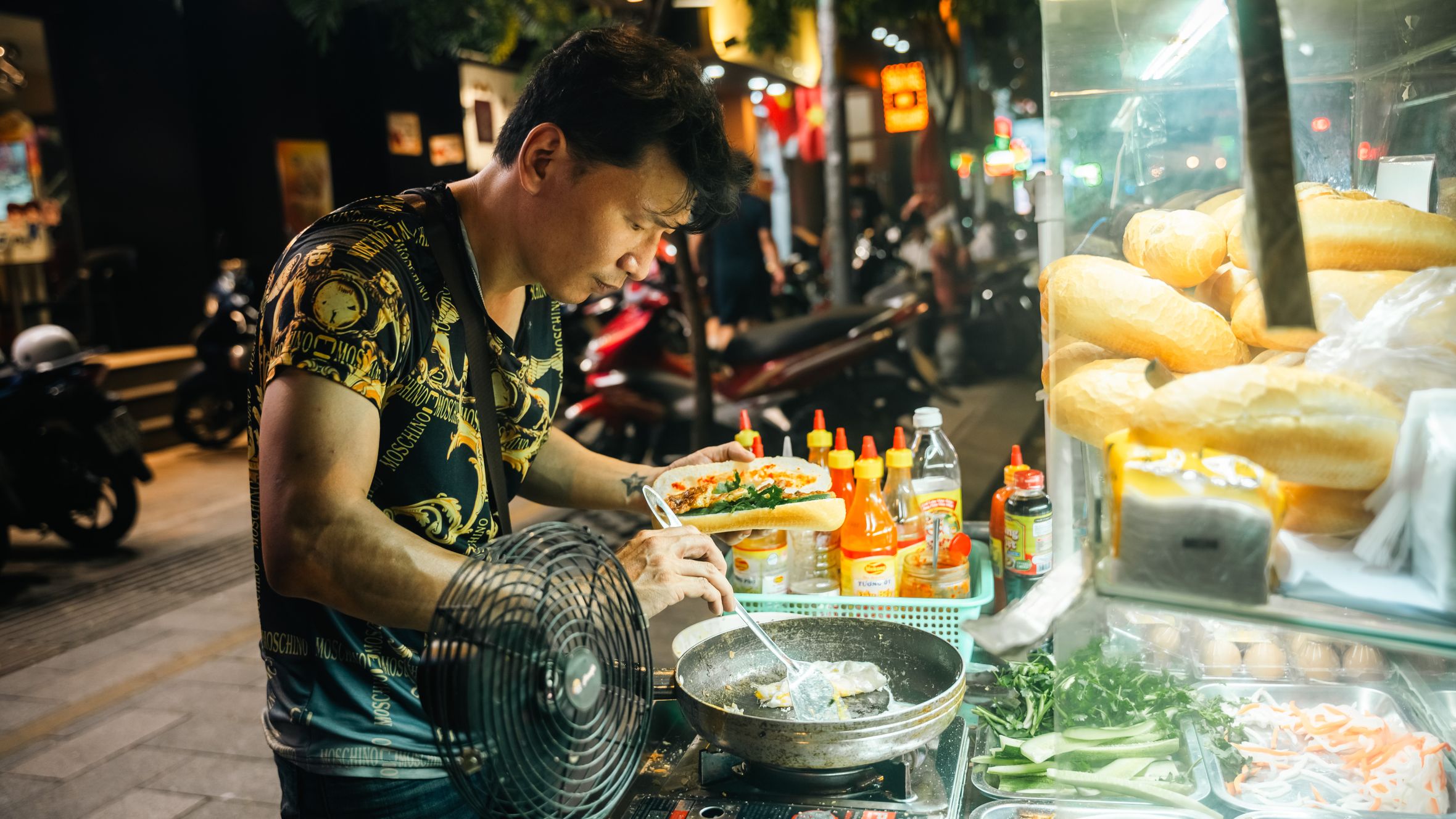
The short answer is fat and heat. Southern-style banh mi (반미 / 越式法包 / バインミー) leans heavily on do chua (pickled daikon and carrot), a proper smear of pate, a drizzle of Maggi seasoning, and enough chili to make your ears warm. The bread itself tends to be shorter and airier than Hanoi's denser baguette — a remnant of French colonial bakeries that adapted to local flour. The fillings are also more maximalist down here: you'll regularly find grilled pork, cold cuts, fried egg, cucumber, and fresh coriander all crammed into one 25,000 VND roll.
Banh mi shops in Saigon (사이공 / 西贡 / サイゴン) typically peak between 6:30–9:00 AM and again around noon. Show up outside those windows and you risk stale bread and depleted fillings. The city's best vendors often sell out entirely by 1 PM.
Four Shops Worth the Detour
Banh Mi Huynh Hoa — 26 Le Thi Rieng, District 1
This is the one everyone argues about, and the argument is mostly justified. Huynh Hoa runs 40,000–50,000 VND per sandwich, which is double what most street carts charge, and the queue during peak hours can stretch past the motorbikes parked along Le Thi Rieng. What you get for it: a roll so stuffed it's practically spherical, built around a combination of cha lua (pork sausage), head cheese, shredded pork skin, and a generous butter-and-pate base. They don't do variations. You get what they make. Go between 7:00–9:00 AM or after 3:00 PM when the lunchtime crush thins.
Banh Mi 37 Nguyen Trai — 37 Nguyen Trai, District 1
A cart, not a shop — a single woman with a converted motorbike setup who has been running this spot in various forms for decades. The specialty here is banh mi op la, the fried egg version, where a sunny-side-up egg goes straight into the roll with pate, cucumber, and a chili-soy drizzle. Price sits around 25,000–30,000 VND. Best before 9:00 AM; she frequently packs up by midmorning.
Banh Mi Ba Lan — 507 Nguyen Dinh Chieu, District 3
Less famous than Huynh Hoa but more consistent across visits, and no queue at most hours. Ba Lan does a solid grilled pork (thit nuong) banh mi — pork marinated in lemongrass and fish sauce, char-grilled, laid over pickled veg and fresh herbs. Around 30,000 VND. The bread here is particularly good: thin crust, hollow center, doesn't turn to mush under the sauces. Worth a stop if you're already moving through District 3 toward the Saigon Zoo area.
Banh Mi Phuong — 2B Phan Chu Trinh, District 1 (Saigon outpost)
Yes, Banh Mi Phuong is originally from Hoi An and carries all the tourist-recognition baggage that comes with Anthony Bourdain having eaten there on camera. But the District 1 branch in Saigon holds up independently. The southern outpost adapts the recipe slightly for local taste — more pate, more chili oil — and the bread quality is reliably excellent. Expect 35,000–45,000 VND depending on filling. Good if you've never tried the Hoi An original and want a benchmark.
Banh Mi Binh Duong — 12 Dinh Tien Hoang, Binh Thanh District
This one requires a 3 km ride from District 1, which is why it stays off most tourist lists — and why locals still own it. Binh Duong makes a banh mi dac biet (special combination) with a wider selection of cold cuts than most shops, plus a roasted pork option that comes with crackling skin. Prices hover at 28,000–35,000 VND. The surrounding Binh Thanh streets are worth exploring anyway for com tam shops and afternoon iced coffee.

Photo by Pragyan Bezbaruah on Pexels
Ordering Tips
If your Vietnamese is limited, pointing works fine at most of these places. But a few useful phrases:
- "Banh mi dac biet" — the full combination, usually everything the shop offers
- "Khong hanh" — no green onion, if you're sensitive to it
- "Them ot" — more chili
- "It ot" — less chili (say this clearly if you're heat-averse; Saigon cooks are generous by default)
Almost every banh mi sold on the street comes wrapped in paper or a small plastic bag. Eat it immediately — the bread goes soft within about 15 minutes once the sauces are in.

Photo by Trần Phan Phạm Lê on Pexels
What It Costs
Budget 25,000–50,000 VND per sandwich depending on the vendor and filling. Egg versions and basic pate rolls are cheapest. Full combination rolls with grilled meat at specialty shops top out around 50,000 VND. You won't need to spend more than that anywhere in the city for a proper banh mi, regardless of what the tourist-zone menus suggest.
Practical Notes
Most banh mi vendors in Saigon operate cash-only and don't give change for 500,000 VND notes — bring small bills (20,000s and 50,000s work well). The city's best carts move or close seasonally, so if a specific address has shifted, ask a nearby shopkeeper; regulars always know where the cart relocated. Morning is always the safest window: fresh bread, full fillings, shorter wait.
Last updated · Jun 7, 2026 · independently researched, never sponsored.