What Da Nhay Beach actually is
About 25 km north of Dong Hoi, the capital of Quang Binh province, a stretch of coastline breaks apart into something that looks more like a geology textbook than a beach. "Bai bien Da Nhay" — literally "Jumping Rock Beach" — gets its name from clusters of dark limestone boulders that jut out of the sand and shallow water at odd angles, as if they leapt out of the earth and froze mid-air. The formations were shaped over millions of years by waves and wind eroding the softer rock around harder limestone cores, leaving behind pillars, arches, and mushroom-shaped towers scattered across roughly 2 km of sand.
The beach sits in Bo Trach district, the same area that's home to Phong Nha-Ke Bang National Park. Most travelers blast through on their way to the caves and never stop. That's a mistake — not a catastrophic one, but a small, correctable one.
Why travelers go
Da Nhay Beach doesn't have the resort infrastructure of Da Nang or the party energy of Phu Quoc. What it has is a coastline that looks genuinely strange, in a good way. The rock formations change character depending on the tide — at low tide you can walk between them on wet sand, finding tide pools and natural archways. At high tide, waves crash against the pillars and send spray through gaps in the stone. It's one of the few beaches in central Vietnam where the geology is the main attraction rather than the swimming.
It's also quiet. Even during summer weekends, you're sharing the beach with a handful of Vietnamese families and the occasional backpacker who took a detour from the Phong Nha (퐁냐 / 峰牙 / フォンニャ) circuit. If you've spent a week dodging selfie sticks at Ha Long Bay, the emptiness here feels earned.
Best time to visit
The sweet spot is April through August. Quang Binh's coast gets genuinely hot from May to July (35-38°C), but the water is warm and the skies are mostly clear. April and August bookend the peak with slightly cooler temperatures and fewer domestic tourists.
Avoid October through December — this is when the central coast gets hammered by monsoon rains and occasional typhoons. The beach is technically accessible year-round, but grey skies and rough surf make the rock formations less impressive, and some of the tide-pool areas become dangerous.
September is a coin flip. You might get a perfect week; you might get rained out for three days straight.
How to get there
The nearest hub is Dong Hoi, which has both a train station and Dong Hoi Airport (VDH) with direct flights from Hanoi and Saigon (typically 800,000-1,500,000 VND one way on VietJet or Bamboo Airways).
From Dong Hoi, Da Nhay Beach is about 25 km north along the coast road (QL1A, then cut east). Your options:
- Motorbike rental from Dong Hoi: 120,000-180,000 VND/day for a semi-auto. The ride takes about 35 minutes and the road is flat and straightforward. This is the best option if you're comfortable on two wheels.
- Grab car or local taxi: around 250,000-350,000 VND one way. Grab coverage in Dong Hoi is decent but not guaranteed — book early in the morning if you want a car.
- Organized tour: many Phong Nha hostels and guesthouses offer half-day trips that combine Da Nhay Beach with nearby Bau Tro Lake or the Nhat Le River mouth. Expect 300,000-500,000 VND per person.
If you're coming from Hue (후에 / 顺化 / フエ) (about 210 km south), the drive takes roughly 3.5 hours by car. The stretch of highway between Hue and Dong Hoi passes through some of the emptiest, greenest countryside in central Vietnam — worth doing in daylight.
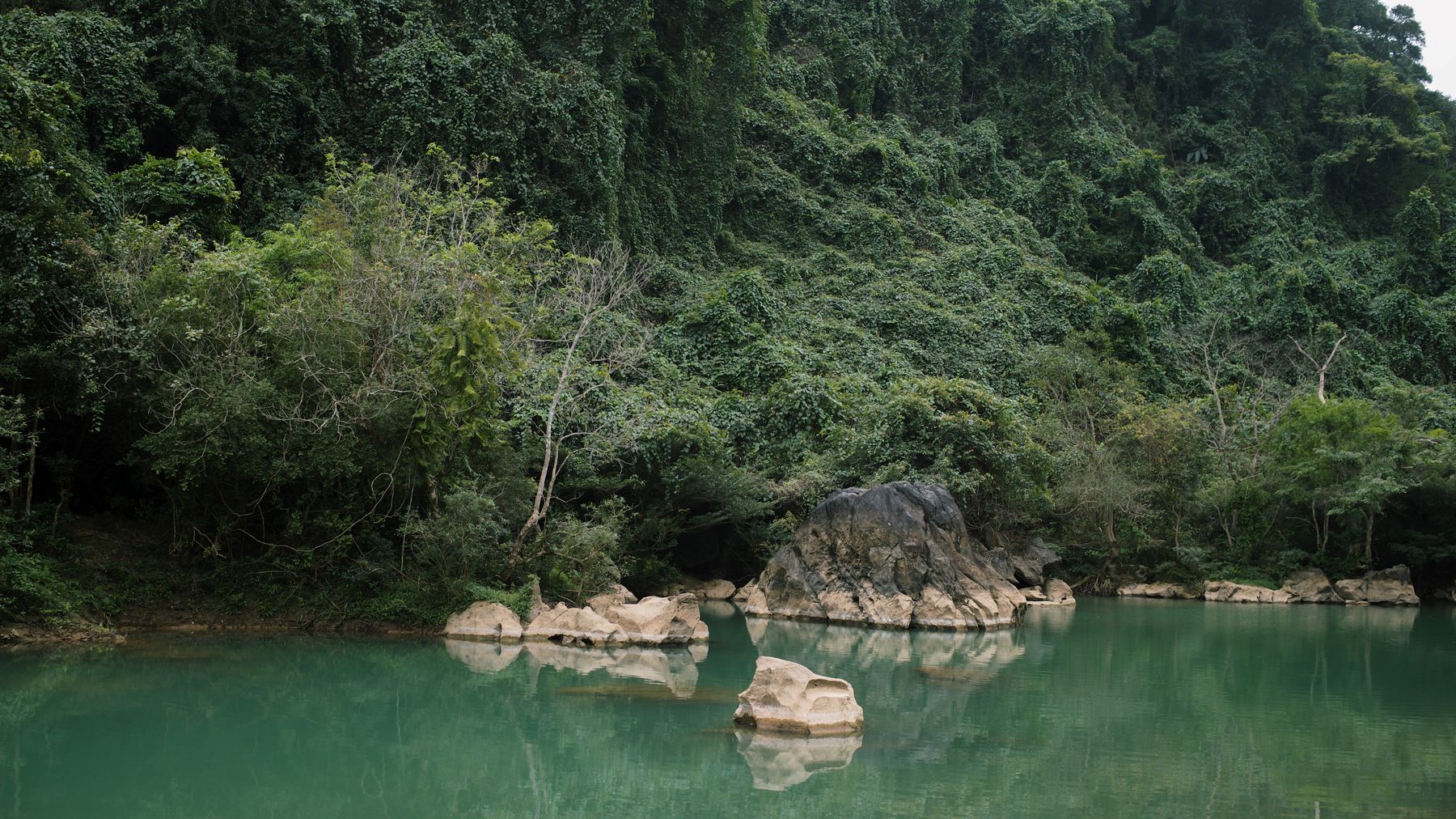
Photo by Lucas Tran on Pexels
What to do
Walk the rock formations at low tide
Check the tide schedule before you go (ask your hotel or search "thuy trieu Dong Hoi" online). Low tide exposes the full base of the formations and reveals tide pools with small crabs and sea snails. The southern end of the beach has the densest cluster of rocks and the best natural arches for photographs.
Swim in the calmer northern section
The northern stretch of Da Nhay has fewer rocks and a gentler slope into the water. It's the better spot for actual swimming. The sand is coarse compared to Mui Ne or Lang Co, but the water is clean and usually calm from April to July.
Watch sunrise from the boulders
Da Nhay faces northeast, which means the sun comes up directly over the water. If you're staying nearby, set an alarm for 5:00 AM — the light hitting the wet rock in the first twenty minutes after sunrise is the best the beach gets.
Combine with Phong Nha caves
Phong Nha-Ke Bang is only about 45 km west. Most people base themselves in Phong Nha village for the caves and treat Da Nhay as a half-day side trip. The reverse works too — stay on the coast and day-trip to Paradise Cave or the Dark Cave.
Rent a kayak
A few local vendors near the beach parking area rent basic sit-on-top kayaks for around 100,000 VND per hour. Paddling between the rock pillars at mid-tide is genuinely fun, though the kayaks are beat-up and don't come with much instruction.
Where to eat nearby
There are a couple of seafood shacks near the beach entrance that serve grilled squid, steamed clams, and fried fish with rice. Prices are reasonable — a full seafood spread for two runs about 200,000-350,000 VND. The quality varies, but the clams are usually good because they're local.
For something more substantial, head back toward Dong Hoi. The city has solid "bun cha" spots and decent "banh xeo" — the central Vietnamese version with smaller, crispier crepes than what you'll find in Saigon. The row of seafood restaurants along Nhat Le Beach in Dong Hoi is where locals eat when they want a proper meal.
Where to stay
Da Nhay Beach itself has limited accommodation — a couple of basic guesthouses and one or two mid-range resorts that come and go.
- Budget: Guesthouses near the beach or in Dong Hoi, 200,000-400,000 VND/night.
- Mid-range: Hotels in Dong Hoi with air conditioning, hot water, and breakfast, 500,000-900,000 VND/night.
- Comfort: Sun Spa Resort or similar properties along Nhat Le Beach in Dong Hoi, 1,200,000-2,500,000 VND/night.
Most travelers stay in Dong Hoi or Phong Nha village and visit Da Nhay as a day trip.

Photo by Serg Alesenko on Pexels
Practical tips locals would tell you
- Wear shoes you don't mind getting wet. The rocks are slippery with algae, and bare feet on limestone edges will cut you up. Old sandals with grip work fine.
- Bring your own water and sunscreen. The vendors at the beach are limited and overcharge for basics.
- Don't climb the tallest formations. Some of the mushroom-shaped rocks look climbable but the tops are eroded and crumbly. A fall onto wet limestone is a fast way to end your trip early.
- Trash situation is real. Like many Vietnamese beaches outside resort zones, litter accumulates, especially after weekends. It's worse in summer. Bring a bag if you want to help.
Common mistakes
- Showing up at high tide and leaving disappointed. The beach looks like a generic rocky shore at high tide. Time your visit around low tide — the difference is dramatic.
- Skipping it entirely for Phong Nha. The caves deserve priority, sure. But Da Nhay is 30 minutes from Dong Hoi and takes two to three hours to enjoy properly. It's not competing with the caves; it's complementing them.
- Expecting resort-level facilities. There are no lounge chairs, no cocktail bars, no lifeguards. This is a raw beach with rocks and sand and a couple of food stalls. Pack accordingly.
Practical notes
Da Nhay Beach is free to access — there's a small parking fee of 10,000-20,000 VND for motorbikes. Mobile signal (Viettel, Mobifone) is reliable. The nearest ATM is in Dong Hoi. If you're building a longer central Vietnam itinerary, Da Nhay slots in naturally between Phong Nha and the drive south to Hue.
Last updated · May 29, 2026 · independently researched, never sponsored.