Dai Noi — the Imperial Citadel of Hue — is the single site that defines the city. It's the reason most travelers stop here, and unlike a lot of Vietnam (베트남 / 越南 / ベトナム)'s historical attractions, it genuinely rewards a slow visit. This is your practical guide to getting the most out of it.
What it is
Dai Noi (literally "great interior") is the walled royal compound where the Nguyen Dynasty ruled Vietnam from 1802 to 1945. It sits on the north bank of the Perfume River, enclosed by thick stone walls and a wide moat. Inside is the Imperial City, and nested within that is the Forbidden Purple City — once reserved exclusively for the emperor and his household.
Much of the complex was damaged during the wars of the 20th century, particularly in 1968. Restoration has been ongoing for decades, and today you'll find a mix of carefully rebuilt palaces, original gateways, crumbling foundations, and open courtyards where entire buildings once stood. That contrast — polished restoration next to overgrown ruins — is part of what makes walking through it genuinely interesting rather than feeling like a theme park.
Why travelers go
Dai Noi is the most intact royal complex in Vietnam. It's a UNESCO World Heritage Site and the anchor of the broader Complex of Hue (후에 / 顺化 / フエ) Monuments, which includes the royal tombs scattered along the Perfume River (the Tomb of Tu Duc and the Tomb of Khai Dinh are the two most visited). If you have any interest in Vietnamese history, architecture, or just want to understand how Hue became the cultural city it is today, this is where you start.
It's also genuinely photogenic — not in a generic way, but in how the faded ochre walls and lotus-filled moats catch the light in early morning.
Best time to visit
Hue's weather is its own thing, separate from the rest of Vietnam. The driest and most comfortable months are February through April — warm but not brutal, with relatively low rainfall. May to August gets seriously hot (35°C+), which matters because Dai Noi involves a lot of walking in open courtyards with limited shade. September through December is Hue's rainy season, and when it rains here, it commits — weeks of grey drizzle punctuated by proper downpours.
If you visit in summer, go early. The gates open at 7:00 AM and the first two hours are the best: cooler air, fewer tour groups, better light.
How to get there
Hue has its own airport (Phu Bai, about 15 km south of the city center), with direct flights from Hanoi and Saigon. A Grab from the airport to the citadel area costs around 150,000–200,000 VND.
From Da Nang — the nearest major hub — you have several options:
- Train: about 2.5 hours, 60,000–120,000 VND depending on seat class. The route crosses the Hai Van Pass, and the views from the train are excellent. This is the best way to arrive.
- Bus: 2–3 hours, around 100,000–150,000 VND for a tourist bus.
- Grab/private car: 2 hours via the highway tunnel, roughly 800,000–1,000,000 VND.
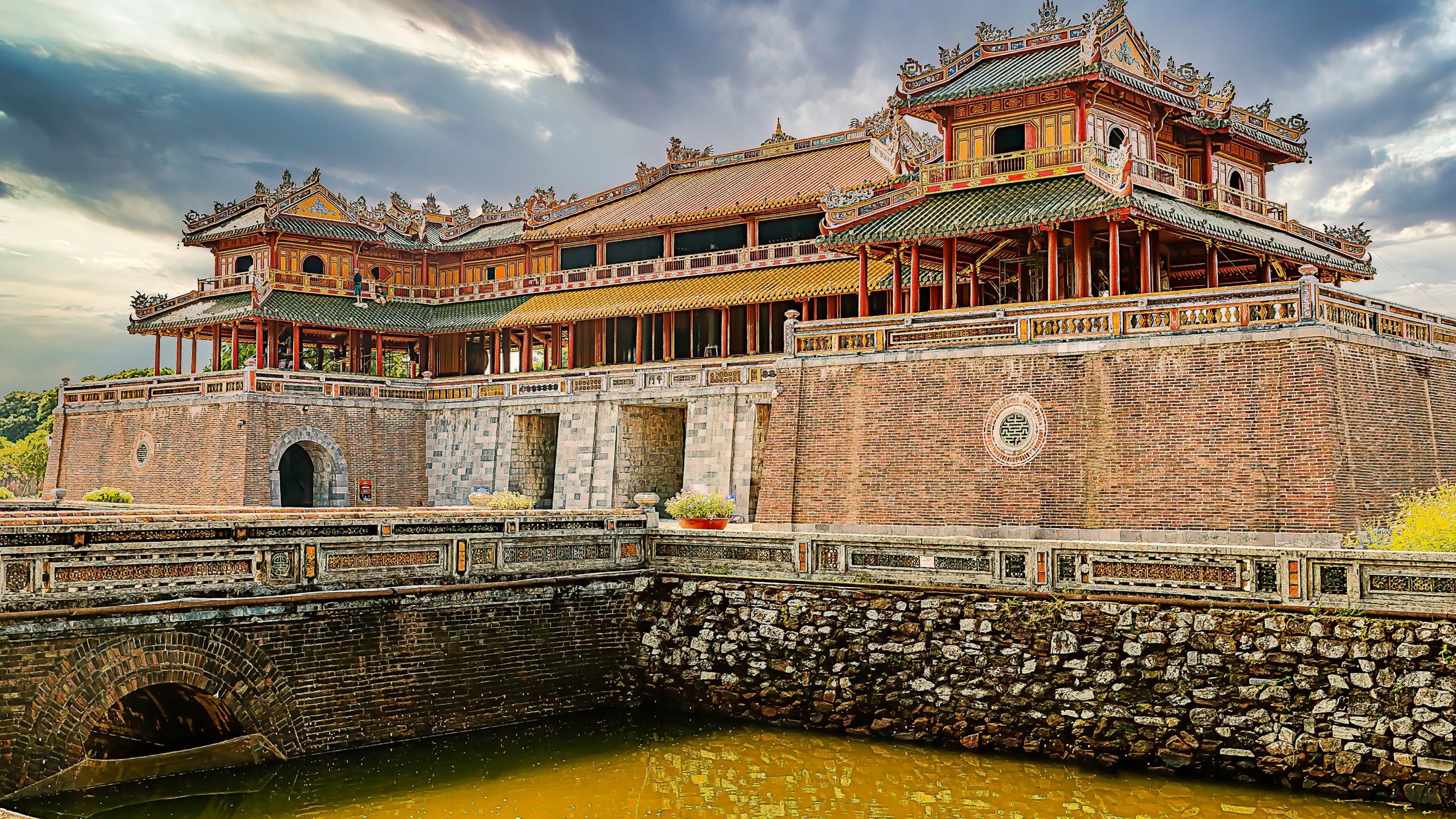
Once in Hue, Dai Noi is right in the center of town. Most hotels are within a 10-minute ride. The main entrance is at Ngo Mon Gate on the south side.

Photo by Quang Nguyen Vinh on Pexels
What to do inside
Walk through Ngo Mon Gate properly
Don't just pass through — go up. The upper pavilion of Ngo Mon Gate (the yellow-roofed structure on top) is open to visitors and gives you a straight-ahead view down the central axis of the citadel toward Thai Hoa Palace. This was where the emperor appeared for ceremonies. It takes five minutes and most people walk right past it.
Spend time in Thai Hoa Palace
The Throne Hall is the best-restored building in the complex. The lacquered columns, gilded ceiling, and tile work have been painstakingly repaired. Stand in the center and look up — the craftsmanship is dense and layered in a way that photographs don't capture well.
Explore the Forbidden Purple City ruins
Behind Thai Hoa Palace, you enter the Forbidden Purple City. Most of this area was destroyed, and what remains is a strange, quiet landscape of stone foundations, ornamental gardens, and a few reconstructed buildings. The Royal Theatre (Duyet Thi Duong) hosts occasional "ca tru" and royal court music performances — check the schedule at the ticket office. This part of the citadel is where you'll find the fewest crowds.
Visit the temples and gardens on the edges
The Hung Mieu and The Mieu temple complexes on the western side are often overlooked. The Nine Dynastic Urns (massive bronze cauldrons cast in the 1830s, each representing a Nguyen emperor) sit in front of The Mieu and are among the most impressive bronze castings in Southeast Asia.
Don't skip the eastern galleries
Several restored galleries on the eastern side now house photo exhibitions and historical displays about the restoration process. They're air-conditioned — a genuine benefit if you're visiting in the heat — and give useful context to what you're seeing outside.
Where to eat nearby
Hue is arguably Vietnam's best food city, and the area around Dai Noi doesn't disappoint.
"Bun bo Hue" — the spicy, lemongrass-heavy beef noodle soup that originated here — is the obvious pick. Quan Bun Bo Hue O Phuong on Chi Lang street (about 1 km south of the citadel) serves a proper bowl for 35,000 VND. It's a local lunch spot, not a tourist restaurant.
For "banh canh" — thick tapioca noodles in a rich crab or pork broth — try the vendors along Pham Hong Thai street near Dong Ba Market. A bowl runs 30,000–40,000 VND. Hue's version is thicker and more savory than what you'll find elsewhere in Vietnam.
If you want something quick before or after your citadel visit, the "banh mi" stalls outside Dong Ba Market (a 10-minute walk east of Ngo Mon Gate) are solid and cost 15,000–20,000 VND.
Where to stay
Most travelers stay south of the Perfume River, where the restaurant and cafe density is higher. Budget guesthouses run 200,000–400,000 VND/night. Mid-range hotels with river views go for 600,000–1,200,000 VND. For something with character, a few boutique places inside the citadel walls themselves have opened in recent years — expect 1,500,000–3,000,000 VND/night.
Staying on the north side (citadel side) of the river is quieter and puts you within walking distance of Dai Noi, which is nice for early-morning visits.

Photo by Tuấn Vũ on Pexels
Practical tips locals would tell you
- Tickets cost 200,000 VND (as of 2024). A combo ticket covering the citadel plus the Tomb of Tu Duc and Tomb of Khai Dinh costs 530,000 VND and is worth it if you're doing all three.
- Budget 2–3 hours minimum. The complex is large — rushing through in 45 minutes (as many tour groups do) means you'll miss the best parts.
- Bring water and sun protection. There are a few drink vendors inside, but not many. The courtyards are exposed.
- Hire a local guide at the gate if you want context. Freelance guides hang around Ngo Mon and charge 200,000–300,000 VND for a tour. Quality varies, but even a mediocre guide adds more than an audio guide.
- Rent a bicycle for the day (30,000–50,000 VND from most hotels). The citadel area, the Perfume River banks, and the surrounding streets are flat and easy to ride.
Common mistakes to avoid
- Visiting midday in summer. The heat between 11 AM and 2 PM is punishing and there's almost no shade inside the main courtyards.
- Only seeing the central axis. Most visitors walk straight from Ngo Mon to Thai Hoa Palace and turn around. The side temples, gardens, and eastern galleries are where you escape the crowds.
- Combining Dai Noi with too many tombs in one day. You'll be exhausted and won't enjoy any of them. Do the citadel in the morning, rest through the hottest hours, and visit one tomb in the late afternoon.
Practical notes
Dai Noi is open daily from 7:00 AM to 5:30 PM (last entry around 5:00 PM). It's closed or has reduced hours during some Tet / 越南春节 / テト) holiday periods — check locally if you're visiting in January or February. Hue is a compact city and the citadel is the natural starting point for exploring it — once you've oriented yourself here, the tombs, pagodas, and food streets all fall into place around it.
Last updated · May 29, 2026 · independently researched, never sponsored.