Dong Xuan Market is Hanoi's oldest and largest indoor market, and it operates less like a tourist attraction and more like the commercial engine of the Old Quarter. If you want to understand how Hanoi actually trades — wholesale fabric, dried goods by the kilo, knockoff electronics stacked to the ceiling — this is where you go.
What it is and how it got here
Dong Xuan Market sits at the northern end of Hanoi (하노이 / 河内 / ハノイ)'s Old Quarter, taking up most of a city block between Dong Xuan Street and the southern bank of the Red River area. The original market dates back to 1889 under French colonial administration. A massive fire gutted the building in 1994, and the current Soviet-style concrete structure went up shortly after — three floors, no air conditioning, and a layout that rewards patience over planning.
Despite the rebuild, the market kept its role as Hanoi's main wholesale hub. The ground floor moves fresh produce, meat, and dried goods. The upper floors deal in textiles, clothing, shoes, toys, and household items. It's loud, it's dense, and vendors aren't here to curate an experience for you — they're here to move product.
Why travelers go
Dong Xuan Market isn't a sanitized night market or a craft fair. That's the appeal. You're walking through an active wholesale operation where Hanoi's small retailers come to stock their own shops. For travelers, the draw is threefold: it's one of the best places to see daily commercial life in the Old Quarter, the surrounding streets have some of Hanoi's best street food, and if you're after fabric, souvenirs, or "non la" (conical hats), prices here undercut the tourist shops by a wide margin — if you negotiate.
Best time to visit
The market opens daily from roughly 6:00 AM to 6:00 PM. Early morning — between 6:00 and 8:00 AM — is when the ground floor food section is most active, with vendors unloading produce and meat buyers crowding the aisles. If you're there for textiles or souvenirs, mid-morning (9:00–11:00 AM) is less frantic.
Avoid weekends if you dislike crowds. The market gets noticeably more packed on Saturdays, and on Friday, Saturday, and Sunday nights the surrounding streets transform into the Dong Xuan Night Market (roughly 6:00 PM to 11:00 PM), which is a separate operation — more tourist-oriented, with stalls selling T-shirts, snacks, and trinkets along Hang Dao and Hang Ngang streets.
Season-wise, October through December is comfortable weather for wandering an un-air-conditioned building. June through August means you'll be sweating through a concrete box with minimal ventilation. Plan accordingly.
How to get there
From Hoan Kiem Lake — the default center of tourist Hanoi — Dong Xuan Market is about 1 km north, a 12–15 minute walk straight up Hang Dao Street. This is the best option because the Old Quarter streets are narrow and traffic-choked.
If you're coming from further out, a Grab bike from most points in central Hanoi runs 15,000–30,000 VND. A Grab car will cost 25,000–50,000 VND but might take longer due to the tight streets. The nearest bus stops serve routes 14, 18, and 34, with fares at 7,000 VND per ride.
From Noi Bai Airport, it's about 25 km. A Grab car runs 250,000–350,000 VND depending on traffic, or you can take the 86 Express Bus to Hanoi Old Quarter for 45,000 VND and walk from there.

Photo by Quang Nguyen Vinh on Pexels
What to do
Walk the ground floor food section
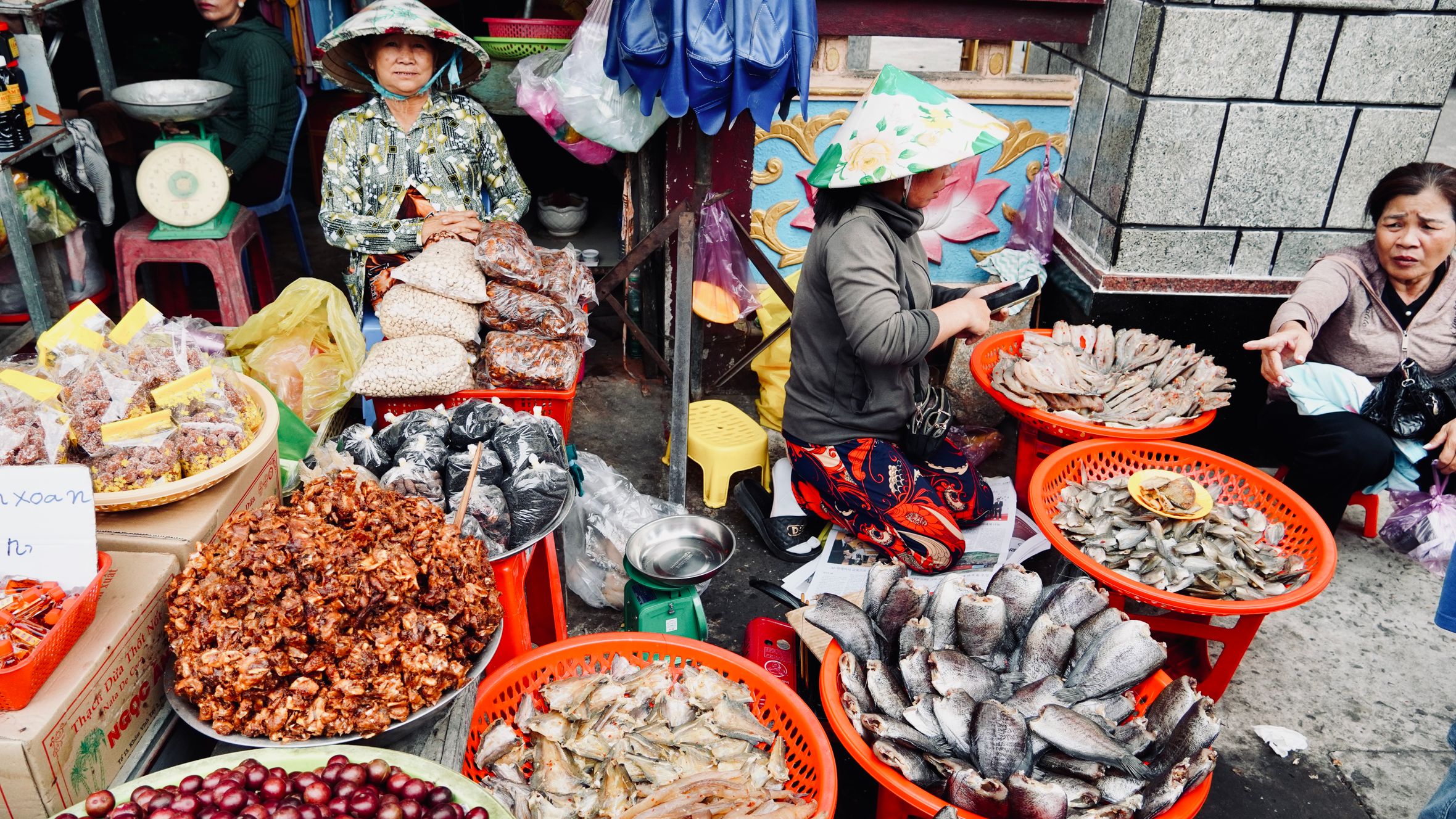
The fresh market on the ground floor is where things feel most alive. Whole pigs, tanks of live fish, mountains of herbs and greens. Even if you're not buying, it's a visceral look at how Hanoi feeds itself. The dried goods section is worth browsing too — dried shrimp, mushrooms, lotus seeds, and Vietnamese spices make surprisingly good lightweight souvenirs.
Buy fabric and tailoring supplies on the upper floors
The second and third floors are stacked with bolts of silk, cotton, and synthetic fabric. If you're heading to Hoi An later for custom tailoring, buying fabric here can save you 30–40% compared to Hoi An market prices. Expect to negotiate — opening prices for tourists are inflated.
Browse the night market on weekends
The Friday–Sunday night market stretches south from the market building along Hang Dao. It's more relaxed than the daytime wholesale chaos. Street food stalls set up along the edges — grilled meats, "che" (sweet dessert soups), and fresh sugarcane juice. Quality varies, but the people-watching is consistent.
Pick up Hanoi souvenirs at wholesale prices
Propaganda posters, lacquerware, "ao dai" fabric, coffee gift sets, and bags of dried fruit — all cheaper here than in the boutique shops around Hoan Kiem. A printed T-shirt that costs 200,000 VND on Ta Hien Street goes for 60,000–80,000 VND here if you buy two or three.
Explore the surrounding Old Quarter streets
Dong Xuan Market anchors a web of specialist streets — Hang Ma (paper goods and decorations, especially wild during Tet (뗏 (베트남 설날) / 越南春节 / テト) and Mid-Autumn Festival), Hang Buom (snacks and sweets), Lan Ong (traditional medicine). Each block has its own trade identity, a holdover from Hanoi's guild-street system.
Where to eat nearby
You're in the Old Quarter, so food is everywhere. Two worth seeking out:
"Pho" on Hang Dong Street — A cluster of small pho shops operate within two blocks south of the market. A bowl runs 40,000–55,000 VND. Nothing fancy, just properly made beef broth and fresh noodles.
"Banh cuon" on Hang Ga Street — Steamed rice rolls filled with minced pork and wood ear mushroom, served with fried shallots and "cha" (pork sausage). A full plate costs around 35,000–45,000 VND. Look for the shops with the steaming racks visible from the street.
If you want egg coffee afterward, several cafes on Hang Bac and Hang Gai streets are a short walk south.
Where to stay
The Old Quarter has hundreds of guesthouses and hotels within walking distance of Dong Xuan Market.
- Budget: Hostels and basic guesthouses on Hang Bac or Hang Bo streets run 150,000–350,000 VND per night for a dorm bed or simple private room.
- Mid-range: Three-star hotels around Hang Dao and Hang Ngang go for 600,000–1,200,000 VND per night, often with breakfast included.
- Higher-end: Boutique hotels closer to Hoan Kiem Lake start around 1,500,000–3,000,000 VND per night.

Photo by HONG SON on Pexels
Practical tips locals would tell you
- Negotiate everything on the upper floors. Fixed prices don't really exist for clothing and fabric. Start at 50–60% of the asking price and work from there.
- Keep your bag in front of you. The market is crowded and pickpocketing happens, especially on the ground floor during peak morning hours.
- Bring cash. Almost no vendors accept cards. ATMs are nearby on Dong Xuan and Hang Chieu streets.
- Don't eat the pre-cut fruit inside the market. Hygiene is inconsistent. Eat at the established street food stalls outside instead.
Common mistakes to avoid
- Treating it like a tourist market. This is a wholesale operation. Vendors aren't trying to charm you — don't take brusqueness personally.
- Going at noon in summer. The building traps heat. Mornings or late afternoon are far more tolerable.
- Buying electronics here. The phones, headphones, and chargers on the upper floors are almost universally low-quality knockoffs. Fine if you need a temporary charging cable for 20,000 VND, but don't expect it to last.
- Confusing the night market with the main market. They're different operations. If someone told you to visit Dong Xuan Market and you only showed up on a Friday night, you saw the tourist night market, not the real thing.
Practical notes
Dong Xuan Market is free to enter and open every day. Budget 1–2 hours for a proper walk-through, more if you're shopping fabric. Combine it with a morning walk through the Old Quarter streets — start at the Temple of Literature or Long Bien Bridge, loop north to the market, eat "pho" nearby, and you've had a solid Hanoi morning without a tour guide.
Last updated · May 29, 2026 · independently researched, never sponsored.