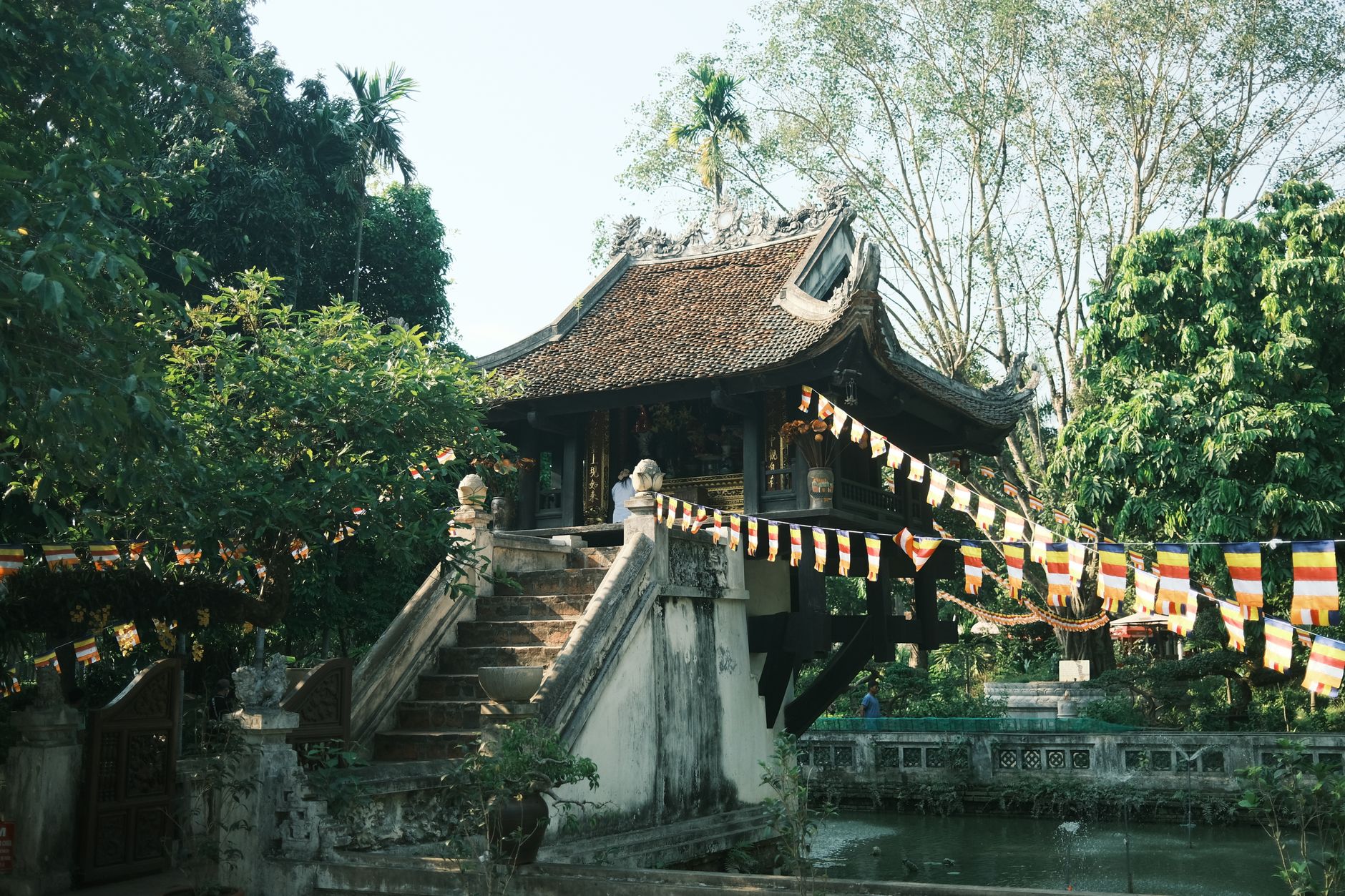
Duong Lam sits about 45 km west of central Hanoi, a laterite village where houses are built from the same rust-colored stone that lines its narrow alleys. It earned national heritage status in 2006 — the first village in Vietnam (베트남 / 越南 / ベトナム) to get that recognition — and it still functions as a living community, not a museum. People farm, press rice, and dry persimmons on the same flagstone courtyards their families have used for generations.
What makes Duong Lam worth the trip
This is not a reconstructed tourist village. Around 300 houses here date back a century or more, some pushing past 400 years old. The layout follows traditional feng shui principles — communal wells, banyan trees, village gates — and you can trace the evolution of northern Vietnamese rural architecture just by walking from one lane to the next.
Two Vietnamese national heroes were born here: Phung Hung and Ngo Quyen, both celebrated for resisting Chinese rule over a thousand years ago. Their temples still stand in the village and locals maintain active worship at both sites. For anyone interested in the deep layers of Vietnamese culture beyond what you see in Hanoi (하노이 / 河内 / ハノイ)'s Old Quarter, Duong Lam delivers something more grounded.
Best time to visit
November through February is ideal. The air is cooler and drier, the light is soft, and persimmon season (peaking around November and December) turns the village photogenic in a way that feels earned rather than staged — orange fruit drying on rooftops, golden rice spread across courtyards.
Avoid summer weekends (June through August) if you can. Hanoi day-trippers flood the village, and the heat plus humidity makes wandering laterite alleys less pleasant. Weekday mornings year-round are your best bet for a quieter experience.
How to get there from Hanoi
By motorbike or scooter: The most flexible option. Head west on the Thang Long Highway toward Son Tay town, then follow signs to Duong Lam. About 45 km, roughly 1.5 hours depending on traffic. The road is straightforward and mostly flat.
By bus: Catch bus 71 from My Dinh bus station toward Son Tay (around 15,000 VND, about 1.5 hours). From Son Tay bus station, grab a "xe om" (motorbike taxi) for the last 5 km to the village gate — expect to pay 30,000-50,000 VND.
By car or private driver: A return trip with a Hanoi-based driver typically runs 800,000-1,200,000 VND for the day, including waiting time. Worth it if you want to combine with a stop at Tay Phuong Pagoda or Thay Pagoda on the way back.
Entrance to the village costs 20,000 VND per person. A local guide (arranged at the ticket office) costs around 100,000-150,000 VND for a walking tour of the main sights — genuinely useful, since the alleys are unmarked and easy to get turned around in.

Photo by Quang Nguyen Vinh on Pexels
What to do
Walk the laterite lanes of Mong Phu
Mong Phu is the core hamlet and where most of the oldest houses cluster. The Mong Phu communal house ("dinh lang") is the centerpiece — an 18th-century wooden structure with carved dragons and a courtyard shaded by a massive banyan. Walk slowly. The texture of these walls, built from blocks of local laterite stone, changes color depending on the light.
Visit the ancient houses
Several families open their homes to visitors. The most well-known is the Giang family house, roughly 400 years old, with original wooden beams and a layout that hasn't changed since the Le Dynasty. The families living inside will usually offer you tea and explain the house's history — tip 20,000-50,000 VND, it's appreciated.
Temples of Phung Hung and Ngo Quyen
Both temples are modest but atmospheric. Ngo Quyen's temple sits on a small hill with views over the surrounding rice paddies. Neither takes more than 15 minutes, but they give context to why this village matters beyond its architecture.
Explore the surrounding rice fields
Rent a bicycle (50,000 VND from guesthouses near the entrance) and ride out past the village edge into the paddies. The flat terrain makes this easy even if you're not a cyclist. In harvest season (May-June and September-October), the fields turn a deep gold.
Try local craft workshops
Some households still produce "tuong" (fermented soybean paste) and "che lam" (a chewy ginger-peanut candy). You can watch the process and buy directly — che lam makes a solid, lightweight souvenir.
Where to eat
Duong Lam doesn't have a restaurant scene, but several family-run kitchens serve lunch to visitors. Ask at the ticket office or your guide will know.
The dish to order is "ga Mia" — a local chicken breed from nearby Mia village, smaller and leaner than standard chicken, usually steamed or boiled and served with rice and tuong dipping sauce. A full meal runs 80,000-120,000 VND per person.
Also worth trying: "banh te," a pyramid-shaped rice cake stuffed with pork and wrapped in banana leaf. Vendors near the communal house sell them for 5,000-10,000 VND each. Pair everything with local "che lam" for dessert.
If you head back through Son Tay town, there are decent "pho" and "bun cha" spots along the main road — nothing destination-worthy, but solid and cheap.
Where to stay
Most visitors do Duong Lam as a day trip from Hanoi, and honestly that's the practical move. But if you want to experience the village at dawn before the crowds arrive, a few homestays operate inside the village.
Expect basic rooms — clean beds, fans or simple AC, shared bathrooms in some cases. Prices range from 200,000-400,000 VND per night. The Thu Hien and Hung Cuong homestays are both inside the old village and can arrange dinner. Book by phone — these aren't reliably listed on booking apps.
For more comfort, Son Tay town (5 km away) has a handful of hotels in the 400,000-800,000 VND range.

Photo by Quang Nguyen Vinh on Pexels
Practical tips locals would tell you
- Wear shoes you don't mind getting dusty. The laterite paths are unpaved and can be muddy after rain.
- Bring cash. There are no ATMs inside the village and nobody takes cards.
- Start early. Arrive by 8:00-8:30 AM to get an hour or two before tour groups show up around 10:00.
- Be respectful in homes. These are actual residences, not exhibits. Ask before photographing altars or bedrooms.
- Combine it. Duong Lam pairs naturally with Tay Phuong Pagoda (20 minutes east) for a full day trip from Hanoi.
Common mistakes to avoid
Don't try to rush Duong Lam in an hour. The village rewards slow walking — ducking into side lanes, sitting with tea, watching daily life happen. Two to three hours is the minimum to do it justice.
Don't skip the guide at the entrance. Self-navigating sounds appealing but the village has no signage in English and the most interesting houses aren't obvious from the outside.
Don't visit only on weekends. Saturday and Sunday, especially in autumn, bring school groups and photography clubs by the busload. A Tuesday morning is a different experience entirely.
Practical notes
Duong Lam is one of the more honest half-day trips you can make from Hanoi — no theme park veneer, no entrance-fee inflation, just a village that happens to be very old and still inhabited. Budget a full morning, bring patience and cash, and you'll come back with a sense of rural northern Vietnam that the capital can't give you.
Last updated · Jun 27, 2026 · independently researched, never sponsored.