Chua Quan Su — the Ambassadors' Pagoda — is the headquarters of Vietnamese Buddhism and one of the most active pagodas in Hanoi. It sits on a busy downtown street, not tucked away on a hillside, which makes it both easy to reach and easy to underestimate.
What it is and how it got here
The pagoda dates to the 15th century, during the Le dynasty, when the court built a guesthouse on this site to host Buddhist envoys from neighboring kingdoms. The name "Quan Su" literally means "ambassadors," a reference to that diplomatic function. Over the centuries, the compound was rebuilt multiple times — the current structure is largely from the 1940s, with further restorations since.
Today it serves as the headquarters of the Vietnam (베트남 / 越南 / ベトナム) Buddhist Sangha, the country's official Buddhist organization. That makes it less of a museum piece and more of a working religious center. On any given morning, you'll find monks chanting, locals lighting incense, and elderly women arranging lotus flowers on altars. It's not a ruin you walk through with an audio guide — it's a place people actually use.
Why travelers go
Chua Quan Su gives you a window into everyday Buddhist practice in northern Vietnam without requiring a day trip. It's located at 73 Quan Su Street, about a 10-minute walk south of Hoan Kiem Lake and the Old Quarter, so it fits naturally into a walking day around central Hanoi (하노이 / 河内 / ハノイ).
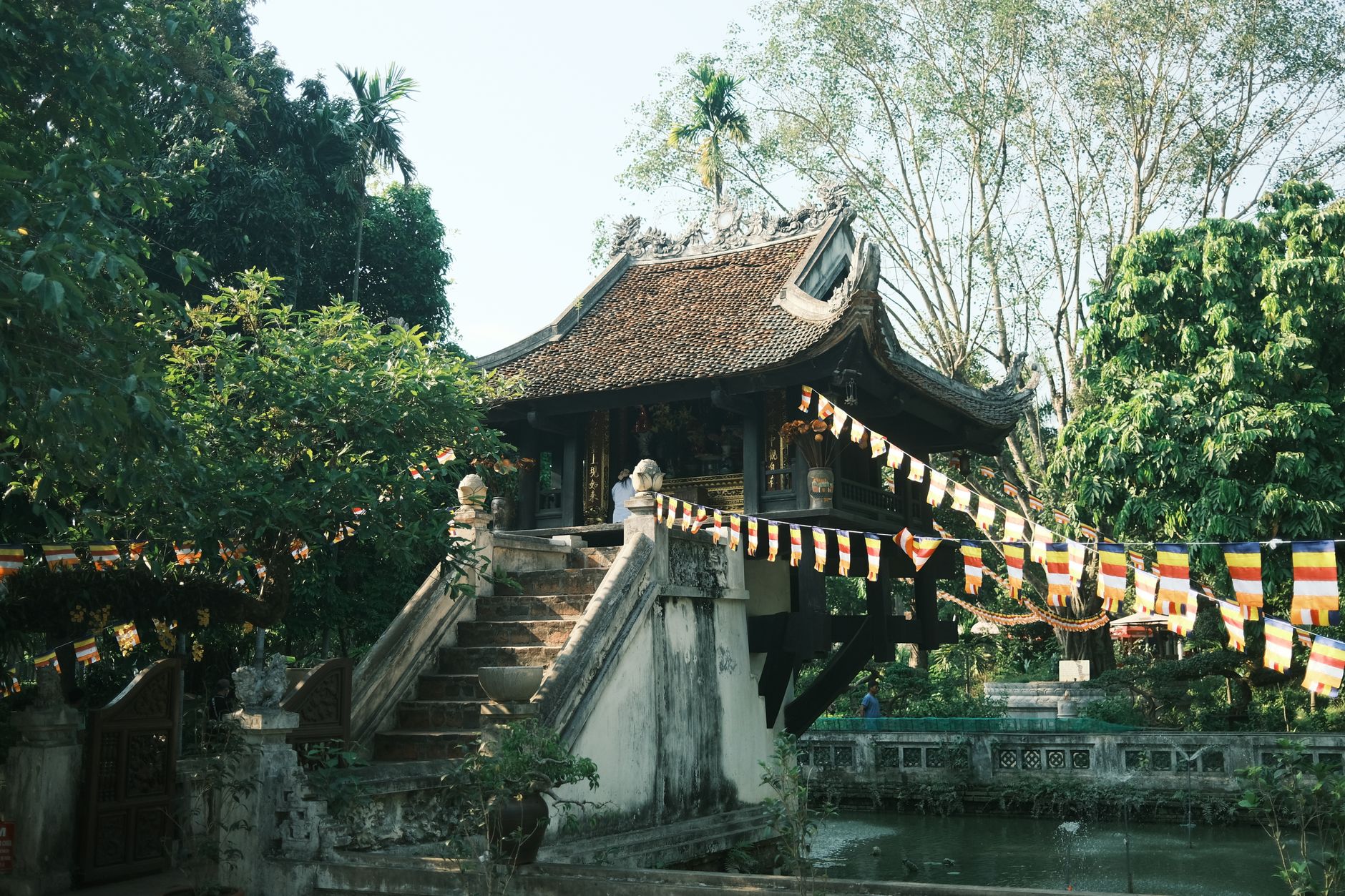
The pagoda also happens to be one of the best places in the city to see traditional Vietnamese Buddhist architecture up close — carved wooden panels, heavy incense-filled halls, and a courtyard that somehow muffles the motorbike noise from the street outside. It's a genuine contrast to the frenetic pace of Hanoi's sidewalks.
Best time to visit
The pagoda is open daily, roughly from 7:30 AM to 11:30 AM and again from 1:30 PM to 5:00 PM. Morning visits are best — the light is better, the monks are often mid-ceremony, and the incense smoke drifts through the main hall in a way that feels cinematic without trying.
If you want to see the pagoda at its most intense, visit on the 1st or 15th of the lunar month. These are the days when Vietnamese Buddhists come to pray in large numbers. The courtyard fills with people, vendors sell flowers and incense outside the gates, and the energy shifts from contemplative to communal. Tet / 越南春节 / テト) is another peak period — the first days of the lunar new year bring enormous crowds.
Weather-wise, October through December offers cooler, drier conditions in Hanoi. The summer months (June through August) are hot and humid, and the pagoda's halls don't have air conditioning.
How to get there
From the Old Quarter or Hoan Kiem Lake, Chua Quan Su is about 1.5 km south — a straightforward 15-minute walk down Ly Thuong Kiet or Ba Trieu streets.
By taxi or Grab, the ride from most central Hanoi hotels costs 15,000–30,000 VND. From Noi Bai Airport, expect 250,000–350,000 VND by Grab car, or take the 86 airport bus to the Opera House stop (35,000 VND) and walk 10 minutes south.
The pagoda is also a short walk from the Hanoi Railway Station — useful if you're arriving by train from Hue or Sapa.

Photo by Hồng Quang Official on Pexels
What to do
Walk the main hall slowly
The central worship hall holds a large Shakyamuni Buddha statue flanked by bodhisattvas. The woodwork on the altar and ceiling panels is detailed and old. Don't rush through — stand to one side and watch how worshippers interact with the space. You'll notice a specific rhythm: incense first, then kneeling, then placing offerings.
Watch a ceremony
If you arrive between 8:00 and 9:30 AM, there's a good chance monks will be chanting. The sound reverberates off the tiled floors and wooden walls. You can stand quietly at the back or sit on one of the low benches along the sides. Nobody will bother you as long as you're respectful.
Explore the courtyard and side buildings
The compound is larger than it looks from the street. Behind the main hall, there are smaller shrines, a garden area, and administrative buildings for the Buddhist Sangha. The courtyard often has bonsai trees and potted plants arranged by the monks.
Browse the Buddhist shops outside
Quan Su Street, directly in front of the pagoda, is lined with shops selling Buddhist supplies — incense, prayer beads, small statues, and religious texts. Even if you're not buying, the concentration of these shops gives the street a distinct atmosphere you won't find elsewhere in central Hanoi.
Visit the vegetarian food stalls
On the 1st and 15th of the lunar month, street vendors set up outside the pagoda selling vegetarian dishes — rice with mock meat, noodle soups, and sticky rice wrapped in banana leaves. It's cheap (20,000–40,000 VND per dish) and genuinely good.
Where to eat nearby
The area around Quan Su Street isn't a major food destination on its own, but you're close to some solid options. Walk 10 minutes north toward the Old Quarter and you're in prime territory for "bun cha" — grilled pork patties with rice noodles and herbs. Bun Cha Dac Kim on Hang Manh Street is a reliable local favorite.
For something quicker, grab a "banh mi" from one of the carts near Hoan Kiem Lake. And if you haven't tried "egg coffee" yet, Giang Cafe on Nguyen Huu Huan Street is a 15-minute walk north — it's where this Hanoi specialty was invented.
Where to stay
The pagoda is in Hoan Kiem District, which is where most travelers base themselves anyway. Budget guesthouses in the Old Quarter run 200,000–500,000 VND per night. Mid-range hotels around the lake area cost 800,000–1,500,000 VND. If you want something upscale, the French Quarter south of the lake has international-brand hotels starting around 2,500,000 VND.

Photo by Hưng Phạm on Pexels
Practical tips locals would tell you
- Dress modestly. Cover your shoulders and knees. This is actively enforced — volunteers at the door may hand you a wrap if your clothes are too revealing.
- Remove your shoes before entering any worship hall. There's usually a rack or a mat near the entrance.
- Don't point your feet at Buddha statues or altars. If you sit down, tuck your legs to the side.
- Photography is allowed in the courtyard and exterior, but ask before shooting inside the main hall during ceremonies. Some monks are fine with it; others prefer you don't.
- Incense is available for free or for a small donation at the entrance. Light it outside at the large burner, not inside the halls.
Common mistakes to avoid
- Showing up at noon. The pagoda closes for lunch. Arrive before 11:00 AM or after 1:30 PM.
- Treating it like a tourist attraction. This is an active place of worship. Keep your voice low, don't block worshippers, and don't pose for selfies in front of people praying.
- Skipping it because it's not old enough. Yes, the current building is 20th century. But the site's history goes back 600 years, and the religious activity happening here is real and ongoing — which is more than you can say for plenty of "ancient" temples that are really just reconstructions with a gift shop.
- Not combining it with a walk. Chua Quan Su is best experienced as part of a longer route through central Hanoi. Walk from the Temple of Literature south to the pagoda, then north to Dong Xuan Market — you'll cover three very different sides of the city in one morning.
Practical notes
Chua Quan Su is free to enter. Budget about 30–45 minutes for a visit, longer if you catch a ceremony. It pairs well with a morning spent exploring Hanoi's Old Quarter or an afternoon walk around Hoan Kiem Lake.
Last updated · May 29, 2026 · independently researched, never sponsored.