Hanoi's Opera House — "Nha Hat Lon" to locals — sits at the eastern end of Trang Tien street like a slightly smaller, slightly yellower cousin of the Palais Garnier. It's one of the few French-colonial buildings in the city that still does exactly what it was built to do: host performances.
What it is and how it got here
The French broke ground on the Opera House in 1901 and finished it in 1911, during a period when Hanoi (하노이 / 河内 / ハノイ) was being reshaped into the administrative capital of French Indochina. The architects — Harlay and Broyer — modeled it after late-19th-century Parisian theaters, with a neoclassical facade, grey slate roof tiles shipped from France, and a 600-seat auditorium lined with mirrors and wrought-iron balconies.
The building has been restored several times, most recently in the late 1990s with French funding. Today it hosts a rotating schedule of Vietnamese and international performances — traditional music, ballet, orchestral concerts, and the occasional modern dance production. It's also the permanent home of the Hanoi Philharmonic Orchestra.
Why travelers go
Honestly, about half the visitors never go inside. The exterior alone — a grand staircase, Ionic columns, green-shuttered windows — makes it one of the most photographed buildings in Hanoi. It anchors a triangle of French-colonial architecture that includes the Sofitel Legend Metropole and the old Banque de l'Indochine building, so it fits naturally into a walk through the French Quarter.
But the real reason to come is to catch a performance. Sitting inside a century-old European theater in the middle of Southeast Asia, watching Vietnamese artists perform "ca tru" or classical piano, is a genuinely strange and memorable experience. The acoustics are better than you'd expect.
Best time to visit
The performance season runs roughly from September through June, with the heaviest programming between October and April. This also happens to overlap with Hanoi's cooler months, which is a bonus — standing outside in August heat waiting for doors to open is not fun.
If you're visiting during Tet, the Opera House sometimes hosts special performances in the days leading up to the holiday, though the building itself closes for the main festival days. The square in front gets decorated and is worth a walk even if nothing is scheduled.
For exterior photos, early morning (before 8 AM) gives you the best light on the facade and the fewest motorbikes parked out front.
How to get there
The Opera House sits at 1 Trang Tien, Hoan Kiem District — about 800 meters southeast of Hoan Kiem Lake. If you're staying in the Old Quarter, it's a 10-15 minute walk.
From Noi Bai Airport, a Grab car runs 250,000-350,000 VND and takes 40-60 minutes depending on traffic. The 86 express bus (35,000 VND) drops you at the Hanoi train station; from there it's a 2 km walk or a short Grab ride (15,000-20,000 VND).
There's no dedicated parking, but motorbike parking attendants set up along the side streets. Expect to pay 5,000-10,000 VND.
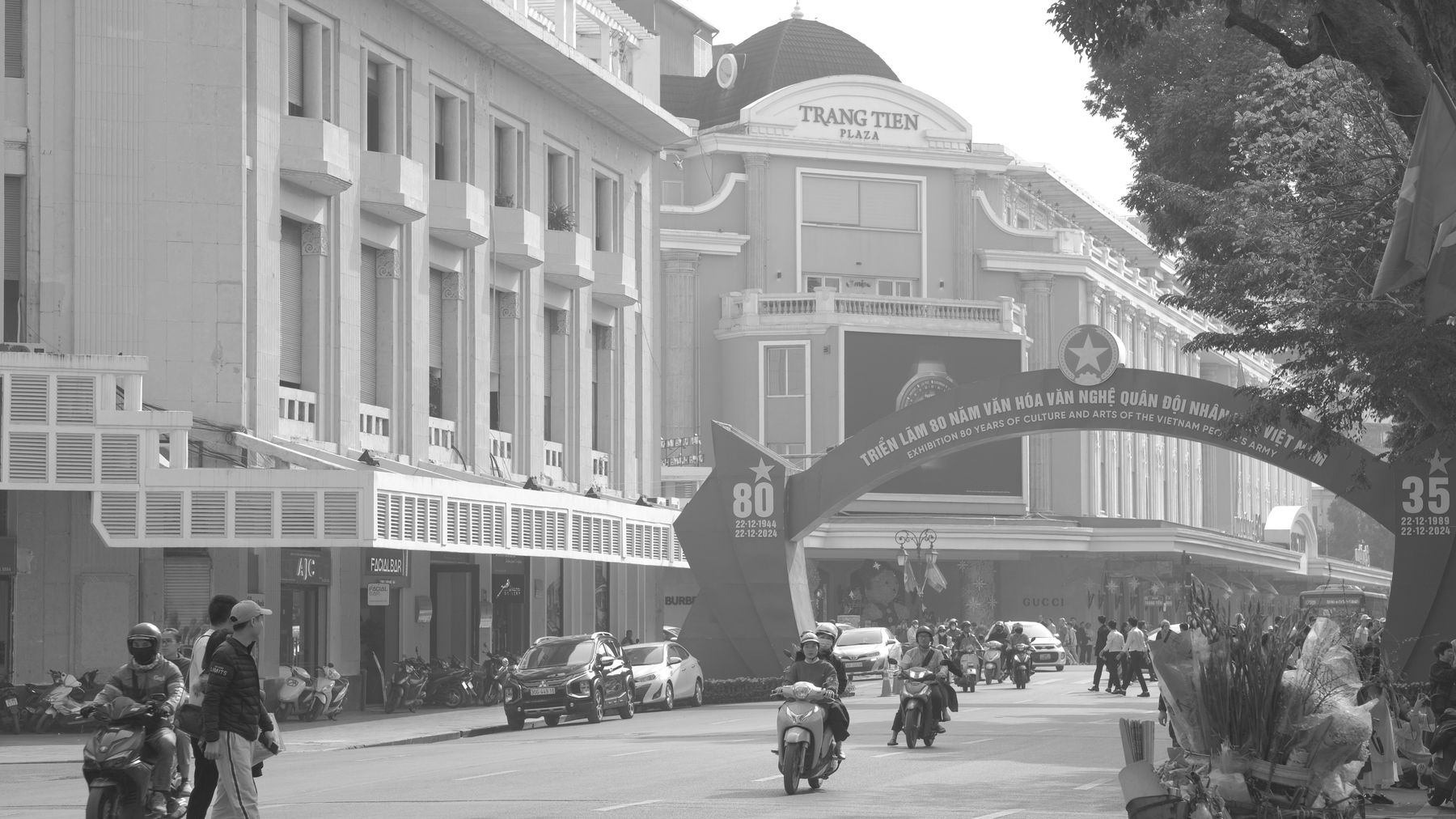
Photo by Toàn Văn on Pexels
What to do
Catch a show
This is the obvious one, and you should actually do it. Check the schedule on the Opera House's official website or the Ticketbox app. Ticket prices range from 300,000 VND for basic seats to 1,500,000 VND for front-center orchestra. The "Lang Toi" (My Village) bamboo circus show runs regularly and is designed for international audiences — it's genuinely well-produced, not a tourist trap.
Walk the French Quarter triangle
Start at the Opera House, walk northwest along Trang Tien to Hoan Kiem Lake, then loop back down Ngo Quyen past the Metropole Hotel. The whole route is about 2 km and passes bookshops, colonial-era government buildings, and some of Hanoi's oldest hotels. You'll pass near the Temple of Literature if you extend the walk westward.
Photograph the facade at night
The building is lit up after dark, usually from 7 PM onward. The square empties out a bit and the yellow lighting against the columns photographs well. Bring a wide-angle lens if you have one — the street is narrow and you'll struggle to get the full building in frame otherwise.
Visit the nearby Revolution Museum
Two blocks north at 25 Tong Dan, this small museum covers Vietnamese history through artifacts, photos, and propaganda posters. Entry is 40,000 VND. It's worth 45 minutes if you're interested in context for the architecture around you.
Sit and watch the square
The steps of the Opera House are an informal gathering point, especially on weekend evenings. Young couples, street performers, kids on scooters — it's one of those rare spots in Hanoi where people actually sit still for a while. Grab an iced tea from a street vendor and join them.
Where to eat nearby
Trang Tien street has a cluster of solid food options. "Kem Trang Tien" — the ice cream shop at 35 Trang Tien — has been selling coconut and green bean ice cream bars since the 1950s. They cost 7,000-15,000 VND and locals line up for them year-round.
For a proper meal, walk five minutes north to 67 Hang Buom for a bowl of "pho" at Pho Thin, or head to Ly Quoc Su street for "banh cuon" — steamed rice rolls filled with minced pork and wood ear mushroom. A plate runs 35,000-50,000 VND. If you want "egg coffee", Cafe Giang on Nguyen Huu Huan is a 10-minute walk and worth the detour.
Where to stay
The French Quarter around the Opera House has the widest range of accommodation in Hanoi.
- Budget: Hostels and guesthouses in the Old Quarter start at 150,000-250,000 VND per night, a 10-minute walk north.
- Mid-range: Hotels on Ly Thuong Kiet or Hai Ba Trung streets run 800,000-1,500,000 VND. Clean, air-conditioned, usually with breakfast.
- Splurge: The Sofitel Legend Metropole is literally next door. Rooms start around 6,000,000 VND, but you're sleeping in a building with as much history as the Opera House itself.

Photo by HONG SON on Pexels
Practical tips locals would tell you
- Dress code exists for evening performances. You don't need a suit, but shorts and flip-flops will get you turned away at the door. Smart casual is fine.
- The box office closes early. Buy tickets online if you can — walkup availability is unpredictable, especially for weekend shows.
- The interior is not open for casual tours outside of scheduled performances or special events. Don't show up at 2 PM expecting to walk in.
- The square floods during heavy rain in July and August. The drainage around Trang Tien is poor. Wear shoes you don't mind getting wet.
Common mistakes to avoid
- Assuming it's just a photo stop. People snap the exterior and leave. The performances are the actual point of the building.
- Showing up without checking the schedule. There's no daily programming. Some weeks have four shows; some have none.
- Taking a taxi from the Old Quarter. It's close enough to walk, and traffic around Trang Tien makes driving slower than walking most of the time.
- Skipping the side streets. The blocks immediately behind the Opera House — Ly Thai To, Ngo Quyen — have some of Hanoi's best colonial architecture, and almost no tourists look at them.
Practical notes
The Opera House is one of those rare Hanoi landmarks that rewards you for slowing down. Come for a show, eat your way through the surrounding streets, and give the French Quarter more than a passing glance. It's not the oldest part of the city, but it's one of the most layered.
Last updated · May 26, 2026 · independently researched, never sponsored.