O Quan Chuong sits at the eastern edge of Hanoi's Old Quarter, where Hang Chieu street meets Thanh Ha. It's the last remaining gate of the original 16 that once enclosed the old merchant city — and most visitors walk right past it without realizing what they're looking at.
What it is and why it matters
Built in 1749 during the Later Le dynasty, O Quan Chuong (the name roughly translates to "Gate of the Commanding Officer") was one of the entrance points into Hanoi (하노이 / 河内 / ハノイ)'s trading quarter. The gate served a practical purpose: it was locked at night to control access and protect merchants and residents inside the walls.
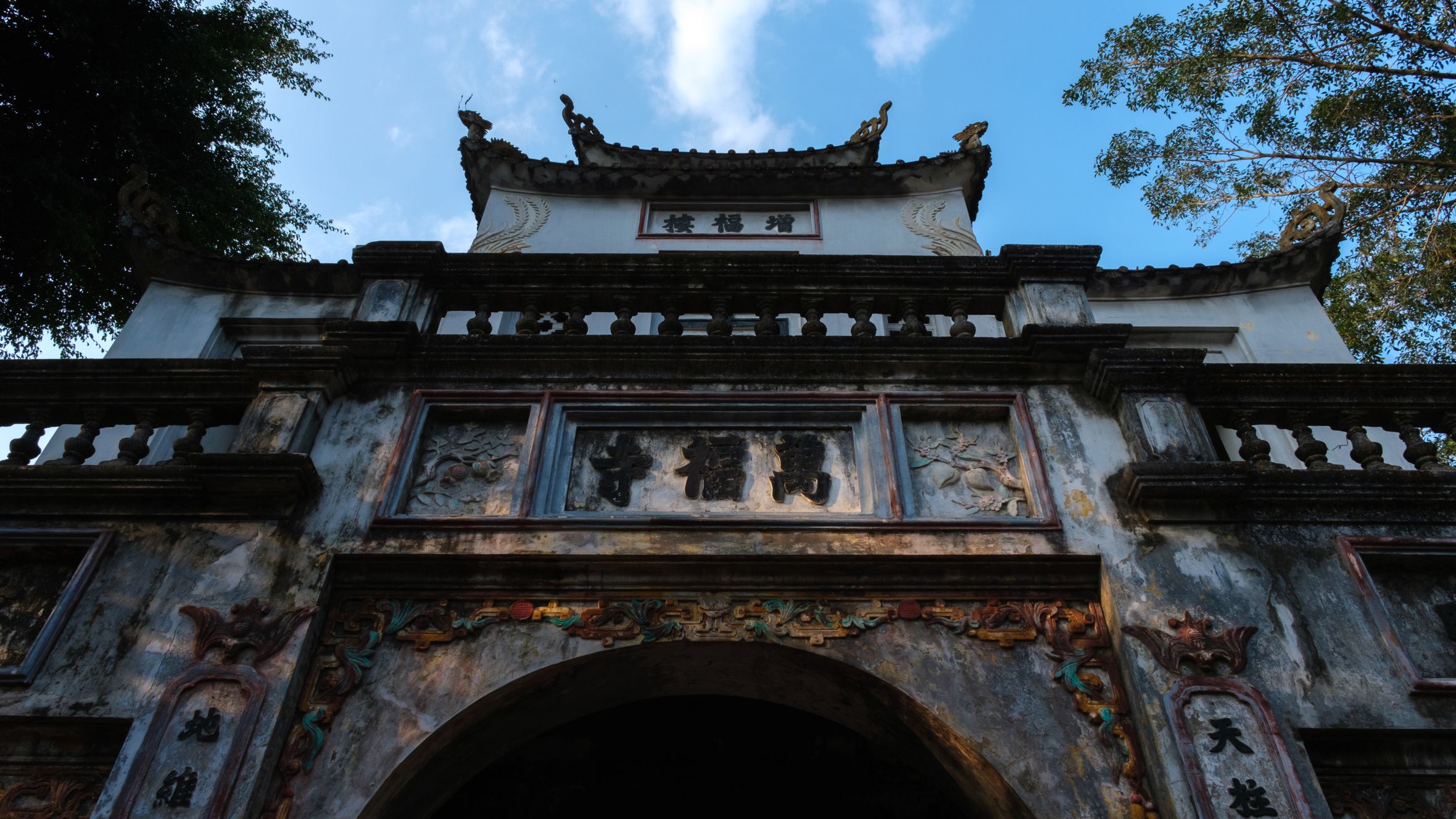
Of the original 16 gates, this is the only one still standing. The structure you see today is a squat, arch-shaped portal made of brick and stone, about 3 meters tall, with a small shrine on top dedicated to the soldiers who defended it. It was restored in the early 2000s, but the bones of the thing are genuinely old — you can see the difference between original brickwork and the patched sections if you look closely.
It's not a grand monument. It won't take your breath away. But for anyone interested in the physical layers of Hanoi's history, this is a real piece of the city that predates most of what surrounds it by centuries.
Why travelers go
O Quan Chuong works best as an anchor point for exploring the Old Quarter on foot rather than a standalone destination. It gives context to the neighborhood — once you know there were walls and gates here, the dense tangle of Hang streets (Hang Chieu, Hang Buom, Hang Ma) starts to make more sense as an old merchant grid.
Photographers come early in the morning when the light hits the gate from the east and the flower sellers on Hang Chieu are setting up. The contrast between the old stone archway and the motorbike traffic flowing through it is pure Hanoi.
Best time to visit
The gate is outdoors and open 24/7, so timing is about weather and atmosphere more than anything.
October through December is ideal — cool, dry air, and the morning light is softer. Hanoi's autumn is genuinely pleasant, hovering around 22-28°C.
Early morning (6:00-7:30 AM) is the best window any time of year. The nearby Hang Chieu morning market is active, locals are doing tai chi by the gate, and foot traffic is manageable. By 9 AM, motorbike congestion makes the area loud and chaotic.
Avoid midday in summer (June-August). The humidity around the Old Quarter is oppressive, and the gate offers zero shade.

Photo by Hiếu Vũ Vlog on Pexels
How to get there
From Hoan Kiem Lake (the center of most travelers' Hanoi orbit), it's a 10-minute walk north along Hang Chieu. No taxi needed.
From Noi Bai Airport, a Grab car to the Old Quarter costs 250,000-350,000 VND and takes 40-60 minutes depending on traffic. The 86 airport bus (35,000 VND) drops you at Hanoi Railway Station on Le Duan, from which O Quan Chuong is a 15-minute walk or a quick 15,000 VND Grab bike ride.
If you're coming from the Temple of Literature or the Imperial Citadel Thang Long area on the west side of the city, budget 20 minutes by motorbike or taxi (around 40,000-60,000 VND).
What to do
Walk through the gate and look up
Most people photograph the exterior and move on. Step through and look at the interior face — there's a faded inscription above the arch and the small rooftop shrine is visible from the inside. The brickwork tells a story if you pay attention: darker, rougher stone at the base is original 18th-century material.
Explore Hang Chieu morning market
The stretch of Hang Chieu immediately west of the gate transforms into a street market before dawn. Vendors sell mats, rattan goods, dried foods, and household items. It's not a tourist market — prices are in VND and negotiation is minimal because margins are already thin. By 8 AM, most stalls are packing up.
Walk the old merchant streets
Use the gate as your starting point for an Old Quarter loop. Head west on Hang Chieu, turn south on Hang Buom (the old spice-trading street, now packed with cheap beer spots and backpacker bars), continue to Hang Ma (paper goods and festival decorations — particularly vivid before Tet or Tet Trung Thu), and circle back via Hang Duong.
Visit Dong Xuan Market
Dong Xuan Market is 200 meters northwest of O Quan Chuong. It's Hanoi's largest covered market — three floors of wholesale goods, textiles, and food stalls. The ground floor food section is worth a walk-through even if you don't buy anything.
Photograph Long Bien Bridge from Tran Nhat Duat
Walk east from the gate to Tran Nhat Duat street along the old dike road. From here you get a clear sightline to Long Bien Bridge, the French-era steel cantilever bridge that still carries trains and motorbikes across the Red River. The view at sunset is worth the five-minute walk.
Where to eat nearby
The Old Quarter around O Quan Chuong is dense with food options.
For "pho (쌀국수 / 越南河粉 / フォー)," head to Pho Gia Truyen at 49 Bat Dan, about a 10-minute walk southwest. A bowl runs 50,000-60,000 VND and the line moves fast in the morning. This is beef pho done simply and well — clear broth, fresh herbs, no fuss.
For "banh cuon" (steamed rice rolls), try the stall at 14 Hang Ga, a 5-minute walk from the gate. Thin, translucent rice sheets filled with minced pork and wood ear mushroom, served with fried shallots and "cha gio" on the side. Around 40,000 VND for a full plate.
If you want egg coffee after your walk, Cafe Giang at 39 Nguyen Huu Huan is a 7-minute walk south. The original egg coffee spot — thick, sweet, and better hot than iced despite what Instagram suggests.

Photo by Hồng Quang Official on Pexels
Where to stay
The Old Quarter has accommodation at every price point.
Budget (200,000-500,000 VND/night): Hostels and basic guesthouses line Hang Buom, Hang Bac, and Ma May streets. Expect shared bathrooms and thin walls, but you're steps from everything.
Mid-range (800,000-1,500,000 VND/night): Small hotels on Hang Gai and Hang Trong offer private rooms with air conditioning and breakfast. Many have rooftop terraces overlooking the Old Quarter roofline.
High-end (3,000,000+ VND/night): The Sofitel Legend Metropole on Ngo Quyen is a 12-minute walk south from the gate. Colonial-era architecture, excellent restaurants, and genuinely good service.
Practical tips locals would tell you
- There's no ticket, no entrance fee, no opening hours. It's a public gate on a public street. Just walk up.
- The shrine on top of the gate is maintained by local residents. If it's open and you want to look, remove your shoes and keep your voice down.
- Motorbikes flow through the gate constantly. Don't stand in the archway for photos — step to the side or you'll cause a traffic jam and earn some honking.
- The nearby stretch of Tran Nhat Duat has decent ATMs (Vietcombank and Techcombank) if you need cash.
Common mistakes to avoid
- Expecting a big attraction. This is a single gate on a busy street corner. If you arrive expecting a grand monument, you'll be disappointed. Come with the right expectations — it's a small, historically significant structure, not a temple complex.
- Visiting at midday. The gate faces east-west, so midday light is flat and the surrounding streets are at peak chaos. Morning or late afternoon is better in every way.
- Skipping the surrounding streets. The gate alone is a five-minute stop. The real value is using it as a starting point for the Old Quarter. Budget at least two hours for the wider neighborhood.
- Confusing it with Cua Bac or Cua Nam. Those are street names that reference other former gates — but the physical gates are long gone. O Quan Chuong is the only one still standing.
Last updated · May 29, 2026 · independently researched, never sponsored.