What it is
Imperial Citadel Thang Long is a UNESCO World Heritage Site sitting right in the middle of Hanoi, about 2 km west of Hoan Kiem Lake. It served as the political center of Vietnam (베트남 / 越南 / ベトナム) for over a thousand years, starting in the 11th century under the Ly dynasty and running through successive dynasties until the Nguyen moved the capital to Hue in 1802. What you walk through today is a layered archaeological site — literally. Excavations starting in 2002 uncovered foundations, ceramics, and artifacts from multiple periods stacked on top of each other, spanning from the 7th century through the 20th.
The complex covers around 18 hectares. Some structures are restored originals; others are excavation pits under protective roofing. It is not a polished theme park. It is a real dig site mixed with standing architecture, and that is exactly what makes it worth your time.
Why travelers go
Most visitors to Hanoi (하노이 / 河内 / ハノイ) spend their time around Hoan Kiem, the Old Quarter, and the Temple of Literature. The citadel gets fewer crowds, which is part of the appeal. You get a sense of the sheer age of this city that the Old Quarter — mostly 19th and 20th century — cannot give you. The archaeological pits at 18 Hoang Dieu are genuinely impressive: you look down through transparent walkways at foundation layers from dynasties separated by centuries, all in one trench.
It also appeals if you have any interest in 20th-century military history. Bunker D67, built in the 1960s, sits inside the complex. It is where senior military figures planned operations during wartime. The bunker is open to visitors and still has its original meeting rooms and communications equipment.
Best time to visit
Hanoi's autumn — October and November — is the obvious pick. Temperatures sit around 24-28°C, humidity drops, and the sky is often clear. Walking an open archaeological site in July or August heat (35°C+, 85%+ humidity) is genuinely unpleasant.
Spring (March-April) also works, though expect some drizzle. If you visit during Tet, the citadel sometimes hosts calligraphy and folk art displays, which adds a layer of atmosphere.
Avoid the midday slot year-round. The site has limited shade. Morning visits (8:00-10:30) are best for comfort and for photos without harsh overhead light.
How to get there
From Hoan Kiem Lake, the citadel is about 2 km due west. A Grab car takes 10-15 minutes and costs roughly 25,000-40,000 VND depending on traffic. By motorbike taxi, expect around 15,000-20,000 VND.
Bus route 32 (from Long Bien bus station) and route 22 both stop within walking distance on Hoang Dieu street. Fare is 7,000 VND.
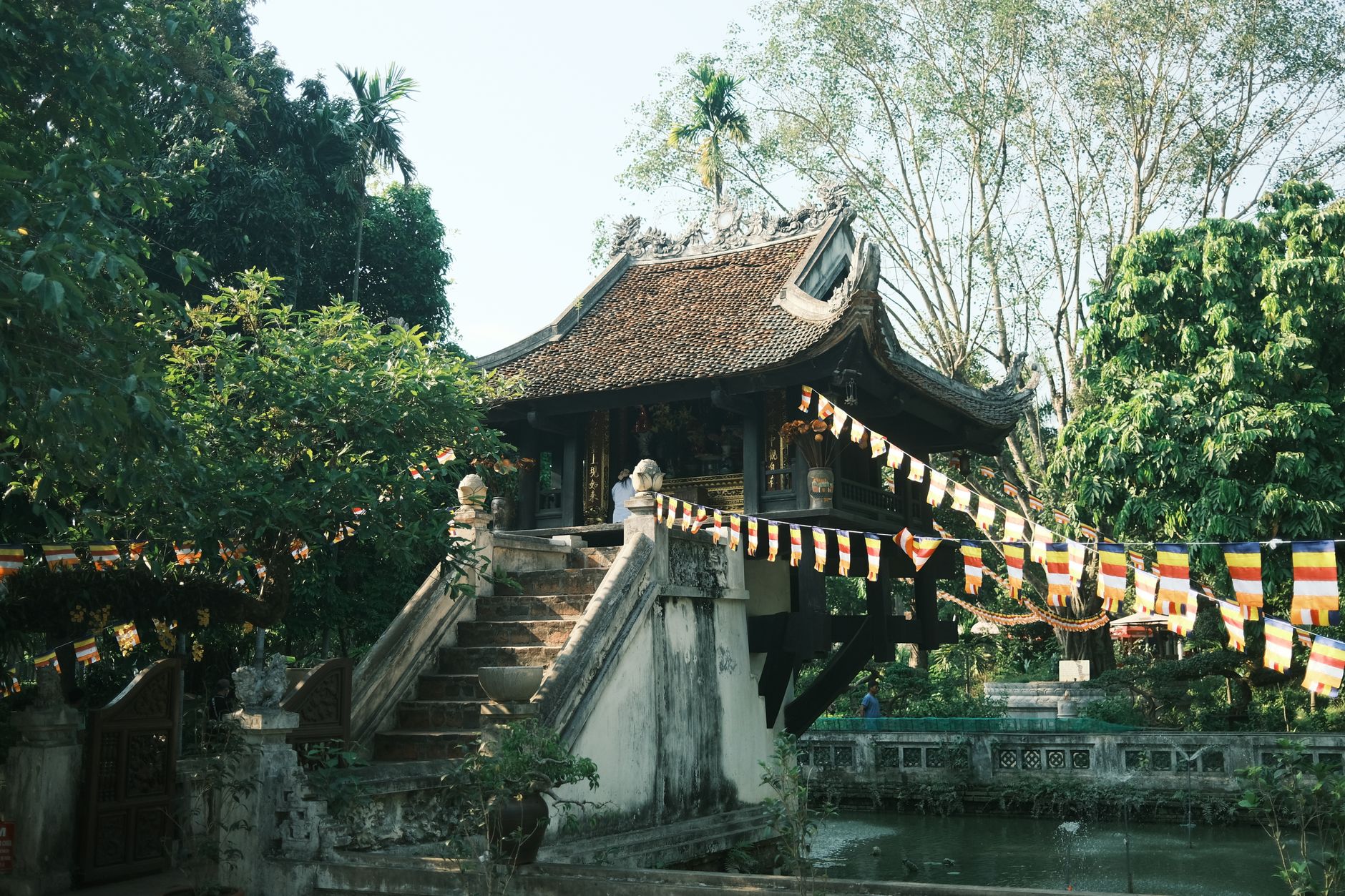
If you are walking from the Old Quarter, it takes about 25 minutes through Ba Dinh district — a pleasant route that passes the One Pillar Pagoda and Ho Chi Minh Mausoleum area.
The main entrance is at 19C Hoang Dieu. The archaeological site at 18 Hoang Dieu is a separate entrance nearby.

Photo by Hugo Heimendinger on Pexels
What to do
Walk through Doan Mon (Main Gate)
This is the principal southern gate, originally built under the Le dynasty in the 15th century and reconstructed multiple times. It is the starting point for most visits and gives you an immediate sense of the scale of the old fortress. Five arched passageways — the central one was reserved for the king.
Climb the Flag Tower (Cot Co)
Built in 1812 under the Nguyen dynasty, the Flag Tower is one of the few structures that survived French colonial demolition of the citadel walls. It stands 33 meters tall and you can climb to the top for a 360-degree view over Ba Dinh district. It is one of the most recognizable landmarks in Hanoi.
Explore the 18 Hoang Dieu archaeological site
This is the real draw for anyone interested in history. The excavation — one of the largest urban digs in Southeast Asia — reveals building foundations, wells, drainage systems, and thousands of artifacts from the 7th to 19th centuries. Ceramic shards, roof tiles with dragon motifs, and coins are displayed in situ. English-language signage is decent but not comprehensive; a guide helps.
Visit Bunker D67
A concrete bunker built during the 1960s inside the citadel compound. The meeting room, communications room, and map room are preserved with original furniture. It gives a very specific, tangible sense of 20th-century history that you do not get from most Hanoi attractions.
Check the Kinh Thien Palace foundation
Only the stone steps and dragon balustrades of the original palace survive — the French dismantled the building in the 19th century. The carved stone dragons flanking the staircase are among the finest examples of Le dynasty sculpture in Vietnam.
Where to eat nearby
The citadel sits in Ba Dinh, which is more of an administrative district than a food destination. But you have solid options within a 10-minute walk.
Head east toward Nguyen Tri Phuong street for a bowl of "bun cha" — grilled pork patties with rice noodles and dipping broth. Bun Cha 34 Hang Than, about 1 km north, is a reliable local spot (40,000-55,000 VND per set). For "pho", Pho Thin on Lo Duc street is a 15-minute taxi ride but worth the detour for its stir-fried beef version. A bowl runs about 50,000-60,000 VND.
If you just need a coffee break, the streets south of the citadel near Nguyen Thai Hoc have several sidewalk "ca phe sua da" stalls — iced milk coffee for 20,000-30,000 VND.
Where to stay
Most travelers base themselves in the Old Quarter or around Hoan Kiem Lake, both within easy taxi range. Budget guesthouses in the Old Quarter start around 250,000-400,000 VND/night. Mid-range hotels near Hoan Kiem run 800,000-1,500,000 VND. If you prefer to stay closer to the citadel itself, the Ba Dinh area has a few boutique hotels in the 1,200,000-2,500,000 VND range, though dining and nightlife options are thinner.

Photo by Karolina on Pexels
Practical tips locals would tell you
- Ticket price: 30,000 VND for adults (as of 2024). The 18 Hoang Dieu excavation site is included but occasionally closes for active research — check at the ticket booth.
- Time needed: 1.5-2 hours for a thorough visit. Add 30 minutes if you want to read every exhibit panel.
- Hire a guide: English-speaking guides are available at the entrance for around 200,000-300,000 VND. The site's context is not always obvious from the ruins alone, and a guide makes the archaeological layers make sense.
- Bring water. There is one small drink stand inside, but do not count on it.
- Photography: allowed everywhere except inside Bunker D67, where flash is prohibited.
Common mistakes to avoid
- Skipping 18 Hoang Dieu: Many visitors only walk the above-ground monuments and miss the excavation site entirely. It is the most historically significant part.
- Coming at noon in summer: There is almost no shade across the open courtyards. You will last 20 minutes before retreating.
- Confusing it with the Imperial Citadel in Hue: They are different places. Thang Long is in Hanoi; the Hue citadel is 700 km south. Both are worth seeing, but they represent different dynasties and eras.
- Not checking the calendar: The site occasionally closes sections for state events or archaeological work. A quick check on the official website or a call to your hotel's front desk saves a wasted trip.
Practical notes
Imperial Citadel Thang Long is open Tuesday through Sunday, 8:00-17:00 (last entry at 16:30). Closed Mondays. It pairs well with a morning visit to the nearby Ho Chi Minh Mausoleum complex or an afternoon walk to the Temple of Literature, about 1.5 km south.
Last updated · May 29, 2026 · independently researched, never sponsored.