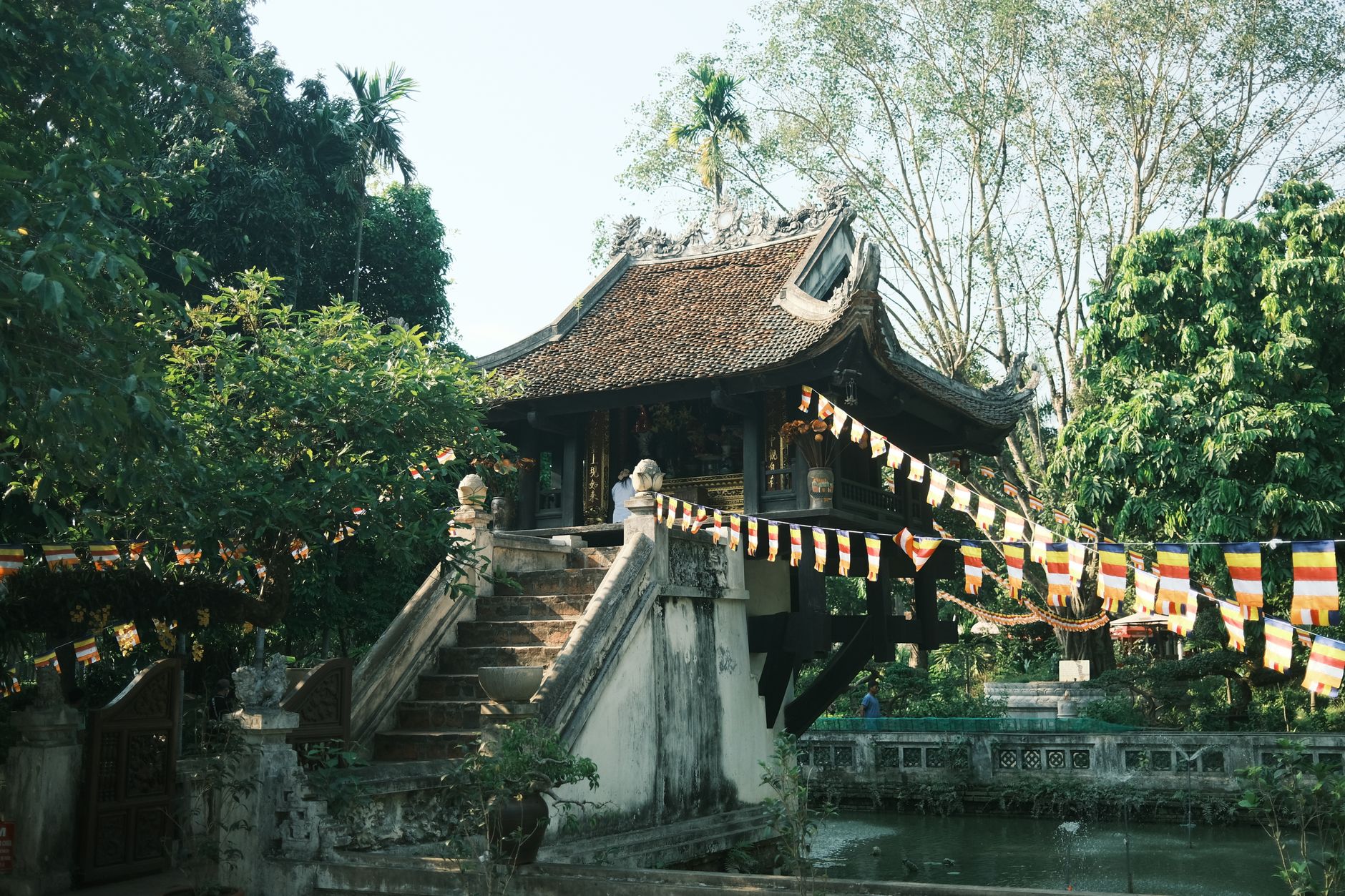
Phu Tay Ho is a working temple complex on a narrow peninsula that reaches into West Lake, about 4 km northwest of Hanoi's Old Quarter. It draws a steady stream of Vietnamese worshippers year-round, and on the 1st and 15th of each lunar month, the place is packed. For travelers, it's one of the more accessible ways to see Vietnamese folk religion up close — not as a museum piece, but as something people actually do.
What it is and how it got here
Phu Tay Ho is a "phu" — a type of temple dedicated to the worship of goddesses in the Vietnamese folk tradition known as "Dao Mau" (Mother Goddess worship). This particular temple honors Lieu Hanh, one of the Four Immortals in Vietnamese mythology. The complex dates back several centuries, though much of what you see today has been rebuilt and expanded over time.
The temple sits at the tip of a finger of land extending into West Lake ("Ho Tay"), Hanoi (하노이 / 河内 / ハノイ)'s largest lake. The location matters — water, in Vietnamese spiritual geography, carries significance, and the temple's position surrounded by the lake on three sides gives it a weight that a landlocked site wouldn't have.
Why travelers go
Phu Tay Ho isn't a tourist attraction in the conventional sense. There are no audio guides or ticket counters. People come here because it's real. On busy days, the incense smoke is thick enough to taste, and the courtyards fill with people making offerings of fruit, flowers, paper money, and whole roasted pigs. If you've been to the Temple of Literature and want to see what active Vietnamese worship looks like outside of a heritage-site context, this is the place.
The walk along the peninsula is also just pleasant — food stalls line both sides of the path leading to the temple, and the lake views open up as you get closer to the tip.
Best time to visit
The temple is open daily, but the experience changes dramatically depending on when you show up.
- Lunar 1st and 15th: These are the main worship days. Expect crowds, heavy incense, chanting, and sometimes "ca tru" or "hat van" (spirit mediumship singing) performances inside the temple halls. This is the most intense experience — arrive before 9 AM to avoid the worst of the midday crush.
- Tet (뗏 (베트남 설날) / 越南春节 / テト) and major festivals: During Tet, the temple is elbow-to-elbow for the first two weeks of the lunar new year. The Hung Kings Festival period also sees higher traffic. Atmospheric, but not for the claustrophobic.
- Regular weekdays: Quiet, a handful of worshippers, easy to walk around and actually look at the architecture. Good for photography.
- Weather: October through March is the most comfortable. Hanoi summers (June–August) are brutally humid, and the exposed peninsula offers little shade.
How to get there
From the Old Quarter, Phu Tay Ho is about 4 km northwest — a straight shot up Thanh Nien Road, which runs between West Lake and Truc Bach Lake.
- Grab/taxi: 25,000–40,000 VND from the Old Quarter, 10–15 minutes depending on traffic.
- Motorbike: Follow Thanh Nien Road north, then turn right onto Dang Thai Mai or Xuan Dieu and follow signs. Parking at the temple entrance costs 5,000–10,000 VND.
- Bicycle: A good ride if you're already cycling around West Lake. The lakeside path connects naturally.
- Bus: Route 33 and 55 pass within walking distance, but honestly, a Grab is easier and cheap enough that the bus isn't worth the hassle unless you enjoy the adventure.

Photo by HONG SON on Pexels
What to do
Walk the full length of the peninsula
Don't rush straight to the main temple. The path from the entrance gate to the temple complex is about 500 meters, lined with vendors selling incense, votive paper, fruit, and flowers. The food stalls here are part of the experience — more on those below.
Watch the offerings and rituals
Inside the temple, worshippers lay out elaborate offerings on altars and pray at multiple shrines. If a "len dong" (spirit mediumship) ceremony is happening, you'll hear it — drums, singing, and a medium cycling through different spirits, each with their own costume and gestures. It's a UNESCO-recognized practice and genuinely compelling to watch. Stay quiet, don't use flash, and you're welcome to observe.
Visit the secondary shrines
The complex isn't just one building. Behind and beside the main hall are smaller shrines dedicated to other spirits in the Dao Mau pantheon. These are quieter, less crowded, and often more visually interesting — look for the wooden carvings and painted panels.
Sit by the lake
At the tip of the peninsula, past the temple buildings, there's a small area where you can sit and look out over West Lake. On clear mornings, it's one of the better spots in Hanoi to just be still for a few minutes.
Check the banyan tree
Near the temple entrance, an old banyan tree is draped with red ribbons and small prayer tokens. It's a natural gathering point and a decent photo spot when the light is right.
Where to eat nearby
The food stalls along the peninsula path are the main draw. Two things to try:
- "Banh tom" (shrimp cakes): This is the signature dish of the Phu Tay Ho area. Deep-fried patties of sweet potato and whole shrimp, served with fresh herbs and a dipping sauce. Most stalls charge 40,000–60,000 VND per plate. Eat them hot.
- "Bun oc" (snail noodle soup): Several stalls near the entrance serve bowls of rice noodles with snails in a tomato-based broth. A full bowl runs 35,000–50,000 VND. The broth is tangy and rich — a distinctly Hanoi thing.
If you want a proper meal after, the Xuan Dieu and Quang An area just south of the temple has a good spread of restaurants, from local "com binh dan" joints to lakeside cafes serving egg coffee and Vietnamese coffee.
Where to stay
Most travelers stay in the Old Quarter or around Truc Bach Lake and visit Phu Tay Ho as a half-day trip. But the Tay Ho district itself has options:
- Budget: Guesthouses along Xuan Dieu or To Ngoc Van streets, 300,000–500,000 VND/night.
- Mid-range: Boutique hotels near West Lake, 800,000–1,500,000 VND/night. Several have lake views.
- High-end: The InterContinental Hanoi Westlake sits on its own peninsula nearby, from around 3,000,000 VND/night.
Staying in Tay Ho puts you close to the expat cafe scene and away from the Old Quarter chaos, which some people prefer.

Photo by Thuan Pham on Pexels
Practical tips locals would tell you
- Dress modestly: Shoulders and knees covered. This is an active place of worship, not a ruin. Staff may ask you to cover up if you don't.
- Buy incense at the entrance: If you want to participate, a basic incense bundle costs 10,000–20,000 VND. Light it, hold it with both hands, bow three times at the main altar.
- Go early on lunar dates: If visiting on the 1st or 15th, arrive by 7–8 AM. By 10 AM, the crowd is significant and parking becomes a headache.
- Bring cash: No card payments at the stalls. ATMs are back on Xuan Dieu, not on the peninsula.
Common mistakes to avoid
- Skipping it because it's "just a temple": Phu Tay Ho is more interesting than most of Hanoi's preserved heritage sites precisely because it's not preserved — it's alive. The energy on a busy worship day is something you won't get at Tran Quoc Pagoda or One Pillar Pagoda.
- Visiting only the main hall: The side shrines and the lakeside area behind the complex are worth the extra ten minutes.
- Photographing worshippers without asking: Read the room. During intense prayer moments, put the camera away.
- Coming at midday in summer: The peninsula is exposed and hot. Morning or late afternoon only.
Practical notes
Phu Tay Ho is free to enter. Budget 1.5–2 hours for a relaxed visit including food. It pairs naturally with a West Lake loop — cycle or walk the lake path, stop at Tran Quoc Pagoda on the way, and end with "banh tom" at the temple stalls. One of the better half-days you can spend in Hanoi.
Last updated · May 29, 2026 · independently researched, never sponsored.