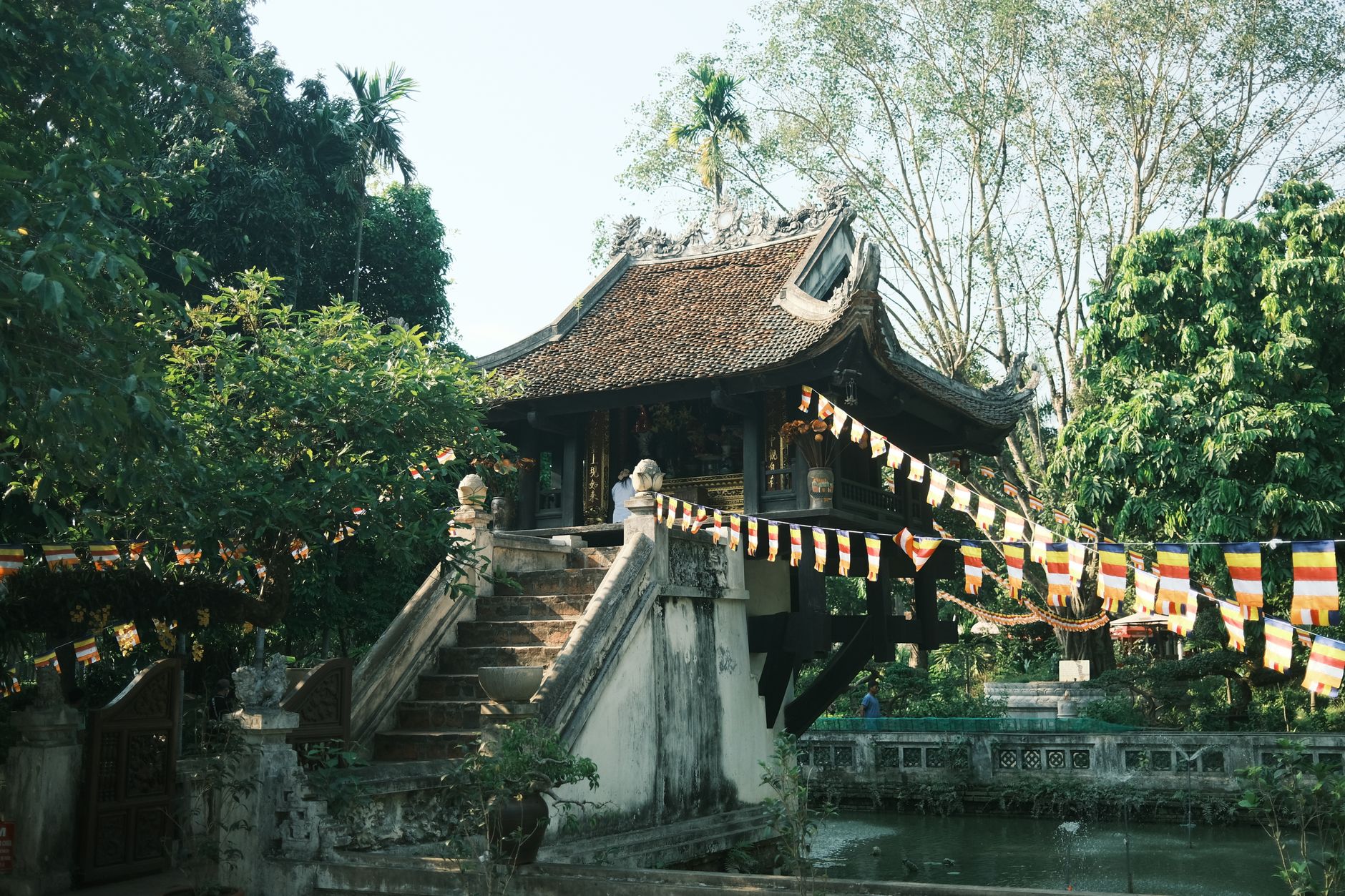
Den Soc and Chua Non Nuoc are part of the same complex on Soc Son mountain, about 40 km north of central Hanoi. Most foreign visitors skip it entirely. That's fine — it means the place still belongs to the locals who come here to pay respect to Thanh Giong, one of Vietnam (베트남 / 越南 / ベトナム)'s Four Immortals, a mythical iron-armored giant who drove out invaders in the country's founding legends. If you're interested in how Vietnamese people actually practice their spiritual life outside of the well-trafficked temples in Hanoi's Old Quarter, this is worth the half-day trip.
What it is
The complex sits across a forested hillside in Soc Son district. "Den Soc" (Soc Temple) is dedicated to Thanh Giong — the story goes that after his victory, he rode his iron horse to this mountain and ascended to the sky. The temple has been here in some form for centuries, though much of what you see today was rebuilt and expanded in the early 2000s.
"Chua Non Nuoc" (Non Nuoc Pagoda) is a Buddhist pagoda a short walk uphill from the temple. It's older in origin, quieter, and has a modest collection of wooden statues and a bell tower with views over the surrounding forest. Together, the two sites make a single visit — you walk a stone path connecting them through the trees.
The complex is also the site of the Giong Festival, held on the sixth day of the first lunar month. UNESCO recognized it as intangible cultural heritage in 2010. During the festival, thousands of people from surrounding villages carry ritual offerings up the mountain in a procession that's been happening for generations.
Why travelers go
Three reasons. First, it's a functioning religious site, not a museum. You'll see families burning incense, older women chanting, kids running around — the atmosphere is genuine. Second, the forested hillside is a break from Hanoi (하노이 / 河内 / ハノイ)'s noise. The walk between the temple and pagoda takes about 20 minutes through actual trees, which counts for something after days in the city. Third, if your timing lines up with the Giong Festival (usually late January or February, depending on the lunar calendar), you get to witness one of northern Vietnam's most important folk traditions.
Best time to visit
The Giong Festival period (sixth day of the first lunar month) is the most culturally rich time, but also the most crowded — expect large groups and limited personal space on the paths. If you want the experience without the crush, go on a weekday morning between October and March, when the weather is cooler and the hillside is comfortable for walking. Summer months (June–August) are hot and humid; the climb to Chua Non Nuoc will have you soaked before you reach the gate. Avoid major holidays like Tet unless you specifically want to see the site during peak devotion — it gets packed.
How to get there from Hanoi
From central Hanoi, you have a few options:
- Motorbike or car: Take the route north on Highway 3 toward Soc Son. It's roughly 40 km and takes about 60–90 minutes depending on traffic. Passing Noi Bai airport area, you'll see signs for Khu Di Tich Den Soc. Parking at the complex costs 10,000–20,000 VND for a motorbike.
- Grab car: A one-way Grab from Hoan Kiem runs around 250,000–350,000 VND. Booking a return can be tricky since drivers are scarce in the area — consider asking yours to wait or arranging a round trip.
- Bus: Bus 56 from Long Bien station heads toward Soc Son town, but you'll still need a xe om (motorbike taxi) for the last 7 km to the complex. Total cost under 50,000 VND, but it takes 2+ hours each way.
Most people with limited time hire a car for the half day. It's the least stressful option.

Photo by Trần Phan Phạm Lê on Pexels
What to do
Walk the full circuit
Start at the main gate of Den Soc, work your way through the temple courtyards, then follow the stone-stepped path uphill to Chua Non Nuoc. The full loop takes about 90 minutes at a relaxed pace. Wear shoes with grip — the stone steps get slippery after rain.
Visit the Thanh Giong statue
A large bronze statue of Thanh Giong on his iron horse sits on the hilltop near the pagoda. It's not subtle — the statue is over 10 meters tall. But the clearing around it gives you a wide view over Soc Son's farmland and forest, and it's a good spot to sit and rest before heading back down.
Spend time in Chua Non Nuoc
The pagoda is smaller and less visited than the temple below. The wooden interior has aged well, and if you visit on a quiet morning, you might be the only person there besides the resident monks. The bell tower is worth climbing for the view.
Watch the incense-making
Soc Son district is known for incense production. On the road approaching the complex, you'll often see bundles of incense sticks drying in the sun outside homes — bright reds and yellows fanned out on the roadside. It's not a formal attraction, but it's part of the area's character.
Catch the Giong Festival (if timing works)
The procession includes palanquin carriers, ritual offerings of betel and areca, and traditional music. It's loud, crowded, and genuinely communal. If you're in Hanoi in early lunar new year and want something beyond the standard Tet / 越南春节 / テト) celebrations, this is it.
Where to eat nearby
The area around Den Soc is rural — don't expect a restaurant strip. A few family-run places near the parking area serve basic dishes: "com binh dan" (everyday rice plates) for 30,000–50,000 VND, and sometimes "bun rieu" if you're lucky. For something more reliable, eat before you leave Hanoi or stop in Soc Son town on the way back, where small pho and "bun cha" shops line the main road. A bowl of pho here runs 35,000–45,000 VND.
Where to stay
There's no real reason to sleep in Soc Son — Hanoi is under two hours away. But if you're combining this with a longer northern trip (heading toward Sapa or Ha Giang), basic guesthouses in Soc Son town go for 200,000–400,000 VND per night. They're clean enough but bare-bones. For anything with amenities, stay in Hanoi.

Photo by Jordan Coleman on Pexels
Practical tips locals would tell you
- Bring cash. There are no ATMs at the complex and no card payment anywhere nearby.
- Dress modestly — shoulders and knees covered. This is an active worship site, not a ruin.
- The "donation" boxes inside the temple are voluntary, but it's customary to leave 10,000–20,000 VND.
- Bring water. There's one small drink stand near the lower gate, but nothing once you start climbing.
- If you hire a local guide at the entrance (sometimes available for 100,000–200,000 VND), they can explain the Thanh Giong mythology in detail. Worth it if you care about context.
Common mistakes to avoid
- Going at midday in summer. The climb is exposed in sections and there's limited shade. Morning is better.
- Expecting English signage. Almost everything is in Vietnamese only. Read up on the Thanh Giong legend before you go — it makes the whole site more meaningful.
- Skipping Chua Non Nuoc. Many visitors turn around after Den Soc. The pagoda is the quieter, more atmospheric half of the visit.
- Relying on Grab for the return. Drivers don't cruise the area. Have a plan before you arrive.
Practical notes
Den Soc and Chua Non Nuoc are open daily, generally from 7:00 to 17:00. Entry is free, though the Giong Festival period may have restricted access to certain areas. Budget a half day for the round trip from Hanoi, including travel time. It pairs well with a stop at Bat Trang pottery village on the way back if you're driving.
Last updated · May 29, 2026 · independently researched, never sponsored.