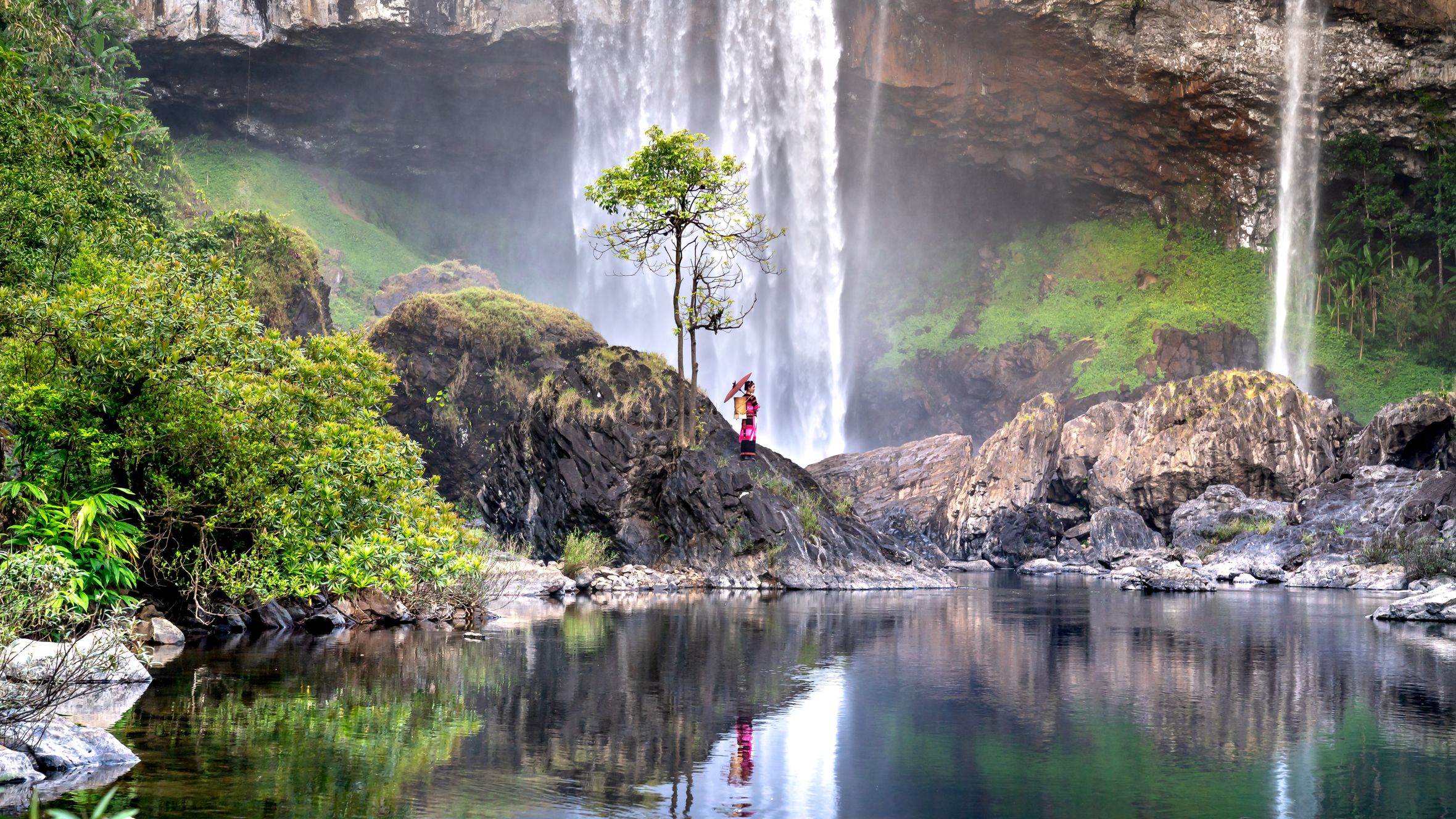
Thac Khe Kem is a 150-meter waterfall tucked inside Pu Mat National Park in western Nghe An province. It's the tallest waterfall in the region and one of the more impressive ones in central Vietnam (베트남 / 越南 / ベトナム) — not because anyone slapped a superlative on a brochure, but because the thing genuinely roars during rainy season and the surrounding forest is dense, old-growth stuff you don't see much of anymore.
What it is
The waterfall sits on the Khe Kem stream, a tributary feeding into the Giang River system, roughly 130 km west of Vinh city. Pu Mat National Park — a UNESCO biosphere reserve — protects over 91,000 hectares of subtropical forest along the Lao border. Thac Khe Kem is the park's most visited natural feature, though "most visited" is relative; this isn't Ha Long Bay. On weekdays outside of summer, you might share the trail with a handful of local families and nobody else.
The waterfall has been a known site for decades among Nghe An residents, but tourism infrastructure only started appearing in the early 2010s. A paved access road and ticket booth now make it far easier to reach than it used to be.
Why travelers go
Three reasons, honestly. First, the waterfall itself: water drops off a cliff face into a rocky pool surrounded by forest canopy. During peak flow (August–September), the mist reaches you 50 meters away. Second, the drive in. The road from Con Cuong town winds through ethnic Thai and Dan Lai villages, rice terraces, and stretches of forest that feel genuinely remote. Third, Pu Mat. If you're interested in biodiversity — primates, birds, rare hardwoods — the national park is one of central Vietnam's last large intact forest blocks. Thac Khe Kem is a reason to come here, but the park itself is the bigger draw for the right traveler.
Best time to visit
The waterfall runs year-round but peaks between July and October, when monsoon rains feed the stream. September is usually the most dramatic month for water volume. The trade-off: rain can make the access trail muddy, and leeches come out in force during wet season.
If you'd rather stay dry and leech-free, March to May offers pleasant weather and a thinner but still photogenic flow. Avoid December through February if you can — the waterfall thins out considerably and mornings in the highlands get cold (10–15°C), which catches people off guard this far south of Hanoi.
Photo by Quang Nguyen Vinh on Pexels
How to get there
The nearest city with onward transport is Vinh (officially Vinh city, Nghe An). From Vinh, you need to reach Con Cuong town first, then continue to the waterfall.
Vinh to Con Cuong
- Bus: Regular local buses depart from Vinh's Ben Xe Bac (north bus station) heading toward Con Cuong. The ride takes about 2.5–3 hours via National Road 7. Tickets run 80,000–100,000 VND.
- Motorbike/car: The 130 km drive on QL7 is straightforward. Renting a motorbike in Vinh costs 120,000–180,000 VND/day. A private car with driver runs roughly 1,200,000–1,500,000 VND round trip.
Con Cuong to Thac Khe Kem
From Con Cuong, it's another 18 km west on a paved but narrow road. You'll pass through the park entrance gate, where admission is 40,000 VND per person (as of 2024). Motorbike parking is 10,000 VND. From the parking area, a maintained trail leads about 1.5 km to the base of the falls — roughly 20–30 minutes on foot.
There's no public bus from Con Cuong to the waterfall. You'll need your own wheels or a "xe om" (motorbike taxi) from town, which should cost around 80,000–100,000 VND one way.
What to do
1. Walk the forest trail to the falls. The 1.5 km path is partly boardwalk, partly dirt trail. It's flat enough for most fitness levels. Along the way, signage identifies some tree species, though the English translations are hit-or-miss. Take your time — the forest canopy here is the real attraction.
2. Swim in the pool (dry season). When water levels are manageable (March–June), locals swim in the pool at the waterfall's base. The rocks are slippery, so water shoes help. Don't attempt this during heavy rain season when the current picks up significantly.
3. Visit a Thai stilt-house village. Several ethnic Thai communities live along the road between Con Cuong and the waterfall. The village of Khe Rạn (about 6 km from Con Cuong) has traditional stilt houses and occasionally hosts overnight visitors. This isn't a ticketed tourist village — be respectful, ask before photographing people.
4. Explore Pu Mat's deeper trails. The national park office in Con Cuong can arrange guided treks (half-day or full-day) into less-visited parts of the reserve. Guides cost roughly 400,000–600,000 VND/day. These treks focus on birdwatching or primate spotting, depending on the guide.
5. Drive the QL7 loop. If you have a motorbike and a full day, continue west on QL7 past the waterfall turnoff toward the Lao border area. The road follows river valleys and passes through increasingly remote villages. It's one of the quieter scenic drives in central Vietnam.
Where to eat nearby
Con Cuong town has a handful of local restaurants — look for places along the main road serving "com binh dan" (everyday rice plates) for 30,000–50,000 VND. Two dishes worth ordering:
- "Ga dong" (hill chicken): Free-range chicken from highland farms, usually grilled or steamed with lime leaves. Tougher and more flavorful than city chicken. A whole bird runs about 250,000–350,000 VND.
- Sticky rice with "muoi vung" (sesame salt): A staple among the Thai ethnic communities here. Simple, filling, and cheap — 15,000–20,000 VND a portion from market vendors.
Don't expect pho or banh mi options to be particularly good this far into the highlands. Eat what locals eat.

Photo by Hồng Quang Official on Pexels
Where to stay
Con Cuong is your base. Options are basic but functional:
- Guesthouses ("nha nghi"): 200,000–350,000 VND/night. Clean rooms, hot water, Wi-Fi that mostly works. Try places along QL7 near the town center.
- Homestays: A few Thai stilt-house homestays operate in villages near the park. Expect mattresses on the floor, mosquito nets, shared bathrooms, and communal meals. Around 150,000–250,000 VND/person including dinner and breakfast. The park office can connect you.
- Mid-range hotel: One or two newer hotels in Con Cuong offer air-conditioned rooms for 400,000–600,000 VND/night.
There's no accommodation at the waterfall itself.
Practical tips
- Bring cash. There's an ATM in Con Cuong town, but card payments don't exist out here.
- Pack leech socks or tuck your pants into your socks during wet season. Seriously.
- The trail to the falls closes after heavy downpours for safety. Check with the ticket booth before walking in.
- Phone signal (Viettel works best) is decent in Con Cuong but drops to nothing on the trail.
- Bring your own water and snacks. There's a small drink vendor near the parking area, but selection is limited.
Common mistakes
- Coming from Hanoi (하노이 / 河内 / ハノイ) as a day trip. It's roughly 300 km from Hanoi to Con Cuong — that's a full day of driving each way. Plan at least one overnight in Con Cuong or Vinh.
- Wearing sandals on the trail. The path gets muddy and the rocks near the falls are slick. Closed-toe shoes with grip save you a twisted ankle.
- Visiting in January and expecting a big waterfall. Dry season means a thin cascade. Adjust your expectations or time your visit for late summer.
- Skipping Con Cuong entirely. The town itself isn't exciting, but the surrounding valley and villages are worth a slow morning of exploring before or after the waterfall.
Last updated · May 26, 2026 · independently researched, never sponsored.