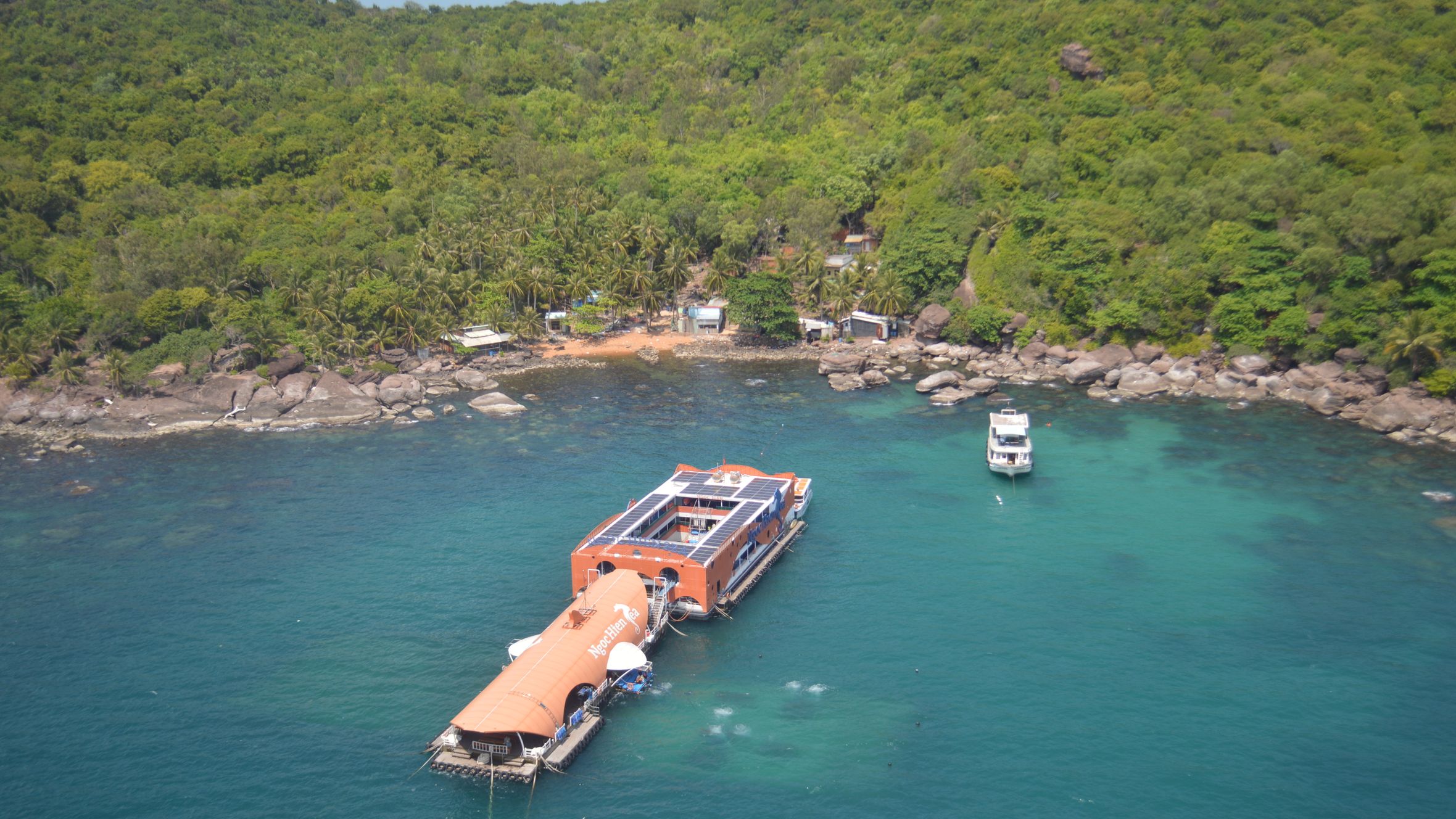
What Hon Rom is — and isn't
Hon Rom (Bai Bien Hon Rom) is a roughly 10 km crescent of sand curving north from Mui Ne (무이네 / 美奈 / ムイネー)'s main tourist strip. If you've seen photos of Mui Ne and imagined wide open beach with fishing boats and not much else, you were probably looking at Hon Rom without knowing it.
The name comes from a rocky headland — "hon" means islet or rock, "rom" refers to straw — that separates it from the more developed stretch closer to Mui Ne town. For years it was where local families came on weekends to grill seafood and camp. Tourism infrastructure arrived slowly: a few resorts in the early 2000s, then backpacker spots, then a scattering of mid-range places. It still doesn't have the density of Mui Ne proper, which is exactly the point.
Administratively, this coastal area now falls under Lam Dong province following the recent provincial merger. But geographically, nothing changed — it's the same dry, wind-scoured coastline it's always been.
Why travelers go
Hon Rom appeals to people who find Mui Ne's main drag too built-up but still want the same climate perks: 300+ sunny days a year, consistent wind October through March, and water warm enough to swim year-round.
The beach itself is wider than what you get in central Mui Ne. The sand is coarser, more golden than white, and at low tide you can walk for what feels like forever. There's no boardwalk, no strip of massage parlors, no thumping bar scene. After dark it gets genuinely quiet.
Kitesurfers and windsurfers know it well — the wind conditions north of the headland are reliable and the beach is less crowded, meaning fewer obstacles when launching or landing.
Best time to visit
The sweet spot is November through April. This is the dry season along this coast. Rain is rare, skies are clear, and temperatures sit around 28-32°C.
October through March is peak wind season, so if you're here for kite or windsurfing, that's your window. December and January get the strongest, most consistent wind.
May through September brings occasional afternoon rain and calmer seas. It's still perfectly fine for a beach trip — accommodation drops 30-40% in price — but the water can get murky after storms and the wind dies off.
Avoid Tet (usually late January or early February) unless you enjoy paying double for everything and sharing the beach with several thousand domestic tourists.
How to get there
The nearest major hub is Saigon (사이공 / 西贡 / サイゴン) (Ho Chi Minh City), roughly 200 km southwest.
- Bus: Sleeping buses from Saigon's Mien Dong bus station to Phan Thiet run throughout the day. Expect 4-5 hours and 150,000-200,000 VND per ticket. From Phan Thiet, a taxi or Grab to Hon Rom costs around 150,000-200,000 VND (about 20 km).
- Train: Saigon to Phan Thiet on the SPT1/SPT2 takes about 4 hours. Soft seat around 120,000-170,000 VND. Then taxi/Grab from the station.
- Motorbike: The ride from Saigon on the QL1A or the coastal DT719 is a solid 5-6 hours depending on traffic. The final stretch along the coast from Mui Ne to Hon Rom is one of the better rides in the south — sand dunes on one side, sea on the other.
- Private car: Book through your hotel or a Saigon travel agency. Expect 1,500,000-2,000,000 VND one way for a 4-seater.
If you're coming from Da Lat, it's about 4 hours by bus or car through the highlands, dropping from 1,500 m elevation down to sea level. The route through the Ngoan Muc Pass is worth doing in daylight.

Photo by thAnh nguyễn on Pexels
What to do
Walk the full beach at low tide
Seriously, just walk it. From the southern headland north toward Suoi Nuoc (Fairy Stream area), it's roughly 10 km of open sand. Bring water, a hat, and sunscreen. You'll pass fishing boats, a few beach bars, and long empty stretches where the only company is crabs.
Kitesurfing or windsurfing
Hon Rom has several schools along the beach. A beginner kitesurfing lesson (2-3 hours) runs around 1,500,000-2,500,000 VND. Gear rental for experienced riders is about 800,000-1,200,000 VND per half day. The flat, shallow water near shore makes it a forgiving spot to learn.
Ride out to the sand dunes
The red and white sand dunes are a short motorbike ride away. The white dunes (Bau Trang) are about 30 km northeast — go early morning before tour buses arrive. The red dunes are closer, maybe 10 km south, and best at sunset. You can rent a plastic sled from kids hanging around for 20,000-50,000 VND.
Watch the fishing fleet come in
Around 5-6 AM, the round basket boats ("thung chai") come back to shore near the south end of Hon Rom. Fishermen sort the catch right on the sand. If you're up that early, it's one of those scenes that reminds you this is still a working coast, not a resort stage set.
Sunset drinks at a beach bar
A handful of low-key spots serve cold beer and seafood right on the sand. A Saigon beer runs 15,000-25,000 VND. Some places do bonfires after dark when it's not too windy.
Where to eat nearby
Seafood is the obvious play. Small local restaurants along the road behind Hon Rom serve grilled fish, clams, and shrimp priced by the kilogram — expect 200,000-400,000 VND for a shared seafood spread for two with rice and beer.
Seek out "banh canh" — the thick tapioca-flour noodle soup that's a Phan Thiet staple. Crab or fish versions are common and cost 30,000-50,000 VND a bowl. For breakfast, look for "banh mi" carts near the main road — Phan Thiet-style with grilled pork and pickled daikon.
Where to stay
- Budget (300,000-500,000 VND/night): Basic guesthouses and hostels set back from the beach. Fans, cold water, hammocks. Fine for a night or two.
- Mid-range (800,000-1,500,000 VND/night): Beach-facing bungalows or small resorts with pools. This is the sweet spot — you get sea views and air conditioning without overpaying.
- Higher end (2,000,000-4,000,000 VND/night): A few boutique resorts with private beach access, decent restaurants, and kite schools on-site.
Book directly with smaller places if you can — they lose 15-20% to booking platforms and will sometimes give you a better rate or a room upgrade.

Photo by Serg Alesenko on Pexels
Practical tips locals would tell you
- Sunscreen is not optional. This coast is drier and sunnier than most of Vietnam. You will burn faster than you expect, even on overcast days.
- Rent a motorbike (150,000-200,000 VND/day) to get around. Taxis exist but are sparse outside the main Mui Ne strip. Grab works but drivers can take 15-20 minutes to reach Hon Rom.
- Bring cash. Most small restaurants and guesthouses along Hon Rom don't take cards. The nearest ATMs are in Mui Ne town or Phan Thiet.
- Check the tide. At high tide, parts of Hon Rom lose most of the sand. The beach is best 2-3 hours either side of low tide.
Common mistakes to avoid
- Booking a resort in Mui Ne and assuming Hon Rom is next door. It's 10+ km from central Mui Ne. If you want to be on Hon Rom, stay on Hon Rom.
- Skipping the morning. The beach is at its best before 9 AM — calm water, cool air, empty sand. By midday the wind picks up and it gets hot enough to drive everyone under a roof.
- Ignoring the jellyfish warnings. They show up occasionally between June and September. If locals tell you not to swim, listen.
Practical notes
Hon Rom works as a day trip from Mui Ne or Phan Thiet, but it's better as a 2-3 night stay if you want to actually slow down. The infrastructure is thin enough that you can't fill every hour with activities, and that's the whole appeal. Bring a book, eat seafood, watch the fishing boats — it's a coast that rewards doing less.
Last updated · May 26, 2026 · independently researched, never sponsored.