Ao Ba Om is one of those places that doesn't photograph particularly well but stays with you longer than most postcard views. It's a square, ancient pond ringed by massive old trees in what used to be Tra Vinh province — now part of the merged Vinh Long province in the Mekong Delta (메콩 델타 / 湄公河三角洲 / メコンデルタ). If you're passing through the south and want something quieter than the usual floating market circuit, this is worth a detour.
What it is and why it matters
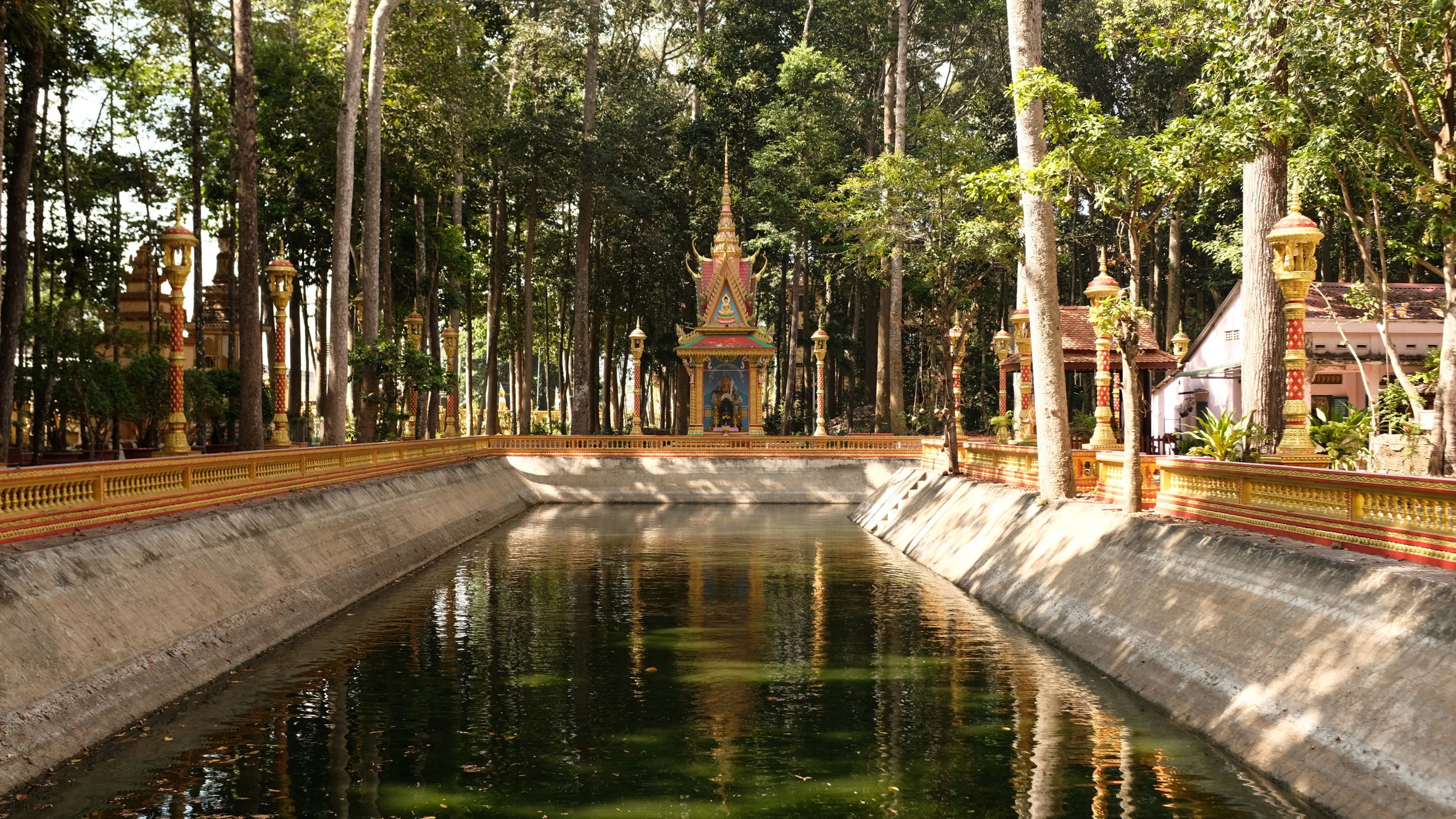
Ao Ba Om (literally "Ba Om Pond") is a large rectangular pond, roughly 300 meters by 500 meters, believed to have been dug by hand by the local Khmer community centuries ago. The origin story most locals will tell you involves a digging contest between men and women — the women won by tricking the men with a fake morning star, and the pond was named after a woman called Ba Om. It's a folk tale, but it gives you a sense of how deeply this place is woven into local Khmer culture.
The pond sits within a park shaded by over 100 old trees, many of them enormous "sao" trees with roots that buckle the walkways. Right next to the pond is the Khmer Culture Museum (Bao Tang Van Hoa Khmer), which houses a modest but worthwhile collection of Khmer artifacts, traditional clothing, and musical instruments from the region. The whole complex is considered a national heritage site.
Why travelers go
Most visitors come for the atmosphere rather than any single attraction. The canopy of old-growth trees keeps the area noticeably cooler than the surrounding town, and the pond itself has a stillness to it that feels genuinely old. It's a place where local families picnic on weekends, monks from the nearby Khmer pagodas walk in the mornings, and the pace of things slows down.
For anyone interested in the Khmer minority communities of the Mekong Delta — and there's a significant population here — Ao Ba Om is a natural starting point. The museum gives context, and there are several active Khmer pagodas within a few kilometers, including Ang Pagoda, one of the most important Khmer temples in the delta.
During the Ok Om Bok festival (usually falling in October or November, tied to the lunar calendar), the pond becomes the center of celebrations with boat races, lantern floating, and traditional Khmer music. If your timing lines up, it's one of the more genuine regional festivals you'll find in southern Vietnam (베트남 / 越南 / ベトナム).
Best time to visit
The dry season — December through April — is most comfortable. The Mekong Delta gets heavy rain from June to November, and while the pond looks beautiful with everything green, the park paths can get muddy and the humidity is punishing. Early morning visits (before 8 AM) are best year-round; by midday even the tree shade won't save you from the heat.
If you specifically want the Ok Om Bok festival, plan for mid-to-late October. Check the lunar calendar that year, as dates shift.
How to get there
Ao Ba Om is located about 5 km south of the old Tra Vinh town center, which is now a district within the expanded Vinh Long province.
From Can Tho: The most common jumping-off point. Buses run from Can Tho's central bus station to Tra Vinh town, taking about 2.5 hours and costing around 80,000–100,000 VND. From Tra Vinh town, a xe om (motorbike taxi) or Grab to Ao Ba Om runs about 15,000–25,000 VND.
From Saigon: Direct buses from the Mien Tay bus station to Tra Vinh take roughly 3.5–4 hours, costing 120,000–160,000 VND depending on the operator. Phuong Trang (FUTA) runs this route regularly.
By motorbike: If you're riding through the delta — and honestly, motorbike is the best way to experience this region — Ao Ba Om is about 100 km from Can Tho via QL54 and QL53. The roads are flat and mostly decent, typical delta riding.

Photo by Nguyen Truong Khang on Pexels
What to do
Walk the pond loop
The full walk around the pond takes about 30–40 minutes at a relaxed pace. The tree roots create a kind of natural sculpture garden, and there are benches scattered throughout. Bring water.
Visit the Khmer Culture Museum
Open daily, small entrance fee (around 10,000 VND). The collection isn't massive, but the displays on Khmer weaving, traditional "ao dai" variations specific to the Khmer community, and ritual objects are well-presented. Allow 30–45 minutes.
Explore Ang Pagoda
About 1 km from Ao Ba Om, Ang Pagoda (Chua Ang) is one of the oldest and most architecturally interesting Khmer pagodas in the delta. The ornate gateway and the painted interior are worth seeing. Dress modestly — shoulders and knees covered.
Catch a sunset at the pond
The western edge of the pond catches good light in the late afternoon. The water reflects the tree line, and the park empties out after 5 PM. Bring a mat if you want to sit.
Try Khmer noodle soup
Around the Tra Vinh area, look for "bun nuoc leo" — a Khmer-style noodle soup with a rich fish-based broth, fermented fish paste, and fresh herbs. It's distinct from any Vietnamese noodle soup you've had. Street stalls near the old Tra Vinh market serve it for 25,000–35,000 VND.
Where to eat nearby
Besides bun nuoc leo, keep an eye out for "banh tet" — the cylindrical sticky rice cakes common in the south, especially around Tet season but available year-round in Tra Vinh's markets. For a sit-down meal, small com binh dan (rice-and-dish) shops line the road between Tra Vinh town and Ao Ba Om. A full plate with two or three dishes runs 30,000–45,000 VND. Vietnamese coffee from any roadside stall will cost 12,000–18,000 VND and is reliably strong.
Where to stay
Tra Vinh town has basic guesthouses (nha nghi) starting at 150,000–250,000 VND per night — clean enough, air-conditioned, no frills. Mid-range hotels like Thanh Tra Hotel or Cuu Long Hotel offer rooms in the 400,000–600,000 VND range with breakfast included. There's nothing luxury-tier here, which is part of the appeal. Most travelers use Tra Vinh as a one-night stop between Can Tho and the coast.

Photo by Huỳnh Hoàng Hiền on Pexels
Practical tips locals would tell you
- Bring mosquito repellent. The tree cover and pond water mean mosquitoes are aggressive, especially at dawn and dusk.
- The museum closes for lunch (roughly 11:30 AM–1:30 PM). Plan accordingly.
- Shoes, not sandals. Tree roots make the paths uneven, and after rain they're slippery.
- Combine with a pagoda circuit. There are over 140 Khmer pagodas in the former Tra Vinh province. Rent a motorbike and visit three or four in a half day — each has its own character.
Common mistakes to avoid
- Rushing through. Ao Ba Om isn't an "attraction" you tick off in 20 minutes. The point is the slowness. Give it at least two hours, ideally a half day.
- Skipping the museum. It's small and easy to dismiss, but it contextualizes everything you see in the surrounding Khmer communities.
- Visiting only midday. The park bakes between 11 AM and 3 PM. Come early or late.
- Expecting tourist infrastructure. There are no English menus, no tour guides waiting at the gate, no souvenir shops. That's the whole point.
Practical notes
Ao Ba Om is free to enter; only the museum charges a small fee. The park is open from early morning until evening. If you're building a Mekong Delta itinerary beyond the usual Can Tho floating market loop, a night in Tra Vinh with Ao Ba Om and the surrounding pagodas gives you a side of the delta most travelers miss entirely.
Last updated · May 29, 2026 · independently researched, never sponsored.