What is Bat Canh Son
Bat Canh Son — literally "Eight Scenes Mountain" — is a cluster of limestone karst peaks about 15 km northeast of Ninh Binh (닌빈 / 宁平 / ニンビン) city, in an area that was formerly part of Ha Nam province before administrative boundary changes folded it into greater Ninh Binh. The name references eight distinct landscape views visible from different angles of the peaks, a poetic designation dating back to the Tran dynasty period when Buddhist monks established meditation caves here.
Unlike the boat-tour circuits at Tam Coc or the vast temple complexes of Bai Dinh, Bat Canh Son is a quieter site — a place where local families come on weekends and where you might be the only foreigner on the trail. The karst formations are the same geology that makes Ninh Binh famous, just without the infrastructure or the tour buses.
Why travelers go
People come here for three reasons: the hiking (short but steep scrambles with ridge views over rice paddies), the cave pagodas carved into the limestone, and the fact that it's genuinely uncrowded. If you've already done Tam Coc and Trang An and want something that feels less packaged, Bat Canh Son delivers that. It's not a full-day destination — think two to four hours — but it pairs well with other stops in the Ninh Binh area.
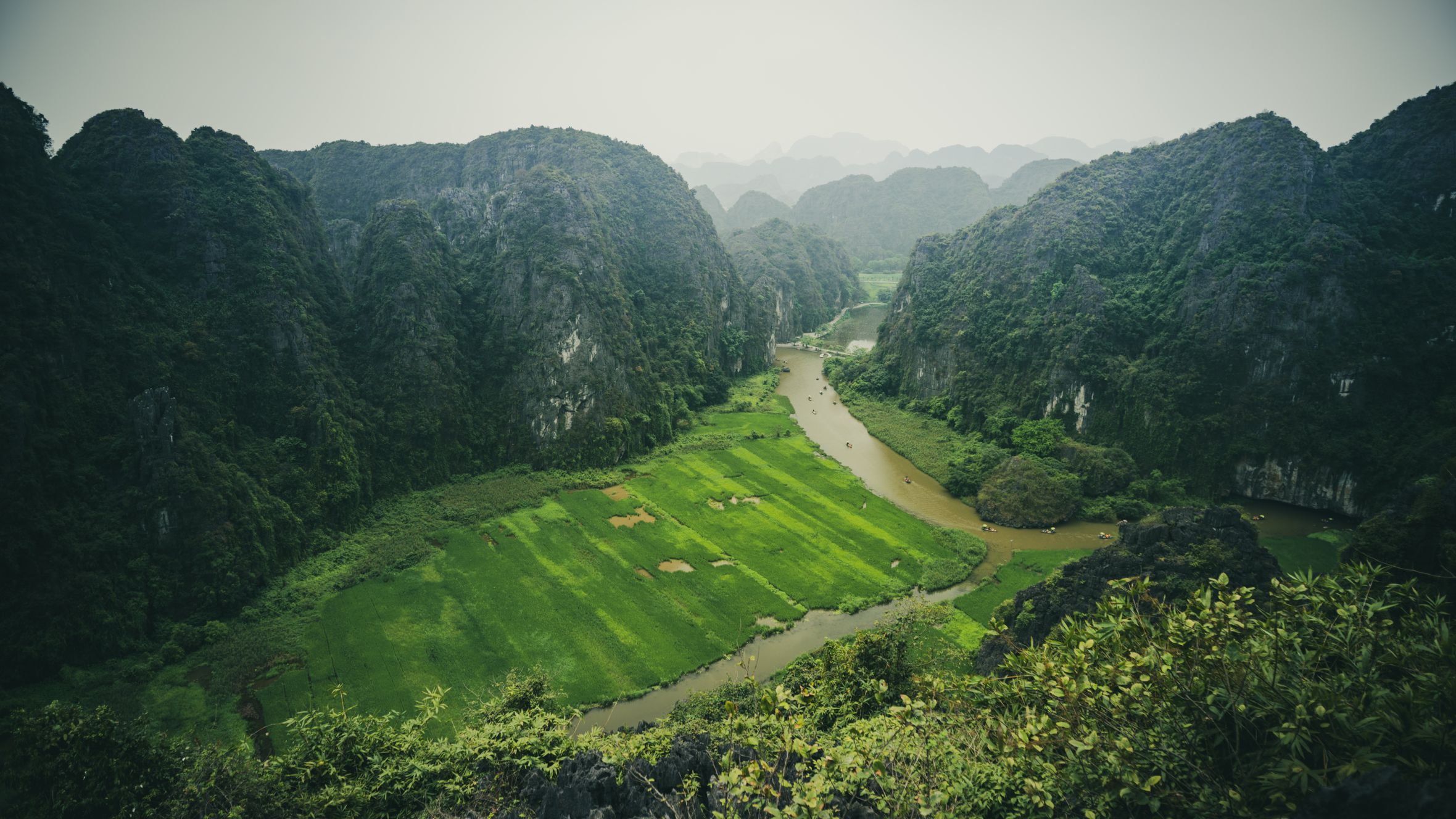
The landscape is classic Red River Delta karst: sheer-sided limestone towers rising out of flat, bright-green rice fields. From the ridgeline, you get wide views south toward Hoa Lu and the Trang An massif.
Best time to visit
The ideal window is October through April — dry season, cooler temperatures, and the rice paddies are either freshly planted (bright green) or ready for harvest (golden). January and February can be grey and drizzly, but rarely enough to cancel a hike.
Avoid June through August if you dislike heat. The limestone absorbs and radiates sun, and the scrambles have no shade. Temperatures hit 37-38°C regularly. If you do visit in summer, go before 8 AM.
The rice harvest around late May and late September/early October creates the most photogenic backdrop — the paddies turn gold and farmers are out working.
How to get there
From Ninh Binh city center, Bat Canh Son is about 15 km northeast, roughly a 25-minute motorbike ride along provincial roads through flat farmland. Options:
- Motorbike rental from your hotel in Ninh Binh or Tam Coc: 120,000-150,000 VND/day for a semi-automatic. This is the most practical option — roads are flat and quiet.
- Grab bike: Around 50,000-70,000 VND one way from Ninh Binh station. Getting one back can be tricky — cell signal is fine but drivers are fewer out here.
- Guided tour: Not commonly offered as a standalone trip. Some Ninh Binh guesthouses will arrange a private car and driver for a half-day loop (400,000-500,000 VND) combining Bat Canh Son with Hoa Lu or other nearby stops.
From Hanoi, take the train or bus to Ninh Binh first (2-2.5 hours, 80,000-120,000 VND by bus from Giap Bat station), then continue by motorbike.

Photo by Q. Hưng Phạm on Pexels
What to do
Hike the ridge trail
The main draw. A stone-step path leads up from the base to a ridgeline that connects several of the eight peaks. Total walking time is 60-90 minutes depending on how many viewpoints you hit. The steps are uneven and can be slippery after rain — proper shoes, not sandals. From the top, you look out over a flat patchwork of rice paddies with karst towers scattered in every direction.
Visit the cave pagodas
Two small pagodas are built into natural limestone caves at the base and mid-level of the peaks. They're active worship sites — you'll see incense burning and offerings. The architecture is modest compared to Bai Dinh, but the setting (altars tucked into dripping limestone, natural light filtering through cracks) is atmospheric. Remove shoes before entering.
Explore the surrounding rice paddies by bike
The flat roads around Bat Canh Son are ideal for cycling. Some guesthouses in Ninh Binh lend bicycles free or for 30,000-50,000 VND/day. The area between Bat Canh Son and Hoa Lu is especially good — narrow concrete paths between paddies, water buffalo, and almost zero traffic.
Combine with Hoa Lu ancient capital
Hoa Lu is only about 8 km south. The temples of Dinh Tien Hoang and Le Dai Hanh are worth an hour. Together with Bat Canh Son, you have a solid half-day loop that avoids the Trang An crowds entirely.
Photograph the karst at golden hour
The east-facing cliffs catch warm light in the late afternoon (the sun sets behind you as you look at the peaks from the paddy fields to the east). Arrive around 4:30 PM in winter for the best conditions.
Where to eat nearby
There's no real restaurant scene at Bat Canh Son itself — just a couple of drink stalls at the base selling water and sugarcane juice. Plan to eat in Ninh Binh town or along the road.
"Com chay" (burned rice) is the Ninh Binh signature — crispy rice crackers topped with stir-fried goat meat or pork. Look for it at local restaurants along Tran Hung Dao street in Ninh Binh city. A plate runs 60,000-80,000 VND.
Goat meat ("thit de") is the other regional specialty, served grilled, in hotpot, or stir-fried with lemon leaves. The cluster of goat restaurants near Thung Nham and along the road to Tam Coc are reliable — expect 150,000-250,000 VND per person for a full spread.
Where to stay
Most travelers base themselves in either Ninh Binh city or the Tam Coc area (about 7-9 km from Bat Canh Son).
- Budget: Hostels and family guesthouses in Tam Coc from 150,000-300,000 VND/night. Basic but clean, often with free bicycles.
- Mid-range: Boutique homestays with rice paddy views in the Tam Coc-Trang An corridor, 500,000-900,000 VND/night. Many have pools.
- Higher-end: A few resort-style properties near Trang An, 1,200,000-2,500,000 VND/night.
Ninh Binh city hotels are cheaper but less scenic. Good if you're arriving late by train and leaving early.

Photo by Hugo Guillemard on Pexels
Practical tips locals would tell you
- Bring water. There's one drink stall at the trailhead and nothing on the hike itself.
- Wear proper shoes with grip. The stone steps are polished smooth in places and mossy after rain.
- The site has no entrance fee as of early 2024. This could change — Ninh Binh has been adding ticketing to more sites.
- Morning light is better for photography from the western approach; afternoon from the east.
- Cell signal (Viettel, Mobifone) is fine throughout — you won't lose GPS navigation.
Common mistakes to avoid
- Wearing flip-flops: The scramble sections are genuinely steep. People slip every week.
- Coming midday in summer: No shade on the ridge, limestone radiates heat. You'll be miserable by the second viewpoint.
- Not combining it with other stops: Bat Canh Son alone is a 2-3 hour visit. Pair it with Hoa Lu, the Thung Nham bird garden, or a Tam Coc boat ride to fill a day.
- Expecting facilities: No cafe, no restaurant, no proper toilet at the site. Use the guesthouse before you leave.
Practical notes
Bat Canh Son works best as part of a Ninh Binh itinerary rather than a standalone day trip from Hanoi (하노이 / 河内 / ハノイ). Budget a half-day, combine it with Hoa Lu or cycling the backroads, and eat goat meat afterward. It's the kind of place that rewards you for having your own wheels and no fixed schedule.
Last updated · May 26, 2026 · independently researched, never sponsored.