
Cat Ba National Park covers roughly half of Cat Ba Island, the largest island in Ha Long Bay's sprawling archipelago. If you want jungle, limestone karst, and a real hike instead of just a boat cruise, this is where you go.
What It Is and Why It Matters
Established in 1986, the park protects around 16,500 hectares of tropical forest, mangrove wetlands, and coastal waters. It's one of the most biodiverse spots in northern Vietnam (베트남 / 越南 / ベトナム) — home to the Cat Ba langur, a golden-headed primate found nowhere else on earth. Fewer than 80 of them remain, making it one of the world's rarest primates.
The landscape is classic northern Vietnam karst: forested limestone peaks, hidden valleys, freshwater lakes tucked inside rock formations. But unlike Ha Long Bay (하롱베이 / 下龙湾 / ハロン湾), where you experience karst from a boat deck, Cat Ba puts you inside it — climbing through it, sweating through it.
Why Travelers Go
Most people visit Cat Ba Island as an alternative base for exploring Ha Long Bay, and the national park ends up being a half-day add-on. That's a mistake. The park deserves a full day minimum. The main draw is trekking through old-growth forest on limestone ridges, but there's also kayaking through mangrove channels, exploring Trung Trang Cave, and — if you're patient and lucky — spotting wildlife you won't see anywhere else in Vietnam.
It's also significantly quieter than the more commercial parts of Ha Long Bay. On a weekday outside of summer, you might share the main trail with fewer than a dozen other hikers.
Best Time to Visit
The sweet spot is September through November. The worst of the summer heat has passed, rain tapers off toward October, and the foliage is dense and green. Temperatures hover around 24-28°C.
March to May also works well — warm but not brutal, relatively dry. Avoid June through August if you can. It's peak domestic tourism season, the trails get muddy, and humidity sits above 85% most days. December through February is cool (15-20°C) and occasionally foggy, which some people enjoy, but visibility from the summit viewpoints drops.
How to Get There
From Hanoi, the most common route is a bus to Hai Phong (about 2 hours, 100,000-120,000 VND from Gia Lam or My Dinh stations), then a speedboat from Got ferry terminal in Hai Phong to Cat Ba town (roughly 1 hour, 250,000-300,000 VND). Total travel time is around 3.5 to 4 hours.
Alternatively, several tour operators run direct bus-plus-boat combos from Hanoi for around 350,000-400,000 VND one way. These are convenient but lock you into their schedule.
Once on Cat Ba Island, the national park entrance is about 15 km from Cat Ba town. A motorbike taxi costs around 80,000-100,000 VND one way, or you can rent a motorbike in town for 120,000-150,000 VND per day. The road is paved and straightforward.
Park entrance fee: 80,000 VND per person.

Photo by Karolina on Pexels
What to Do
Hike the Kim Giao Forest Trail to Ngu Lam Peak
This is the park's signature trek — roughly 6 km round trip through dense forest, ending at a viewpoint over the island and surrounding bay. The trail involves some scrambling over rocks and a few steep sections. Budget 3-4 hours. Bring water; there's no resupply on the trail. The view from the top gives you a different angle on the karst landscape than any boat tour offers.
Explore Trung Trang Cave
A 300-meter limestone cave near the park entrance with decent lighting and a paved walkway. It's not going to change your life, but it's worth 30-40 minutes if you're already there. The formations inside are genuinely impressive, and it rarely feels crowded.
Kayak the Mangrove Wetlands
The park's eastern side includes protected mangrove channels that you can explore by kayak. Several operators near Viet Hai village rent kayaks for around 150,000-200,000 VND for a half-day. Paddling through the mangroves at low tide, when the root systems are exposed, is one of the more memorable things you can do on Cat Ba.
Trek to Viet Hai Village
A longer hike (about 18 km round trip or 9 km one way if you arrange boat transport back) takes you through the park to Viet Hai, a small fishing village on the island's east coast. The trail passes through forest and farmland. You can hire a local guide at the park entrance for around 300,000-400,000 VND. The village itself is quiet — a handful of homestays, chickens in the road, cold beer.
Look for the Cat Ba Langur
You almost certainly won't see one. But if you're on the trails early in the morning and you stay quiet near the limestone cliffs on the park's eastern side, there's a slim chance. Even without a sighting, the guided langur conservation walks offered by the Cat Ba Langur Conservation Project are worth your time.
Where to Eat Nearby
Back in Cat Ba town after your hike, head to the waterfront strip along Nui Ngoc Road. Order "bun cha" from any of the small shopfront kitchens — the island version uses grilled fish alongside pork. Seafood here is fresh and cheap; a plate of steamed clams or grilled squid runs 80,000-150,000 VND. For something filling, ask for "bun rieu" — the crab-based noodle soup is a solid recovery meal after a day on the trails.
Wash it down with a glass of "bia hoi" from the draught stations near the harbour. It's around 10,000-15,000 VND a glass.
Where to Stay
Cat Ba town has the full range. Budget guesthouses start at 200,000-350,000 VND per night for a basic room with air conditioning. Mid-range hotels along the waterfront run 500,000-900,000 VND and usually include breakfast. A few higher-end resorts sit on the fringes of town at 1,200,000-2,500,000 VND per night.
If you want to stay closer to the park, there are homestays near Viet Hai village for around 300,000-400,000 VND per night — basic but clean, and you wake up inside the landscape.
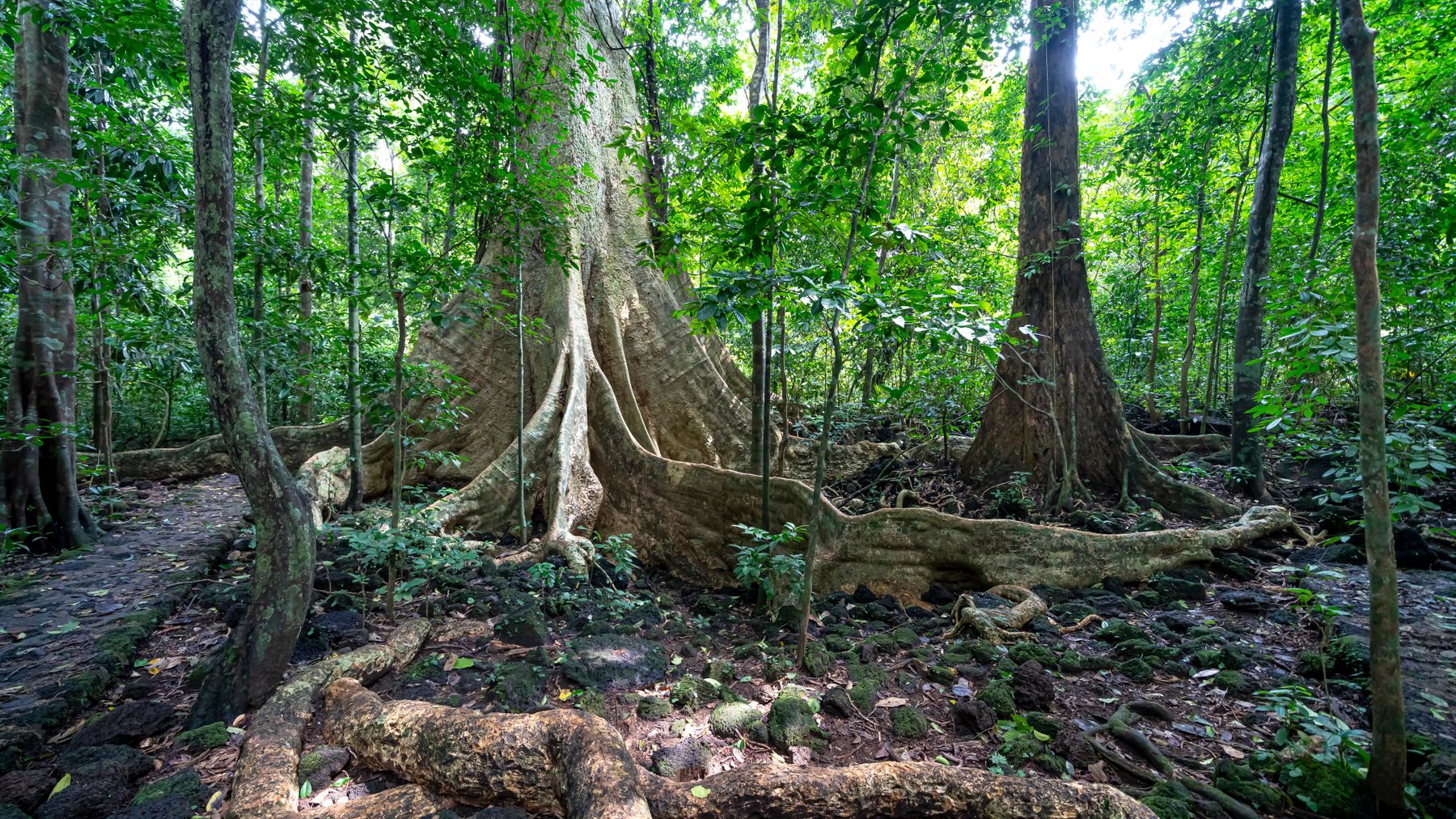
Photo by Quang Nguyen Vinh on Pexels
Tips Locals Would Tell You
- Start the Kim Giao trail before 8 AM. By midday the heat inside the forest canopy is punishing, even in shoulder season.
- Bring a refillable water bottle and at least 1.5 liters. There's no water on the trails.
- Leeches are real during and just after the rainy season (June-September). Tuck your pants into your socks and carry salt or a lighter.
- The park closes its gates at 5 PM. Don't start the Viet Hai trek after noon unless you've arranged to stay overnight.
- Rent a motorbike only if you're comfortable riding. The road to the park has some curves, and local traffic doesn't always follow lane discipline.
Common Mistakes
- Treating the national park as a two-hour detour. Give it a full day.
- Wearing sandals on the trails. The rocks are sharp and often wet. Proper shoes with grip matter.
- Skipping the mangrove kayaking. It's easy to focus on the forest trek and miss one of the park's best features.
- Visiting on a weekend in July. You'll share the trails with large domestic tour groups and lose the atmosphere entirely.
Practical Notes
Cat Ba Island is an easy side trip from either Hanoi or Hai Phong, and combining the national park with a day cruise through Ha Long Bay makes for one of the better three-day trips in northern Vietnam. Bring cash — ATMs in Cat Ba town exist but aren't always reliable. And don't skip the park just because someone told you Ha Long Bay is the real attraction. The bay is the postcard. The park is the experience.
Last updated · May 29, 2026 · independently researched, never sponsored.






