Before Hanoi was anything more than a swampy bend in the Red River, Hoa Lu was where Vietnamese kings held court. Spending a morning here — properly, not just a drive-by — gives you a cleaner read on early Vietnamese statehood than most museums manage.
Why Hoa Lu Was the Capital
In 968 CE, Dinh Bo Linh unified the warring lords of the Twelve Warlords period and declared himself emperor of Dai Co Viet — Vietnam (베트남 / 越南 / ベトナム)'s first fully independent state after a millennium of Chinese rule. He chose Hoa Lu, about 90 km south of present-day Hanoi, as his capital. The location wasn't accidental. The site is ringed by sheer limestone karst peaks that drop straight into rice paddies, forming a natural fortress. Rivers thread through the valleys and could be blocked with iron chains to stop river-borne attacks. For a new state still nervous about Chinese reconquest from the north, it was defensible terrain first, administrative convenience second.
The capital stayed here through the short-lived Early Le dynasty — founded by Le Hoan in 980 CE after he overthrew the Dinh line — and was only abandoned in 1010, when Ly Thai To moved the court north to Thang Long, the city that became Hanoi (하노이 / 河内 / ハノイ). The Imperial Citadel Thang Long, which you can still visit in Hanoi today, is the direct successor to what began here.
Hoa Lu itself was never a large city. Estimates put the walled royal enclosure at around 300 hectares. Almost nothing of the original palace structures survives above ground — centuries of weather, war, and stone-robbing for other construction saw to that. What you visit today are two temples built much later, during the 17th century, on the original palace foundations.
The Two Temples
Den Dinh Tien Hoang
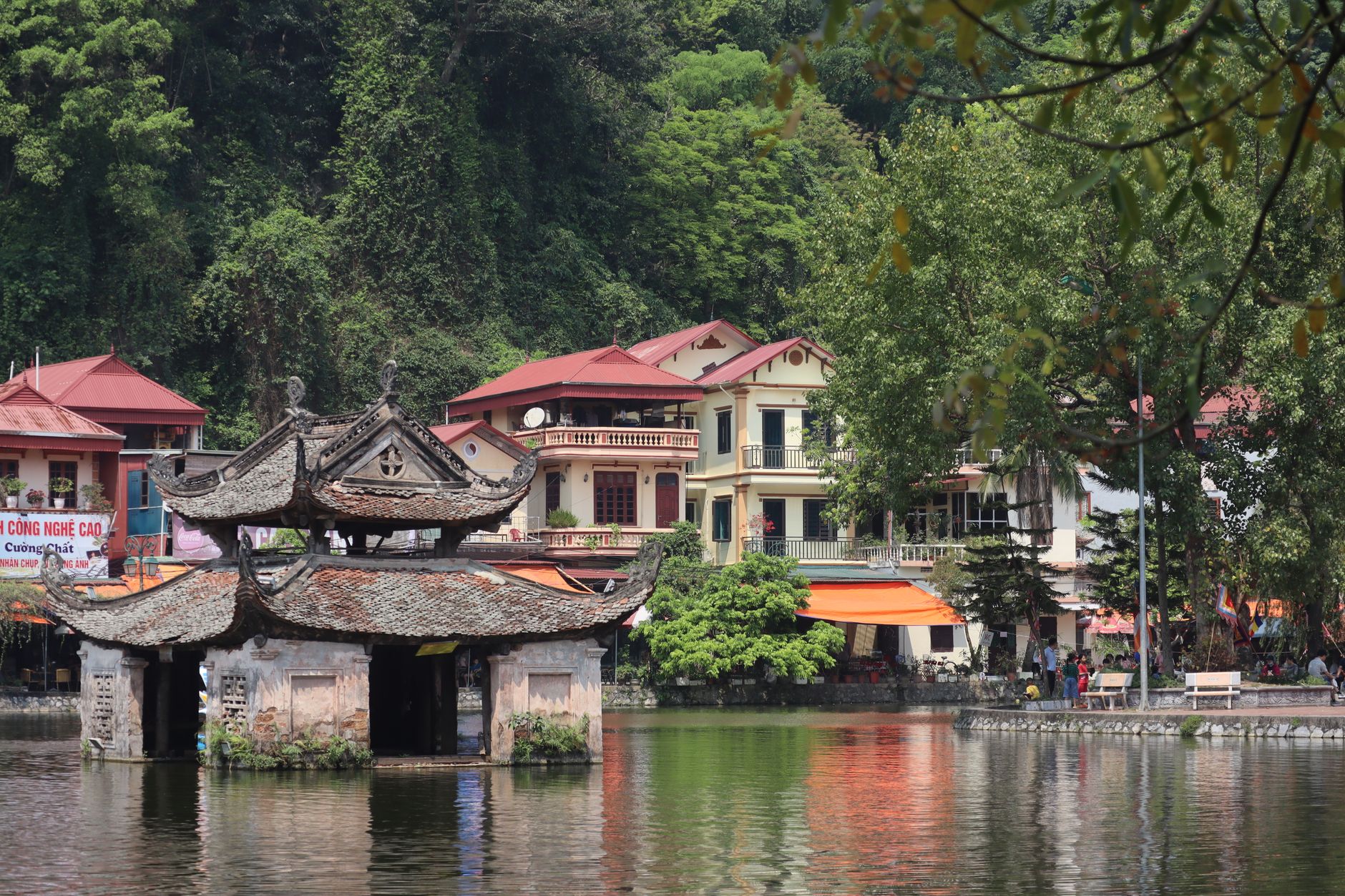
The temple dedicated to Dinh Bo Linh — the title Dinh Tien Hoang, meaning "First Emperor Dinh" — sits in the northern compound and is the larger of the two complexes. You walk through a series of stone courtyards before reaching the main sanctuary. Inside, the altar holds a gilded statue of the emperor flanked by his three sons. The carved wooden screens and lacquered columns are 17th-century work, dark with incense smoke and age.
Spend a moment in the rear courtyard. There's a low stone stele there, and the whole space feels genuinely quiet compared to the car park outside. Locals do come here to burn incense and make offerings — this isn't a dead museum piece, it's an active site of reverence.
Den Le Dai Hanh
A few hundred meters southwest, the smaller temple honors Le Hoan (Le Dai Hanh), the general who took power after the Dinh dynasty collapsed and successfully repelled a Song Chinese invasion in 981 CE. The architecture is similar — layered gatehouses, stone dragons on the steps, a central altar — but the compound feels more intimate. There's also a side shrine to Duong Van Nga, the queen who served both emperors, which is an interesting footnote in a history that doesn't always foreground its women.

Photo by Bid on Pexels
Getting There and Logistics
Hoa Lu is about 12 km north of Ninh Binh town. From Ninh Binh, a xe om (motorbike taxi) will run you there for around 60,000–80,000 VND one way. If you've hired a bicycle or motorbike in town, the road is flat, well-signed, and takes about 25 minutes. Entry to the temple complex costs 20,000 VND per person — one of the more honest admission prices in the country.
The site opens at 7:00 AM. Go early. By 9:30 AM the tour buses start arriving, and the courtyards that felt contemplative at 8:00 AM fill up fast.
Pairing It With Tam Coc
Tam Coc is 9 km south of Hoa Lu, which makes combining both in a single day straightforward. The natural logic is: Hoa Lu first thing in the morning (temple crowds build through the day), then pedal or ride down to Tam Coc for a late-morning boat trip through the karst caves, then lunch.
Along the road between the two, several family-run places serve "com nieu" — rice cooked in clay pots — alongside grilled goat meat ("de nui"), which is the signature protein of Ninh Binh province. A full meal with de nui, morning glory stir-fry, and rice at one of the roadside spots costs around 80,000–120,000 VND per person. Don't skip it in favor of eating back in Ninh Binh town; the food is noticeably fresher and cheaper out here.
If you're coming from Hanoi as a day trip, the train to Ninh Binh takes about 2 hours and costs 75,000–110,000 VND depending on class. First departure from Hanoi is around 6:05 AM, which gets you to Ninh Binh before 8:30 AM — early enough to do Hoa Lu properly before the heat and crowds settle in.
Photo by Bid on Pexels
What Hoa Lu Is — and Isn't
Manage expectations going in: this is not Angkor. There are no sprawling palace ruins, no towering stone towers. The original capital is mostly farmland and karst now. What the site does well is atmosphere and framing — standing in those 17th-century temple courtyards knowing you're on the footprint of Vietnam's first royal palace, looking out at the same cliff faces that the Dinh emperors looked at, carries genuine weight if you come with a bit of historical context.
Pair it with a good read the night before. The temples reward curiosity more than they reward passive sightseeing.
Practical Notes
Hoa Lu and Tam Coc can both be done as a long day trip from Hanoi, or more comfortably as part of a one-night stay in Ninh Binh. The temple complex at Hoa Lu takes about 45–60 minutes at a relaxed pace. Dress modestly — shoulders and knees covered — as both temples are active worship sites.
Last updated · May 29, 2026 · independently researched, never sponsored.