What is Hon Ba?
Hon Ba is a small rocky island sitting about 200 meters off the coast of Vung Tau, connected to the mainland by a submerged rocky path that only appears during low tide. On top of it sits a modest temple — Minh Duc Hon Ba — perched on volcanic rock above the sea. The whole island is barely larger than a football pitch.
The temple dates back to the early 1970s, built by a Buddhist monk who hauled materials across the tidal path by hand. It's been rebuilt and expanded since, but the setting remains the same: a weathered shrine on bare rock, surrounded by water on all sides when the tide comes in. There's no grand architecture here — just the odd experience of walking across the ocean floor to reach a place that disappears twice a day.
With Vung Tau (붕따우 / 头顿 / ブンタウ) now part of the expanded Ho Chi Minh City administrative area, Hon Ba is technically a Saigon day trip, though most people still think of it as part of the Vung Tau coastline.
Why travelers go
Hon Ba isn't a major attraction in the usual sense. There's no entrance fee, no tour guide, no souvenir shop. People go for one reason: the tidal crossing. Walking 200 meters across exposed seabed — stepping on algae-slicked rocks with waves lapping at your ankles — to reach a temple on a rock in the ocean is genuinely unusual. It's one of those experiences that photographs can't quite capture because the appeal is physical. You feel the pull of the tide, the uneven rock under your feet, the wind once you're out there.
The temple itself is simple. A few altars, incense, a small courtyard. The real draw is sitting on the rocks and watching fishing boats pass while Vung Tau's coastline stretches behind you. On a clear day, you can see the Christ of Vung Tau statue on Nui Nho from here.
Best time to visit
Timing is everything at Hon Ba — literally. You can only cross to the island during low tide. The path is submerged the rest of the time.
Dry season (November to April) is best. Skies are clearer, seas calmer, and the tidal windows tend to be more predictable. The lowest tides usually fall between the 1st and 3rd and the 14th and 17th of each lunar month. Check a tide chart for Vung Tau before you go — this is non-negotiable.
The crossing window typically lasts 2-4 hours. Morning low tides (around 6:00-9:00 AM) are ideal because the light is good and you avoid the midday heat on exposed rock.
Avoid visiting during rainy season storms (July-September) when seas are rough and the rocks become dangerously slippery.
How to get there
Hon Ba sits along Hai Dang street on Vung Tau's southwestern coast, near the foot of Nui Nho (Small Mountain).
From Saigon (사이공 / 西贡 / サイゴン): The fastest option is a hydrofoil from Bach Dang Wharf (District 1) to Vung Tau. Greenlines or Vung Tau Express run multiple daily departures. The ride takes about 90 minutes and costs 250,000-350,000 VND one way. From Vung Tau's hydrofoil terminal, Hon Ba is about 4 km south — a 15-minute taxi or xe om ride for 30,000-50,000 VND.
Alternatively, buses from Mien Dong bus station take around 2-2.5 hours and cost 70,000-120,000 VND. If you're riding a motorbike, it's roughly 120 km via the Vung Tau expressway, about 2 hours without traffic.
From Vung Tau center: Hon Ba is at the southern end of town, near Nghinh Phong cape. Most hotels can point you in the right direction. If you're staying along Back Beach (Bai Sau), it's a 10-15 minute motorbike ride.

Photo by Tường Chopper on Pexels
What to do
Walk the tidal path
This is the main event. The rocky causeway is rough and uneven — wear shoes with grip, not flip-flops. Water may still be ankle-deep in spots even at low tide. Take your time. Locals who do this regularly move slowly and deliberately. Follow their lead.
Explore the temple
Minh Duc Hon Ba temple is small but atmospheric. Leave a small donation if you visit the altar. The courtyard has a few benches where you can sit and take in the view. Dress modestly — shoulders and knees covered — as you would at any Vietnamese temple.
Watch the tide come in
If your timing allows, watching the path slowly disappear as the tide rises is oddly compelling. Some visitors time it so they're the last ones back. Don't cut it too close — getting stranded means waiting 8-10 hours for the next low tide, and the island has no facilities.
Walk the Nghinh Phong cape area
The coastline near Hon Ba is worth exploring on foot. The rocky shore around Nghinh Phong (Wind-Greeting Cape) is a popular spot for Vung Tau locals in the early morning. It connects to paths leading up toward the lighthouse on Nui Nho.
Combine with Bai Dau or the lighthouse
Bai Dau (Mulberry Beach) is a short ride north, a quieter alternative to Vung Tau's main beaches. The Vung Tau Lighthouse on Nui Nho is walkable from the Hon Ba area — about 1 km uphill — and gives a panoramic view of the coastline.
Where to eat nearby
Vung Tau is serious seafood territory. Within a few kilometers of Hon Ba, you'll find local restaurants along Hai Dang street and Tran Phu serving grilled fish, steamed clams, and salt-and-pepper squid at reasonable prices — expect 80,000-150,000 VND per person for a full seafood meal.
Two things worth seeking out: "banh khot" — small crispy turmeric pancakes topped with shrimp, a Vung Tau specialty you'll find at dedicated banh khot shops around town. Banh Khot Goc Vu Sua on Nguyen Truong To street is a reliable choice, around 40,000-60,000 VND per portion. Also try "hu tieu" for breakfast — the southern-style noodle soup is everywhere in Vung Tau and makes a solid pre-tide-crossing meal.
Where to stay
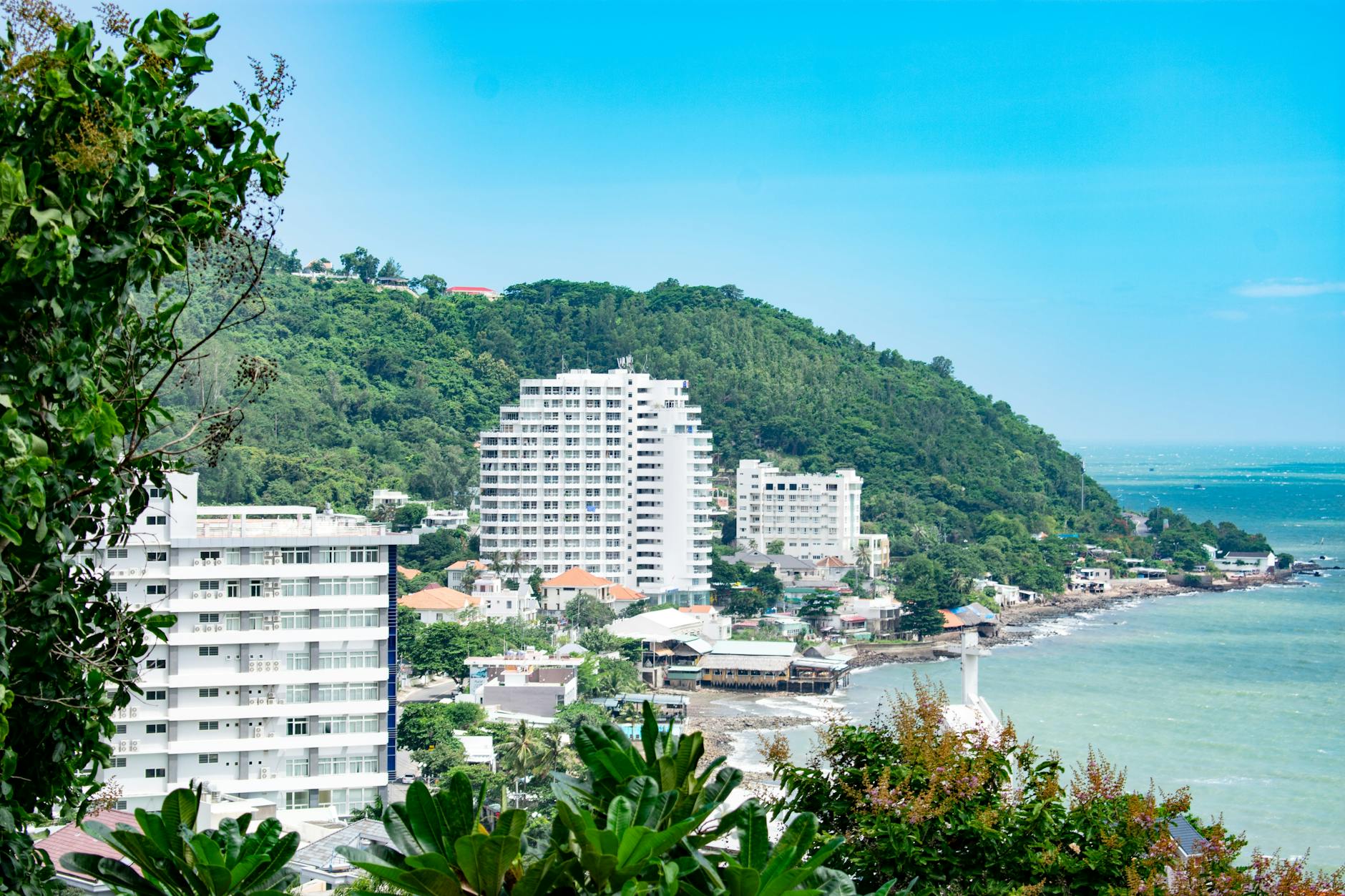
Most travelers base themselves along Bai Sau (Back Beach) or Bai Truoc (Front Beach) in Vung Tau and visit Hon Ba as a morning trip.
- Budget: Guesthouses and mini-hotels along Bai Sau run 200,000-400,000 VND/night. Basic but clean, often with motorbike rental.
- Mid-range: Decent hotels with sea views along Thuy Van street go for 500,000-1,000,000 VND/night.
- Higher-end: A few resort-style properties near Bai Truoc charge 1,500,000-3,000,000 VND/night with pools and breakfast included.
Booking ahead on weekends is smart — Vung Tau fills up fast with Saigon day-trippers.

Photo by Pham Huan on Pexels
Practical tips locals would tell you
- Check the tide chart. This cannot be overstated. Search "lich thuy trieu Vung Tau" (Vung Tau tide schedule) online — several Vietnamese sites publish monthly charts. No low tide, no crossing.
- Wear proper shoes. The rocks are covered in algae and barnacles. Cuts from barnacles get infected fast in tropical heat.
- Bring water. There's nothing to buy on the island.
- Go early. The best light, fewer people, and morning low tides line up well.
- Sunscreen and a hat. There is zero shade on the crossing path and very little on the island itself.
Common mistakes to avoid
- Showing up without checking the tide and finding nothing but ocean where the path should be. This happens constantly.
- Wearing flip-flops on the crossing. You will slip.
- Staying too long on the island and getting caught by the rising tide. Set a phone alarm for one hour before the tide is due to turn.
- Visiting on a weekend or public holiday and finding the path crowded shoulder-to-shoulder. Weekday mornings are far more pleasant.
- Assuming the island has food, water, or toilets. It doesn't.
Practical notes
Hon Ba works best as one stop on a Vung Tau day trip from Saigon — combine it with seafood, the lighthouse, and a beach. The whole island visit takes 1-2 hours including the crossing. It costs nothing but timing and a pair of sturdy shoes.
Last updated · May 26, 2026 · independently researched, never sponsored.