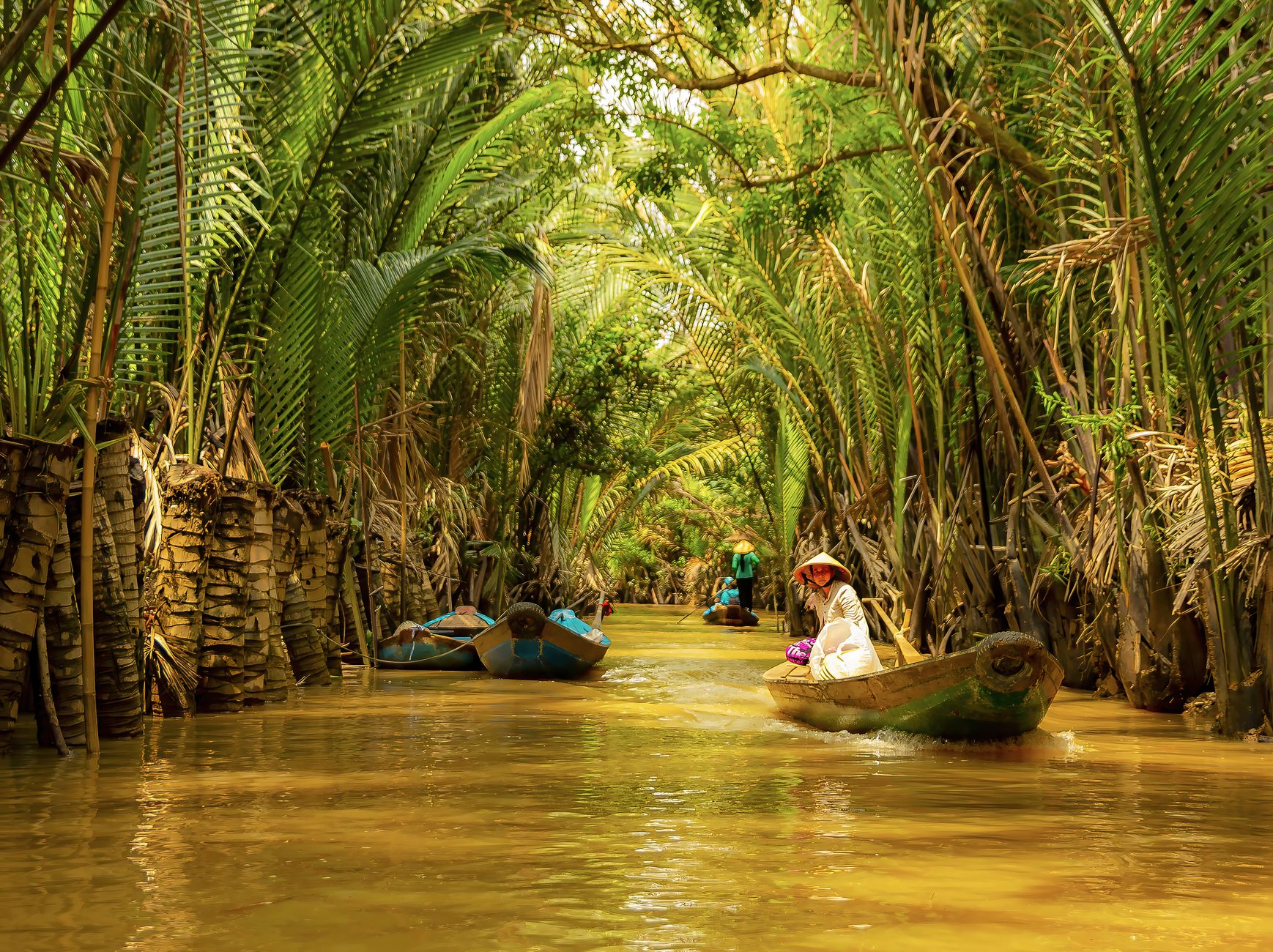
Mui Ca Mau is the geographic full stop at the bottom of Vietnam. It's where the land finally gives up and dissolves into mangrove, mud, and open sea. Most Vietnamese know it as a patriotic symbol — the southern anchor of the country — but for travelers, it's a genuine end-of-the-road destination with a landscape unlike anything else in the Mekong Delta (메콩 델타 / 湄公河三角洲 / メコンデルタ).
What it is
Mui Ca Mau sits inside Ca Mau Cape National Park, about 110 km southwest of Ca Mau city. The cape is a UNESCO Biosphere Reserve, a sprawling tangle of mangrove forest where rivers bleed into the Gulf of Thailand. At the tip, there's a concrete marker — the GPS coordinates monument — that marks the southernmost point of mainland Vietnam (베트남 / 越南 / ベトナム). The land here is still growing: sediment deposits push the coastline outward by roughly 80-100 meters per year, so the "end" keeps moving.
The area was nearly impenetrable swamp for centuries. French colonial maps barely detailed it. During wartime, the mangrove forests served as cover for resistance fighters, and much of the forest was damaged by chemical defoliation. What you see today is largely regrown — a second-generation mangrove ecosystem that's become one of the largest intact mangrove areas in Southeast Asia.
Why travelers go
Honestly, it's not for everyone. There are no resort beaches or Instagram cafes. People come here because they want to reach the literal end of the country, because they're into birding or mangrove ecology, or because they're tracing the full length of Vietnam and want the satisfaction of finishing.
The journey itself is half the draw. The final stretch is by speedboat through narrow waterways hemmed in by walls of mangrove. If you've spent your trip in cities and tourist towns, this is a hard reset — just water, mud, and sky.
Best time to visit
The dry season from December to April is the practical window. Ca Mau province gets hammered by rain from May through November — we're talking Delta-level downpours that can make boat travel unpredictable and trails around the cape muddy to the point of impassable. January to March is the sweet spot: less rain, slightly cooler temperatures (still 28-32°C), and calmer seas.
Avoid Tet if you don't want to deal with boat schedule disruptions and accommodation being booked out in Ca Mau city.
How to get there
The nearest major hub is Ca Mau city, which is your staging point.
Getting to Ca Mau city
From Saigon, you have two main options. Buses run from the Mien Tay bus station to Ca Mau — roughly 350 km, about 7-8 hours, and tickets cost around 180,000-250,000 VND depending on the operator. Phuong Trang (Futa) runs frequent departures. Alternatively, fly from Tan Son Nhat to Ca Mau airport — Vietnam Airlines operates the route, flight time is about 1 hour, and tickets run 800,000-1,500,000 VND if booked in advance.
If you're coming from Can Tho, it's about 180 km by bus, around 3.5-4 hours, costing roughly 120,000-150,000 VND.
Getting from Ca Mau city to the cape
From Ca Mau city, head to the Dat Mui boat pier (Ben Tau Dat Mui). You can take a public speedboat — the ride is about 90 minutes and costs around 100,000-130,000 VND one way. Boats typically leave in the morning, so plan to go early. Some travelers rent a private boat, which gives more flexibility but costs significantly more — expect 1,500,000-2,500,000 VND for a round trip.
An alternative route goes partly by road to Nam Can town (about 60 km by motorbike or car, 1.5 hours), then by boat the remaining distance. This shortens the water portion but adds a land leg.

Photo by maxed. RAW on Pexels
What to do
Walk the boardwalk to the GPS monument
The elevated wooden boardwalk cuts through the mangrove forest to the cape's tip. It's roughly 1.3 km and takes about 20 minutes. At the end sits the concrete marker with Vietnam's coordinates. The surrounding view is flat — mangrove canopy in every direction, tidal flats, and open water. It's quiet and a little eerie. Get there early morning before tour groups arrive.
Explore the mangrove forest by boat
Hire a small wooden boat ("xuong") to navigate the narrower canals. This is the best way to see the mangrove ecosystem up close — root systems arching out of the water, mudskippers, and if you're lucky, monitor lizards. A guided boat tour through the national park runs about 200,000-400,000 VND depending on duration and group size.
Visit the lighthouse
The Ca Mau Cape Lighthouse (built in 2013) stands about 20 meters tall. Climb to the top for a panoramic view over the mangrove canopy and coast. It's right near the main visitor area, so it takes minimal extra effort.
Birding at dawn
The national park hosts over 200 bird species including egrets, herons, cormorants, and kingfishers. The "vuon chim" (bird garden) areas inside the park are best visited at dawn or dusk when birds return to roost. Ask your boat operator to take you to the nesting areas — they know the spots.
Watch the sunset from the western shore
Mui Ca Mau faces west toward the Gulf of Thailand. If you're staying overnight in the Dat Mui area, the sunset over open water with silhouetted mangroves is genuinely worth sticking around for.
Where to eat nearby
Ca Mau province is known for its seafood, pulled straight from the surrounding waters and shrimp farms. Two things to seek out:
"Bun nuoc leo" — a southern soup with fermented fish broth, shrimp, roasted pork, and fresh herbs over rice noodles. It's a Mekong Delta staple and the versions in Ca Mau city are among the best. Try the stalls along Ly Bon street near the central market.
Mud crab — Ca Mau produces more mud crab than almost anywhere in Vietnam. Restaurants in Ca Mau city serve them steamed, fried with tamarind, or in hot pot. Expect to pay 300,000-500,000 VND per kg depending on the season. Quan Hai San Thanh Dat near the river is a reliable option.
At the cape itself, food options are limited to a few basic eateries serving rice plates and seafood. Eat well in Ca Mau city before heading out.
Where to stay
Most travelers base in Ca Mau city and do the cape as a day trip.
- Budget: Guesthouses around the market area run 200,000-350,000 VND/night. Basic but functional.
- Mid-range: Muong Thanh Ca Mau or Anh Nguyet Hotel — clean rooms, air conditioning, around 500,000-800,000 VND/night.
- At the cape: There's a basic guesthouse (nha nghi) in Dat Mui commune. Don't expect luxury — you're here for the experience, not the thread count. Around 250,000-400,000 VND.

Photo by Haneul Trac on Pexels
Practical tips
- Bring cash. There are no ATMs at the cape, and card payments don't exist out there. Stock up in Ca Mau city.
- Mosquito repellent is essential. You're walking through mangrove swamp — the insects are prolific.
- Wear shoes that can get muddy. Flip-flops won't cut it on the boardwalk edges or boat landings.
- If you're prone to motion sickness, take medication before the speedboat ride. The water can be choppy, especially on the return trip in the afternoon.
- Learn the boat schedule the night before. Public speedboat departures are limited and they won't wait.
Common mistakes to avoid
- Trying to do it as a rushed day trip from Saigon. The travel time alone makes that miserable. Spend at least one night in Ca Mau city.
- Showing up in rainy season without checking conditions. Boats get cancelled. Trails flood. Call ahead or ask your hotel to confirm boat schedules.
- Expecting a beach. The cape is mud and mangrove, not sand. If you want southern beaches, Phu Quoc is a different trip entirely.
- Skipping the boat tour and only doing the boardwalk. The monument walk takes 20 minutes. Without the canal exploration, you'll feel like you traveled a long way for a photo op.
Final note
Mui Ca Mau rewards the kind of traveler who values the journey and the geography over polished attractions. It's raw, remote, and genuinely unlike anywhere else in the Mekong Delta. Budget two full days from Ca Mau city and let the mangroves do their thing.
Last updated · May 29, 2026 · independently researched, never sponsored.