
Doi Che Cau Dat is a working tea plantation about 25 km southeast of Da Lat, sitting at roughly 1,650 meters above sea level. The hills aren't a theme park or a curated tourist attraction — they're an active farm where people harvest tea year-round. That's exactly what makes them worth the ride.
What it is and how it got here
The plantation dates back to the French colonial period, when agronomists realized the cool climate and red basalt soil around Da Lat (달랏 / 大叻 / ダラット) were ideal for growing "Oolong" and green tea. Cau Dat Tea Company was formally established in the 1920s, and the terraced rows you see today follow patterns laid out nearly a century ago. The operation changed hands after 1975 but never stopped producing. Today it supplies tea leaves to domestic brands and exports, while the photogenic hillside has become one of the most-visited landscapes in the Da Lat area.
With the recent administrative merger that expanded the Lam Dong provincial boundary to include parts of the former Dak Nong and Binh Thuan provinces, Cau Dat now technically sits within a much larger province — but for travelers, nothing has changed on the ground. You still base yourself in Da Lat and ride out.
Why travelers go
The draw is simple: row after row of bright-green tea bushes rolling over gentle hills, usually wrapped in a thin morning mist. It's a landscape you can actually walk through, not just photograph from a viewpoint. The altitude keeps temperatures between 15–22°C most of the year, which feels like a relief if you've just come from Saigon or the coast. There's no entry fee for most of the hillside (though a few sections near the processing facility may charge 20,000–30,000 VND). The area is quiet on weekdays — a sharp contrast to Da Lat's increasingly crowded center.
Best time to visit
The tea is green year-round, but conditions vary:
- November to March — Dry season with cooler mornings. The mist clears by 8–9 AM, giving you clean light for photos. This is peak domestic tourism season in Da Lat, but Cau Dat stays relatively uncrowded compared to the city.
- April to June — Shoulder months. Warmer, fewer visitors, occasional afternoon rain but mornings are usually clear.
- July to October — Wet season. Rain can roll in anytime. The hills are at their greenest, but mud on the paths between rows makes walking tricky.
For the best light, arrive before 7:30 AM regardless of season. By mid-morning the mist burns off and tour groups start arriving.
How to get there from Da Lat
Cau Dat is about 25 km from Da Lat center, heading southeast on Provincial Road 723 (now sometimes marked as part of the expanded Lam Dong road network). The ride takes 40–50 minutes by motorbike.
- Motorbike rental — The most common option. Rentals in Da Lat run 120,000–180,000 VND/day for a semi-automatic. The road is paved the whole way, with a few steep sections near Cau Dat town. Fill up before you leave Da Lat; fuel stations thin out past Xuan Truong.
- Grab/taxi — A car from Da Lat center costs around 250,000–350,000 VND one way. Negotiate a round-trip with wait time (expect 500,000–700,000 VND for 3–4 hours total).
- Guided tour — Several Da Lat tour operators bundle Cau Dat with other stops (Linh Phuoc Pagoda, flower farms) for 300,000–500,000 VND per person. Fine if you want logistics handled, but you'll spend less time at the tea hills themselves.

Photo by Quang Nguyen Vinh on Pexels
What to do
Walk the tea rows
The main thing. Follow the dirt paths between the bushes and head uphill for the widest views. The rows closest to the road get the most foot traffic — walk 10 minutes deeper and you'll mostly have the hillside to yourself. Wear shoes with grip; the soil is soft and slippery after rain.
Visit the Cau Dat Farm processing area
The Cau Dat Farm complex near the hilltop has a small café and a tea-tasting area where you can sample fresh Oolong, green tea, and "tra atiso" (artichoke tea, a Da Lat specialty). A pot of Oolong costs around 50,000–80,000 VND. You can buy packaged tea directly — prices are reasonable compared to what you'd pay in Da Lat's tourist markets.
Ride to Tram Hanh village
About 5 km past the main tea hills, Tram Hanh is a small Cham community settlement. There isn't a formal tourist setup, but you can see traditional weaving and buy handmade textiles directly from households. It's a quiet stop that adds context to the area beyond tea.
Photograph the pine forests along the road
The ride from Da Lat to Cau Dat passes through stretches of tall pine forest. Several pull-off spots along Provincial Road 723 offer views down into misty valleys. These are worth a 5-minute stop on the way.
Catch the sunset from the upper ridge
If you time your visit for late afternoon, the western-facing slopes of Cau Dat catch golden light from around 4:30–5:30 PM (depending on season). Far fewer people come at this hour.
Where to eat nearby
Cau Dat town has a handful of local rice shops along the main road. Nothing fancy — expect "[com tam](/posts/com-tam-saigon (사이공 / 西贡 / サイゴン)-broken-rice)" (broken rice plates) and "bun bo Hue" for 35,000–50,000 VND. A small place near the intersection of the road to Tram Hanh serves solid "banh canh" with pork — thick tapioca noodles in a peppery broth, around 40,000 VND. If you need more options, eat before you leave Da Lat or pack something. The Cau Dat Farm café serves pastries and light snacks alongside tea, but it's not a full meal.
Where to stay
Most travelers stay in Da Lat and day-trip to Cau Dat. Da Lat has accommodation at every price point:
- Budget — Hostels and guesthouses in the center from 150,000–300,000 VND/night.
- Mid-range — Hotels around Xuan Huong Lake and the market area for 500,000–900,000 VND/night.
- Higher-end — Resorts and boutique stays on the outskirts (Ana Mandara, Terracotta) from 1,500,000 VND and up.
There are a couple of homestays near Cau Dat itself if you want an early-morning start without the ride, but options are limited and basic — expect 200,000–400,000 VND/night with minimal amenities.
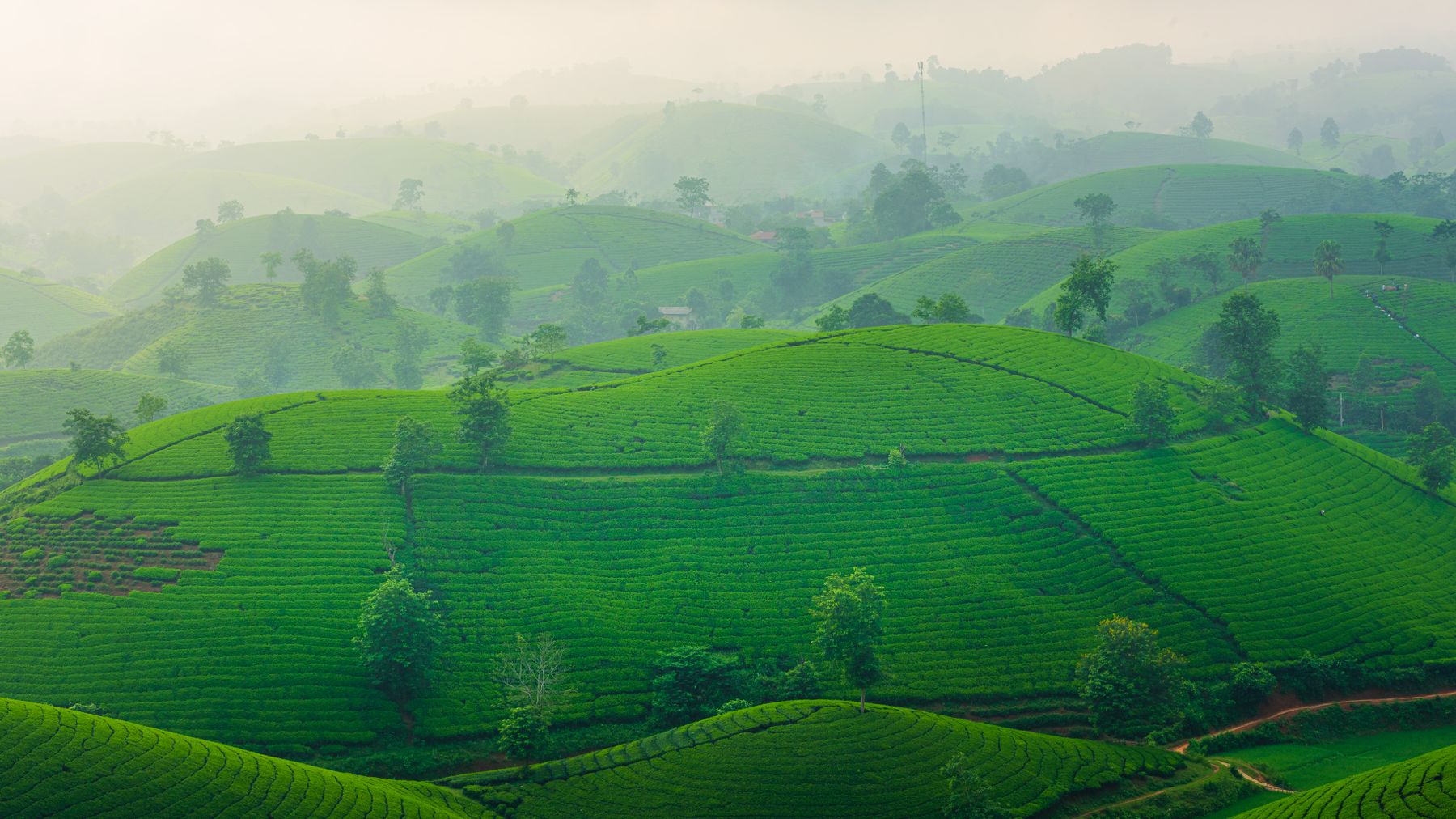
Photo by Duc Nguyen on Pexels
Practical tips locals would tell you
- Bring a jacket. Even in warmer months, Cau Dat at dawn is noticeably colder than Da Lat. Layers work best.
- Don't pick the tea leaves. It sounds obvious, but it happens constantly. The plants are a working crop, and staff will ask you to stop.
- Cash only. The café at Cau Dat Farm sometimes accepts bank transfers, but nothing in the surrounding area takes cards.
- Combine with other stops. On the way back to Da Lat, detour to Tuyen Lam Lake or the Truc Lam Zen Monastery — both are roughly on the route and fill out a full day.
Common mistakes to avoid
- Arriving at midday. The light is flat, the mist is gone, and if it's a weekend, minibuses have already deposited their passengers. Early morning or late afternoon only.
- Wearing sandals. The paths between tea rows are uneven dirt. After any rain, they turn to mud. Closed shoes, every time.
- Expecting a polished experience. There's no visitor center, no guided trail, no audio tour. You walk around a working farm. That's the appeal — but if you want structure, join a Da Lat tour group that includes Cau Dat as a stop.
Practical notes
Doi Che Cau Dat works best as a half-day trip from Da Lat, ideally combined with one or two other stops to justify the ride. Budget 2–3 hours at the tea hills themselves. If you're spending several days in Da Lat exploring the Central Highlands, this is one of the more rewarding morning outings — quiet, green, and completely unlike the city's increasingly crowded core.
Last updated · May 29, 2026 · independently researched, never sponsored.








