What is "sinh to"?
"Sinh to" translates roughly to "life juice," and that name sticks when you're sitting on a plastic stool in 35-degree heat with a tall glass of blended mango and condensed milk. It's not a light, whipped açai bowl; it's dense, sweet, and unapologetically indulgent—part smoothie, part dessert, sometimes closer to a drinkable mousse.
The basic formula is fruit, ice, water or milk, and usually a glug of sweetened condensed milk. The texture should be thick enough that you need to suck through a straw. Temperature swings between street-vendor versions (very cold, very sweet) and cafes (slightly more restrained). Both work.
The standouts
Sinh to bo (avocado)
This one dominates menus and for good reason. Ripe avocado—creamy, mild, buttery—blends into something almost custard-like. Most vendors use sweetened condensed milk, which amplifies the richness. If you want a cleaner version, ask for it without condensed milk and specify "it or less sugar" in Vietnamese: "it duong" or "it sua de" (less sweetened milk). Price: 30,000–40,000 VND. The best ones have that deep yellow-green color and go down heavy; the mediocre ones taste like water and avocado skin.
Sinh to mang cau (soursop)
Soursop is pale green, fibrous, and tart if you eat it raw. Blended, it becomes creamy and slightly floral, with a tang that cuts through condensed milk. This one is less common than mango or avocado but worth seeking out. The flavor is more distinctive, less universally "pretty." Many travelers skip it, but locals order it regularly. Price: 25,000–35,000 VND.
Sinh to xoai (mango)
The safest bet. Most street vendors have a pile of ripe yellow or orange mangoes year-round (peak is April–August). The shake is sweet, uncomplicated, and hard to botch. Blended with condensed milk and ice, it tastes like mango candy. Ask for ripe fruit to avoid woody, unripe versions. Price: 25,000–35,000 VND.
Sinh to mit (jackfruit)
Jackfruit is chunky, golden, and subtly sweet—almost pineapple-adjacent. It doesn't blend as smoothly as softer fruits, so the texture is looser, more like a thick juice. Less common on carts; look in markets or specialty drink shops. Price: 30,000–40,000 VND.
Sinh to sau rieng (durian)
Durian smoothies are a commitment. The fruit is pungent, creamy, and divisive. If you eat durian, you'll probably love this; if you avoid it, don't try the smoothie for the first time thinking it'll be mild. Most street stalls won't have fresh durian blended daily—it's an order-ahead item at cafes. Price: 40,000–60,000 VND.
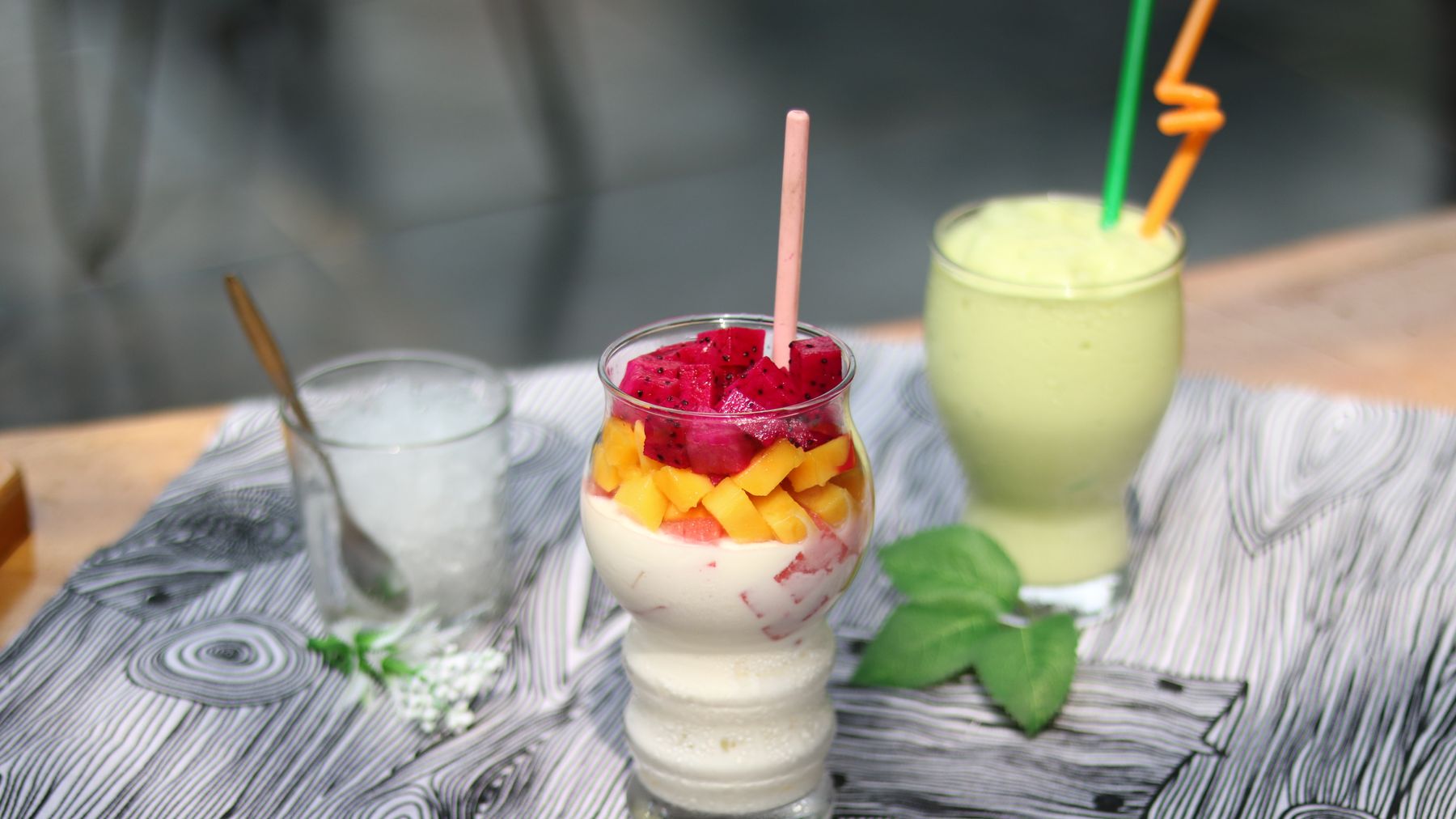
Photo by Ngoc Binh Ha on Pexels
Sweetened condensed milk vs. fresh milk
Most street vendors default to "sua de"—sweetened condensed milk—because it's shelf-stable, travels well, and tastes good. The result is thick and dessert-like. If you want something lighter, ask for "sua tuoi" (fresh milk) or skip milk entirely and ask for "it duong" (less sugar). You'll get a fruitier, less sweet result. Fresh-milk versions are slightly more common in cafes, rarer on carts.
Where to order
Hanoi
Old Quarter street stalls (Hang Dieu, Hang Gai streets) have sinh to carts year-round. Morning vendors (6–11 a.m.) focus on fresh juice and smoothies; afternoon regulars start around 2 p.m. Expect lines during lunch. Dong Xuan Market's perimeter has a cluster of drink stalls on the south side. Prices: 25,000–35,000 VND. Quality varies, but the competition keeps vendors honest.
Cafes like Highland Coffee and Highlands Coffee offer "fruit shakes" and smoothies in a sit-down setting. Price bump to 40,000–60,000 VND, but air-conditioning and a seat matter on hot days.
Saigon
Ben Thanh Market (southeast corner, outside) has a line of juice and smoothie vendors. Sinh to bo and xoai dominate; quality is decent and turnover is high. Prices: 30,000–40,000 VND. The area gets crowded after 3 p.m.
Nguyen Hue Walking Street (Saigon Centre intersection) has vendor clusters in early morning and late afternoon. Tourist-friendly but prices are slightly higher (35,000–50,000 VND).
District 1 cafes (Coco, The Mesh, Nhan Phuong Street) sell smoothies branded as "healthy" shakes with options like yogurt, oats, and protein powder. Price: 50,000–80,000 VND. Closer to Australian smoothie-bar style than street sinh to.
University neighborhoods (both cities)
University areas in Hanoi (Vietnam (베트남 / 越南 / ベトナム) National University campus, Hanoi University of Technology) and Saigon (University of Science, Ton Duc Thang University) have vendor clusters near gates. Students keep prices competitive: 20,000–30,000 VND. Quality is hit-or-miss, but you'll find regulars with loyal following.

Photo by Vietnam Tri Duong Photographer on Pexels
Pro tips
Watch the fruit. Ask the vendor to show you the fruit before blending. Soft, fragrant mangoes and avocados signal ripeness; hard or brown fruit means a mediocre shake. If they won't show you, go elsewhere.
Timing matters. Early morning (6–10 a.m.) vendors have the freshest fruit; afternoon vendors have what's left and sometimes add more condensed milk to mask age. Street carts are also less crowded at dawn.
Language shortcut. Point to the fruit and say "Cho toi sinh to" (Give me a smoothie) plus the fruit name. Vendors understand gestures and will sort the rest.
Hygiene. Water quality at street carts is a valid concern. Reputable vendors keep ice in closed coolers and blend with tap water that's been previously boiled. If the setup looks questionable (water sitting in open buckets, ice melted and refrozen), skip it. Cafes are safer if you're cautious.
Customization. Ask for less ice, less sugar, or no condensed milk. Most vendors are flexible, though they'll look mildly horrified if you skip condensed milk entirely.
Practical notes
Sinh to is cheap, quick, and everywhere. The best ones are on the street at peak hours (morning or late afternoon), made fresh in front of you. Expect to pay 25,000–40,000 VND depending on fruit, location, and how touristy the vendor's spot is. Avocado and soursop are standouts; mango is the reliable choice. Stick to busy stalls with high turnover—that's usually a sign of freshness and quality.
Last updated · Aug 18, 2026 · independently researched, never sponsored.