What makes Ha Giang pho chua different
"Pho chua" — sour "pho" — exists across Vietnam, but Ha Giang's version is its own animal. While southern "pho chua" tends toward sweet-and-sour balance, the northern rendition here cuts deeper. The broth sits darker, sharper from fermented shrimp paste and fish sauce layered in the stock itself, not just at table-side. The sourness comes from tamarind paste and lime squeezed into the bowl, but Ha Giang cooks tend to balance it with beef bone depth rather than sugar.
The noodles themselves are wider and chewier than what you get in a typical bowl of pho in Hanoi or Saigon. Most shops roll them fresh each morning from rice flour sourced in the province. That texture — slippery but with bite — matters because the broth clings differently than a clear Hanoi-style stock would. If you have eaten "bun rieu" (crab noodle soup) in the north, you will recognize the fermented funk, but "pho chua" dials down the tomato and dials up the tamarind.
You'll find it most on the street during wet-season mornings — October through March — when the cold drives demand. Locals eat it year-round, but it's a winter ritual, like how Hanoi's "pho (쌀국수 / 越南河粉 / フォー)" shops fill at dawn. Ha Giang city sits at roughly 500 m elevation and morning temperatures in December can drop to 5-8 °C — a steaming sour broth makes biological sense.
Where to eat it
Pho Chua Thanh Huong
On Ngo Gia Tu street, a short walk north from the Ha Giang Market (Cho Ha Giang), this stall has run since the early 2000s. The owner, Huong, is known for her stock — she simmers beef bone and shrimp shells overnight, then adds a fermented prawn paste made locally in the province. A bowl costs 40,000–50,000 VND. The broth hits with umami first, then the sour rises after you add lime and tamarind. Noodles are fresh, not reused from yesterday. Open 6:00 AM–10:30 AM only. Locals queue by 7:00 AM on weekends.
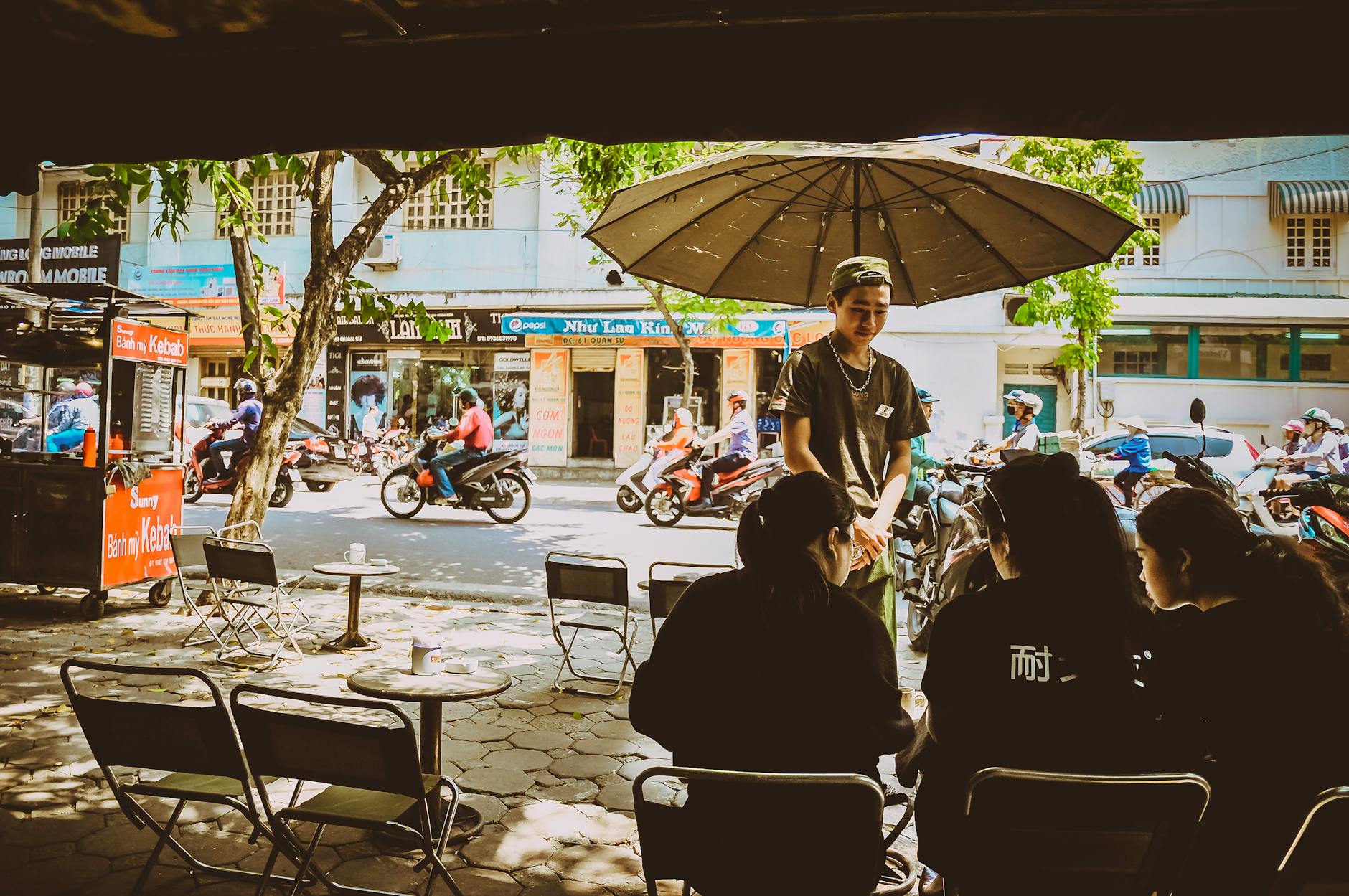
The stall is easy to miss: look for the low blue plastic stools and a metal cart on the left side of the street when walking from the market. There is no signboard in English. Seating is four to five tables on the pavement, so you eat elbow-to-elbow with motorbike taxi drivers and market vendors. If you want a side of "quay" (fried dough sticks) to dip, she usually has them stacked in a basket near the pot — 5,000 VND for two pieces.
Pho Chua Hang Cau
Near the intersection of Hang Cau and Nguyen Hue, this is a sit-down shop (not a stall) with eight small plastic tables. Less famous than Thanh Huong, but the cook, an older man named Duc, learned his craft in Cao Bang before moving to Ha Giang (하장 / 河江 / ハーザン) in the 1990s. His broth is lighter and cleaner than Huong's — less funk, more clarity. A bowl is 35,000–45,000 VND. Ask for "pho chua voi bo" (pho chua with beef) or "pho chua ga" (with chicken; the chicken version is rarer and worth trying). Open 6:30 AM–1:00 PM. Lunch service is thin, but you'll find regulars.
Duc also keeps a jar of house-made chili oil on the counter — a bright orange, slightly smoky condiment that works well if the sour note is too dominant for your palate. A spoonful rounds everything out. The shop is about 1.2 km southwest of the central market, walkable or a 15,000 VND "xe om" (motorbike taxi) ride.
Pho Chua Thanh Nhan
On the ground floor of a residential building on Viet Bac street, this is a casual shop run by a woman in her 50s and her daughter. The broth is the sweetest of the three — still sour, but with sugar balancing the tamarind more noticeably. Some locals prefer it for that reason; others say it's less authentic. A bowl is 40,000 VND. The noodles are hand-rolled daily. They serve beef, chicken, and offal — liver and tripe are available on request. Open 6:00 AM–noon. Closed Sundays.
If you are curious about offal but have never tried it in Vietnamese soup, this is a gentle entry point. The tripe is sliced thin and simmers long enough to turn tender, and the liver has a soft, almost custard texture. Ask for "sach va gan" (tripe and liver) to get both. There is no extra charge — the bowl stays at 40,000 VND.
Photo by Vietnam Hidden Light on Pexels
How to order and what to expect
Walk up and say "mot tia pho chua" (one bowl of pho chua). They'll ask if you want beef ("bo"), chicken ("ga"), or offal ("sach"). If you're undecided, ask the owner what's best that day. Point if your Vietnamese is weak — most of these stalls have no English menus, and that's the point.
The bowl arrives hot. The noodles come separately sometimes, sometimes already in the broth. Add lime (they'll provide wedges), "mam tom" (fermented shrimp paste) if it's not already in the broth, and fresh herbs: mint, cilantro, saw-leaf. Some people add a pinch of chili powder ("tieu"); locals rarely do. The first slurp is the test — the sour should be present but not sharp enough to make you wince. If it tastes too sour, dilute with a spoon of plain broth.
A few useful phrases beyond the initial order:
- "Them nuoc dung" — more broth, please
- "Khong mam tom" — no shrimp paste (if the smell puts you off)
- "It cay" — less spicy
- "Tinh tien" — the bill, please
Payment is cash only at all three spots. The smallest bill you should carry is 10,000 VND; do not hand over 500,000 VND notes and expect easy change at a pavement stall.
Photo by Vietnam Hidden Light on Pexels
Cost and timing
Expect 35,000–50,000 VND per bowl. No surcharge for offal. These are breakfast and lunch spots — closing by 1:00 PM is standard. If you arrive after 10:30 AM, you risk running out of broth. Morning is always better. In summer (May–September), you might find "pho chua" only on Saturdays or not at all; the demand drops hard. Winter mornings are the reliable window.
For context, a bowl of regular pho in Ha Giang city runs 30,000–40,000 VND, and a plate of "com tam" (broken rice) at a lunch shop is about 35,000–45,000 VND. So "pho chua" sits at the same price tier as most local meals — it is not a premium dish, just a seasonal one.
How pho chua fits into a Ha Giang trip
Most travelers pass through Ha Giang city on the way to or from the Ha Giang loop — the 350 km motorbike circuit through Dong Van, Meo Vac, and Yen Minh. The city itself does not get much love, but it is worth arriving the evening before your loop starts, sleeping one night, and hitting a "pho chua" stall at 6:30 AM before you ride out. The sour broth sits well in the stomach for a long morning on mountain roads.
If you are returning from the loop, the same logic applies in reverse: roll into Ha Giang city by late afternoon, rest, and eat "pho chua" the next morning before a bus back to Hanoi (roughly 280 km, six to seven hours by sleeper bus, tickets around 250,000–350,000 VND). The dish is a good bookend to the trip.
Beyond "pho chua," Ha Giang city has solid "banh cuon" (steamed rice rolls) near the market and a few places serving "bun cha" (grilled pork with noodles) that recall Hanoi's style but use a heavier charcoal smoke. Da Nang and Hoi An travelers who have eaten "mi quang" or "cao lau" will notice that northern noodle dishes lean savory and funky where central dishes lean aromatic and herbal — "pho chua" is the clearest example of that divide.
Common mistakes foreigners make
- Arriving after 10:00 AM. Broth runs out. The cook does not make a second batch. If the pot is empty, the shop closes. Set an alarm.
- Dumping all the lime in at once. Squeeze half a wedge first, taste, then adjust. Too much lime kills the fermented depth that makes the dish interesting.
- Skipping the shrimp paste. The smell of "mam tom" stops some visitors cold. In Ha Giang's "pho chua," the paste is usually already cooked into the stock, so refusing the table-side jar is fine — but do not ask them to make the broth without it. That is the dish.
- Expecting English menus or Grab delivery. Ha Giang city is not Ho Chi Minh City. Walk to the stall, sit down, order in Vietnamese or point. That is the experience.
- Confusing "pho chua" with "pho" and complaining about the sourness. They are different dishes. If you want classic clear-broth pho, every block in Ha Giang has a shop for that. "Pho chua" is intentionally tart.
Quick reference
- Dish: "pho chua" (sour pho), a northern Vietnamese noodle soup
- Best season: October – March (cold season); limited or unavailable May – September
- Price range: 35,000 – 50,000 VND per bowl (roughly 1.40 – 2.00 USD)
- Serving hours: 6:00 AM – 1:00 PM; best before 10:00 AM
- Protein options: beef ("bo"), chicken ("ga"), offal/tripe ("sach")
- Payment: cash only, carry small bills (10,000–50,000 VND)
- Top pick for bold flavor: Pho Chua Thanh Huong, Ngo Gia Tu street
- Top pick for cleaner broth: Pho Chua Hang Cau, Hang Cau / Nguyen Hue intersection
- Top pick for offal newcomers: Pho Chua Thanh Nhan, Viet Bac street
- Key phrase: "mot tia pho chua" (one bowl of sour pho)
Practical notes
Pho chua in Ha Giang is breakfast-first, lunch-second. Plan to eat between 6:30 AM and 11:00 AM for the best experience. Don't expect Facebook pages or reservation options — these are neighborhood spots. Ask your hotel or guesthouse owner for the most current location and hours; one stall may close or move during the year.
Ha Giang city has a handful of ATMs (Agribank and BIDV near the market area), but they occasionally run dry on weekends when loop riders all withdraw at once. Pull cash in Hanoi before you travel. Mobile data works fine in the city — buy a Viettel SIM at any phone shop for about 100,000 VND with a week of data — but coverage gets patchy once you head into the northern valleys.
Bottom line
"Pho chua" is not a tourist attraction. It is a local breakfast that happens to be one of the most distinctive bowls of noodles in northern Vietnam. If you are already in Ha Giang for the loop, waking up 30 minutes earlier to eat it costs you nothing but sleep — and the trade is worth it. Sit on the plastic stool, order with a point and a smile, and let the sour broth do the talking.
Last updated · May 29, 2026 · independently researched, never sponsored.