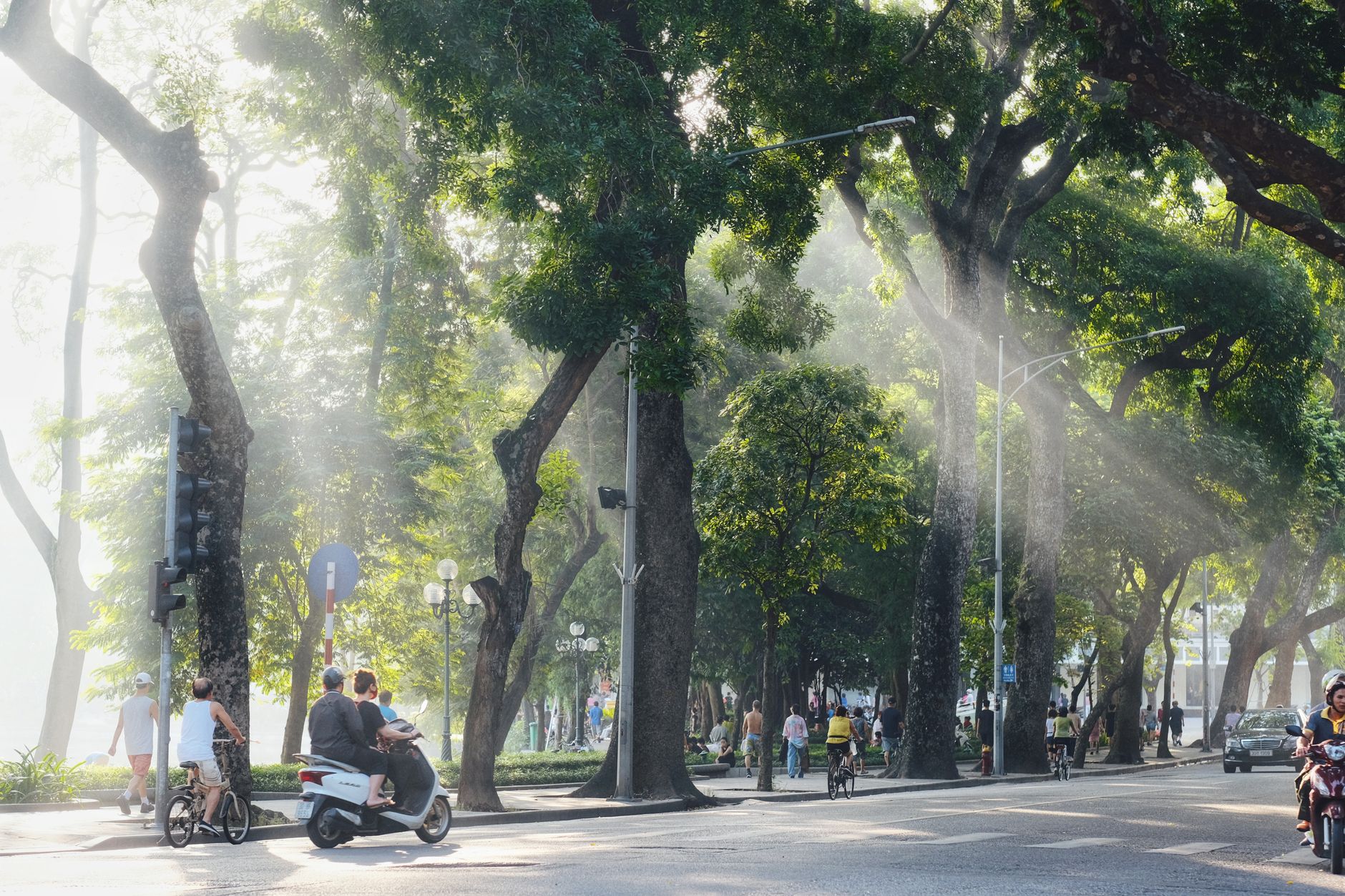
Geography: The Tam Dao Range
The Tam Dao range stretches 80 km and features over 20 peaks above 1,000 meters. The highest, Tam Dao North, reaches 1,592 meters. Other notable summits are Thien Thi (1,375 m), Thach Ban (1,388 m), and Phu Nghia (1,300 m). Sharp ridgelines and steep valleys define the terrain.
The park's core sits at elevations above 100 meters, with a larger buffer zone below that threshold. Seventy percent is natural or restored forest; 30 percent is human-altered woodland. The ridge itself acts as a climatic divider, creating distinct wet and dry zones on either side — which drives the park's exceptional biodiversity.
For context, that 1,592-meter summit puts Tam Dao in the same elevation bracket as Sapa's town center, though the climate feels different — wetter, denser, more subtropical. On clear winter mornings the peaks punch above a sea of cloud that fills the valleys below. It is genuinely cold up there from December through February, sometimes dropping to 5°C near the ridgeline, which shocks visitors who left Hanoi in a t-shirt two hours earlier.
Eight Forest Types and Endemic Species
Eight distinct forest ecosystems grow here, layered by elevation and moisture:
Tropical moist evergreen forest (below 800 m) contains rare species like Hopea chinensis and Pavieasia anamensis.
Subtropical moist evergreen low mountain forest (above 800 m) is home to Lauraceae, Fagaceae, and Theaceae families. Above 1,000 m, conifers like Dacrycarpus imbricatus and Fokienia hodginsii dominate.
High mountain short forest — a dwarf variant — features Ericaceae and Aceraceae species adapted to exposed ridges.
Bamboo forest (500–800 m) covers only 8.84 km² and is thinly scattered.
Restored and plantation forests date to the French period and recent conservation work, dominated by Pinus massoniana (Horsetail Pine).
Bush and grassland occupy previously logged areas, now recovering.
Out of over 2,000 plant species, 42 are endemic to Tam Dao, including the orchid Dendrobium daoensis and three camellia species found nowhere else. Sixty-four others are classified as rare.
The fauna is equally distinctive. Eleven vertebrate species are endemic to the park, including two snake species (Amphiesma angeli and Boiga multitempolaris) and three amphibians. Five bird species, four reptile species, and one amphibian are endemic to Vietnam (베트남 / 越南 / ベトナム) as a whole. At least 22 insect species occur nowhere else in northern Vietnam. Several genera bear the park's name — the grasshopper Caryanda tamdaoensis, the cricket Metriogryllacris tamdao, and others.
Birdwatchers come specifically for species like the short-tailed scimitar-babbler and the Vietnamese greenfinch. The best birding window is March through May, when resident species are vocal and migrants are still passing through. Bring binoculars and patience — the canopy is thick and sightings reward stillness over speed.

Photo by Jerson Martins on Pexels
Tam Dao Town: A French Hill Station
Tam Dao town, founded by the French in 1907 as a colonial retreat, sits in a small valley within the park (just 3 km²). Though modest in scale, it retains physical traces of that era: a stone church, several villas, and the ruins of an older resort complex called Tam Dao 2.
The main waterfall attraction is Thac Bac (Silver Fall). Rung Rinh peak offers hiking and views. The town is administratively part of Vinh Yen city and functions as the park's primary tourist hub — accessible by road, with basic accommodation.
The town has a single main street that curves uphill past guesthouses, restaurants, and a handful of karaoke bars. On weekends — especially from April to September — it fills with Hanoi (하노이 / 河内 / ハノイ) day-trippers and the street turns into a slow-moving car park. If you want the quieter version, arrive on a Tuesday or Wednesday. Room rates at basic guesthouses start around 300,000–500,000 VND per night midweek; expect that to double on Saturday. A few mid-range hotels charge 800,000–1,500,000 VND and offer heated water, which matters more than you think in January.
The food scene in Tam Dao town revolves around local mountain ingredients. "Su su" (chayote) appears everywhere — stir-fried, in soup, or as fried tops. Hill chicken ("ga doi"), grilled over charcoal, is the signature dish. A whole grilled chicken runs about 250,000–350,000 VND at most restaurants along the main road. You will also find "com lam" (bamboo-tube rice) and wild boar, though the latter varies in quality. For breakfast, vendors near the church sell "pho" and "banh cuon" — nothing fancy, but solid and cheap at 30,000–40,000 VND a bowl. If you are used to the street food depth of Hanoi's Old Quarter, set your expectations a notch lower; this is a small mountain town, not a food capital.

Photo by HONG SON on Pexels
Tay Thien: Buddhist Pilgrimage Site
Tay Thien Quoc Mau Temple (Temple of the West Heaven National Mother) and its associated pagodas form the park's spiritual anchor. Thien Vien Truc Lam Tay Thien, a major Buddhist center, ranks alongside Thien Vien Truc Lam in Da Lat and the Yen Tu temple complex as one of Vietnam's most significant Buddhist pilgrimage destinations. The site draws thousands of visitors during major festivals and Tet.
A cable car runs from the base station up to the Thien Vien Truc Lam pagoda area. Tickets cost around 120,000 VND for a round trip (adults) and 80,000 VND for children. The cable car ride itself takes about 10 minutes and drops you at an elevation with wide views across the forested valley — on a clear day, you can see the flatlands of Vinh Phuc stretching toward the Red River Delta. From the upper station, it is a further 20–30 minute walk along a stone path to the main pagoda.
If you prefer to skip the cable car, a hiking trail winds up from the base through forest. Budget about 90 minutes each way. The trail is well-maintained but steep in sections, and it gets slippery after rain. Wear proper shoes, not sandals — I have seen more than a few visitors in flip-flops regretting their choice halfway up.
The busiest pilgrimage period falls during the first three months of the lunar calendar, roughly February through April. During the Tay Thien Festival (typically the 15th of the second lunar month), the site can see tens of thousands of visitors in a single day. If you are not there for the festival specifically, avoid that window entirely unless you enjoy queuing for the cable car for over an hour.
Getting There from Hanoi
Tam Dao National Park sits 85 km northwest of Hanoi. Most visitors drive or arrange private transport. The route goes via National Highway 2 to Vinh Yen (about 50 km, roughly one hour), then a winding 24-km mountain road climbs from the base up to Tam Dao town. That second stretch takes 30–45 minutes depending on traffic and your driver's tolerance for hairpin turns.
By motorbike: A popular option for Hanoi residents. The mountain road is paved but narrow, with sharp bends and occasional fog. Experienced riders will enjoy it; nervous ones should take a car. Fill up in Vinh Yen — there are no fuel stations on the climb.
By bus: Public buses run from Hanoi's My Dinh bus station to Vinh Yen (about 40,000–50,000 VND, departures every 20–30 minutes). From Vinh Yen bus station, you can catch a local bus or hire a "xe om" (motorbike taxi) for the final 24 km up to the town. The xe om ride costs roughly 100,000–150,000 VND — negotiate before you get on.
By private car: Many Hanoi-based tour operators and hotels arrange day trips or overnight transfers. A private car with driver runs approximately 1,200,000–1,500,000 VND round trip. Grab cars are available from Hanoi to Vinh Yen, but finding a return Grab from Tam Dao town itself can be unreliable — drivers are scarce up there.
For the Tay Thien temple complex, the access road branches off before Tam Dao town. If you are visiting both, plan the temple first on the way up, then continue to the town. Trying to do it in reverse adds unnecessary backtracking.
Hiking Routes and What to Expect
Most visitors stick to two main trails. The walk to Thac Bac (Silver Fall) starts from the center of Tam Dao town and takes about 30–40 minutes one way on a paved and stepped path. The waterfall is most impressive during and just after the rainy season (June–September), when the volume is high. In the dry months, it can slow to a trickle — manage your expectations if visiting in March or April.
The longer trek toward the summit ridge follows a trail that begins near the old French ruins of Tam Dao 2 and climbs steeply through dense forest. This is a half-day or full-day outing depending on your fitness and how far along the ridge you go. The trail is not always clearly marked once you pass beyond the tourist zone. A local guide is worth hiring — ask at your guesthouse, and expect to pay around 300,000–500,000 VND for a half-day. Guides know the leech-heavy sections (yes, leeches are real here, especially from May to October) and can point out endemic plants that you would otherwise walk right past.
There is no formal park entrance fee for Tam Dao town itself, though the Tay Thien cable car and certain temple areas have separate ticket charges. Wear long pants and closed shoes for any trail beyond the Silver Fall path. Bring water — there are no shops once you leave the town perimeter.
What Surprises Foreigners
The fog is relentless. Tam Dao town can be completely socked in for days at a time, especially from November through March. You may not see the famous peaks at all. Locals shrug at this; tourists sometimes feel cheated. If clear views are critical to you, check weather forecasts and favor the October or April shoulder months.
It is a domestic destination. Unlike Sapa or Ha Giang, Tam Dao sees very few international tourists. Menus are in Vietnamese. Guesthouse owners may not speak English. Basic Vietnamese phrases — "bao nhieu tien" (how much?), "mot phong" (one room), "khong cay" (not spicy) — go a long way. Google Translate's camera function is your backup for menus.
Weekend crowds are intense. Tam Dao is one of Hanoi's closest hill escapes, and Hanoians use it hard. Friday evening through Sunday, the town fills up, prices rise, and the single road in and out jams. The mountain road has few overtaking opportunities, so you may spend an extra hour in traffic on a Sunday afternoon return. Go midweek if you can.
It is not a luxury destination. Accommodation is functional, not polished. Hot water can be inconsistent. Power cuts happen during storms. If you need resort-level comfort, Tam Dao is not the right fit — try Da Lat or Sapa's newer hotels instead. What Tam Dao offers is proximity, altitude, and a raw mountain feel within a short drive of the capital.
Leeches. They deserve a second mention. Rainy-season hikers will encounter them on any forest trail. Tuck your pants into your socks, use insect repellent on your ankles, and check yourself at rest stops. They are harmless but psychologically unpleasant if you are not expecting them.
Quick Reference
- Location: 85 km northwest of Hanoi, Vinh Phuc / Tuyen Quang / Thai Nguyen provinces
- Highest peak: Tam Dao North, 1,592 m
- Best months: October–May (cooler, drier); March–May best for birding
- Avoid: Weekends year-round; Tay Thien Festival period if you dislike crowds
- Guesthouse rates: 300,000–500,000 VND (midweek), 600,000–1,000,000 VND (weekend)
- Grilled hill chicken: ~250,000–350,000 VND per whole bird
- Pho / banh cuon breakfast: 30,000–40,000 VND
- Tay Thien cable car: ~120,000 VND round trip (adult)
- Local guide (half-day hike): 300,000–500,000 VND
- Private car from Hanoi (round trip): 1,200,000–1,500,000 VND
- Bus Hanoi–Vinh Yen: 40,000–50,000 VND
- Drive time from Hanoi: ~1.5–2 hours total
- Languages spoken: Mostly Vietnamese; very limited English
Visiting Tam Dao
The park is best visited October–May, when temperatures are cooler and rain lighter. Bring a light jacket even in warm months — elevation means temperatures drop sharply above 1,000 meters. Most visitors base themselves in Tam Dao town or nearby Vinh Yen, a provincial capital with hotels and restaurants. Hikes range from 2-hour walks to Silver Fall to all-day summit treks. The Buddhist temple circuit is accessible by foot or local transport from town.
Tam Dao works well as a 1–2 day escape from Hanoi: close enough for a long weekend, remote enough to feel like stepping away. Pair it with a stop at Bat Trang pottery village on the way back if you are driving your own car — it is only a short detour off the highway, and the contrast between mountain forest and Red River Delta craft village makes for a full day.
Frequently Asked Questions
How far is Tam Dao National Park from Hanoi and how long does it take?
Tam Dao is approximately two hours from Hanoi by road. The town sits within a small valley inside the park at an elevation that can drop to 5 degrees Celsius near the ridgeline in winter — a sharp contrast to conditions in the capital. Visitors leaving Hanoi in a t-shirt should pack a layer, particularly from December through February.
What endemic species can I expect to find in Tam Dao National Park?
Tam Dao has 42 plant species found nowhere else, including the orchid Dendrobium daoensis and three camellia species. Eleven vertebrate species are endemic to the park, among them two snake species and three amphibians. At least 22 insect species occur nowhere else in northern Vietnam, including the grasshopper Caryanda tamdaoensis. Birdwatchers target species like the short-tailed scimitar-babbler and the Vietnamese greenfinch.
When is the best time to visit Tam Dao for birdwatching?
March through May is the recommended window for birdwatching. During this period, resident species are vocal and migratory birds are still passing through the park. The forest canopy is thick year-round, so patience and stillness improve sighting chances more than covering distance. Binoculars are essential given the density of the tree cover.
Final Note
Tam Dao is not trying to be Sapa or Ninh Binh. It is a working national park with a small, slightly rough-edged hill town attached to it — one that happens to sit close enough to Hanoi to reach before lunch. That proximity is the whole point. You come here to drop ten degrees in temperature, walk under a forest canopy, eat a hill chicken with "com lam," and head back to the city without the overhead of a flight or overnight train. Keep your expectations calibrated to what it is, and it delivers exactly what it promises.
Last updated · May 29, 2026 · independently researched, never sponsored.