
What it is
Chua Chen Kieu — literally "Cup Pagoda" or "Fragment Pagoda" — is a Khmer Buddhist temple on Ton Duc Thang Street in Soc Trang town, roughly 60 km southeast of Can Tho. What makes it impossible to confuse with any other pagoda in the Mekong Delta (메콩 델타 / 湄公河三角洲 / メコンデルタ): every exterior surface is covered in fragments of smashed bowls, plates, cups, and ceramic vases pressed into the walls and columns like mosaic. The effect is dense, colorful, and slightly unhinged in the best way.
The pagoda dates to the early 1800s but got its current look in the 1960s and 1970s when monks began embedding broken household ceramics, glass shards, and porcelain into the concrete during renovations. Some pieces came from local Khmer families donating chipped or cracked dinnerware they could no longer use. Others were sourced from Chinese-Vietnamese households in the area. The result is a visual archaeology of everyday life in the Delta — rice bowls, tea sets, beer bottles, all frozen into the architecture.
Why travelers go
Three reasons. First, it's genuinely unlike anything else in Vietnam. You've probably seen ornate pagodas before — Bai Dinh near Ninh Binh (닌빈 / 宁平 / ニンビン), the Chinese-style temples around Hoi An — but Chua Chen Kieu's DIY maximalism is in a category of its own. Second, it sits in a region with a significant Khmer population, and the pagoda functions as a living cultural center, not just a tourist site. Monks live and study here. Festivals happen on the Khmer calendar. Third, it's free, it's quiet on weekdays, and it pairs naturally with a broader Soc Trang day trip from Can Tho.
Best time to visit
The Mekong Delta is hot year-round. Dry season (December–April) means less mud and more comfortable wandering outside. Early morning — before 9 AM — gives you softer light for photos and fewer tour groups. If you time it with the Khmer "Oc Om Boc" moon festival (usually October or November), the pagoda comes alive with candle ceremonies and boat races on the nearby river. That said, any random Tuesday works fine.
How to get there
From Can Tho
The most common route. Take National Highway 1A east toward Soc Trang. By motorbike it's about 1.5 hours, by car roughly an hour depending on truck traffic around Phung Hiep. Buses run from Can Tho's main bus station (Ben Xe Khach Can Tho on Nguyen Van Linh) to Soc Trang every 30–45 minutes; tickets cost around 60,000–80,000 VND. From Soc Trang bus station, the pagoda is 2 km south — a quick xe om ride for 15,000–20,000 VND.
From Saigon
Long-haul buses to Soc Trang depart from Mien Tay station. Journey is 5–6 hours. Phuong Trang (FUTA) runs comfortable sleeper coaches for around 180,000 VND.
By motorbike
If you're touring the Delta by bike, Soc Trang sits on a natural loop between Can Tho, Bac Lieu, and Ca Mau. Roads are flat, paved, and lined with coconut palms — easy riding.
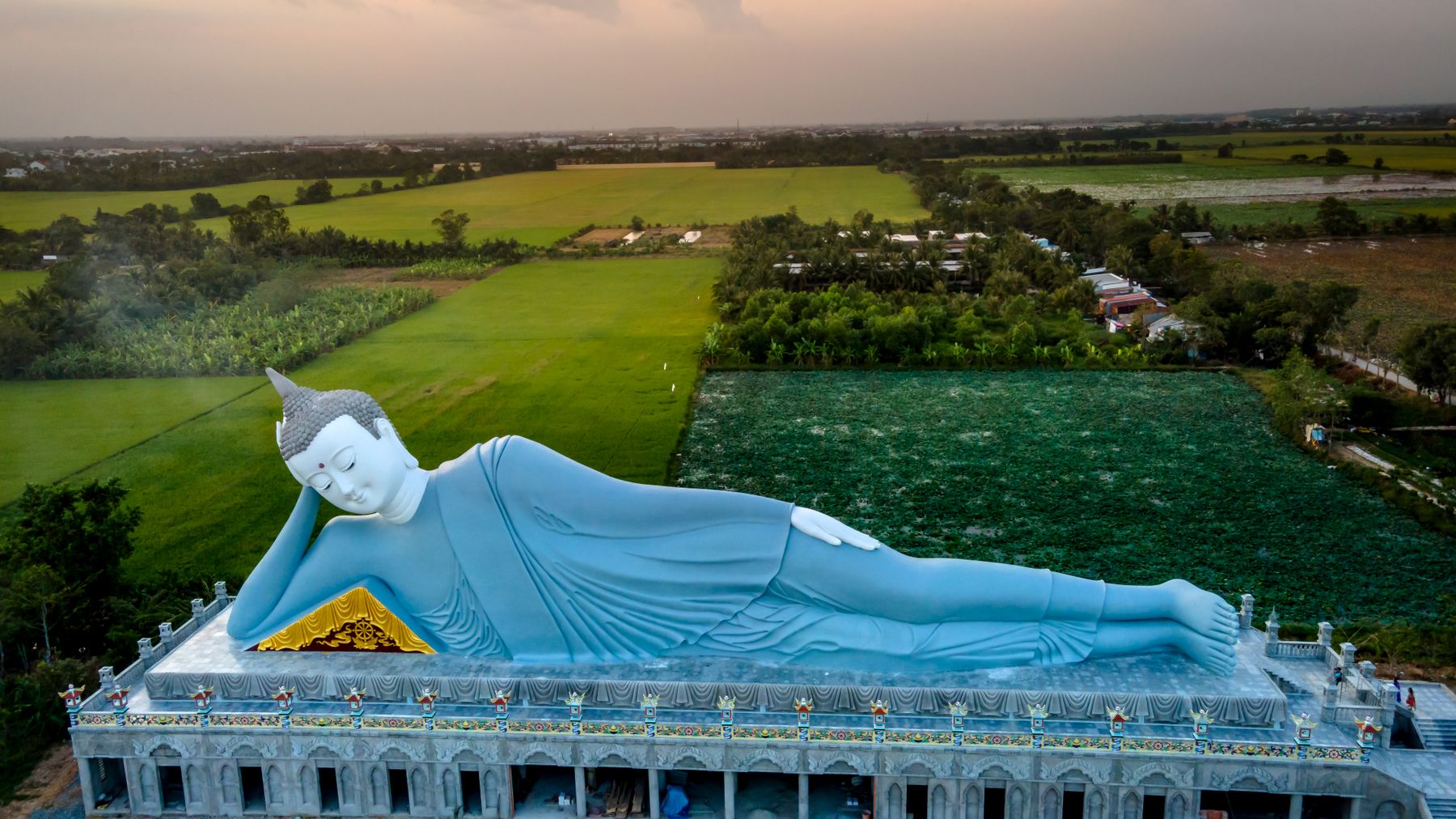
Photo by Quang Nguyen Vinh on Pexels
What to do
Walk the exterior slowly
This is the main event. The fragment mosaics cover columns, eaves, balustrades, and dragon sculptures. Look for the mix of Chinese blue-and-white porcelain, brown Vietnamese rice bowls, green glass from old Saigon beer bottles, and the occasional French-era tile. Bring a macro lens or just use your phone up close — the details reward patience.
Go inside the main hall
The interior houses a gilded reclining Buddha and painted ceiling panels in traditional Khmer style. It's quieter and cooler in here. Remove shoes at the entrance.
Explore the grounds
The compound includes monk quarters, a small garden, and ornamental gates. There's a Khmer-language school behind the main building. Wander but stay respectful — this is someone's home and workplace.
Combine with Doi pagoda and Bat Pagoda
Soc Trang has three well-known Khmer pagodas. Doi Pagoda (Chua Doi) is famous for its colony of fruit bats hanging in the trees. Bat Pagoda (Chua Ma Toc) is known for intricate wood carvings. All three are within 5 km of each other. Budget half a day to see the trio.
Where to eat
Soc Trang town has solid Khmer and Chinese-Vietnamese food. Try "bun nuoc leo" — a Khmer-origin fish-broth noodle soup that's the local signature. Street stalls on Mau Than Street sell it for 25,000–35,000 VND. "Banh pia" (flaky durian-and-mung-bean pastry) is the regional snack — Tan Hue Vien is the most established brand, with a shopfront near the central market.
For something more substantial, look for com tam rice plates or "hu tieu" noodle soup at the market stalls around Cho Soc Trang (Soc Trang Central Market). Nothing fancy, all good.
Where to stay
Most travelers base in Can Tho and visit Soc Trang as a day trip. Can Tho has better accommodation range — from budget guesthouses near Ninh Kieu Wharf (300,000–500,000 VND/night) to mid-range hotels with river views. If you want to stay in Soc Trang itself, Khanh Hung Hotel on Tran Hung Dao Street is clean and central at around 350,000 VND.

Photo by ㅤ quang vinh ㅤ on Pexels
Practical tips
- Dress code: Cover knees and shoulders inside the main hall. This is an active place of worship.
- Entrance fee: Free. Donation boxes are available if you want to contribute.
- Time needed: 45 minutes to an hour for the pagoda alone. Half a day if combining with Doi Pagoda and Bat Pagoda.
- Language: Very little English spoken here. Google Translate's camera mode handles Khmer script poorly, but basic Vietnamese phrases work with the monks.
- Photography: Allowed outside. Ask permission before photographing monks or ceremonies inside.
Common mistakes
Rushing through. Tour groups get 15 minutes here and miss most of the mosaic detail. Give yourself time to circle the building twice.
Skipping Soc Trang entirely. Many Delta itineraries jump straight from Can Tho to Ca Mau or back to Saigon. Soc Trang's Khmer heritage sites are among the most distinctive in the south — the detour is worth it.
Visiting midday. Between 11 AM and 2 PM the sun is directly overhead, flattening the textures on the mosaic walls. Morning or late afternoon light brings out the colors and depth.
Practical notes
Chua Chen Kieu works best as part of a broader Can Tho and Mekong Delta trip — pair it with a floating market morning and a Soc Trang afternoon. It's not a destination you'd fly to Vietnam specifically for, but if you're in the south and you like the weird, handmade, and genuinely local over the polished and packaged, this one delivers.
Last updated · May 29, 2026 · independently researched, never sponsored.










