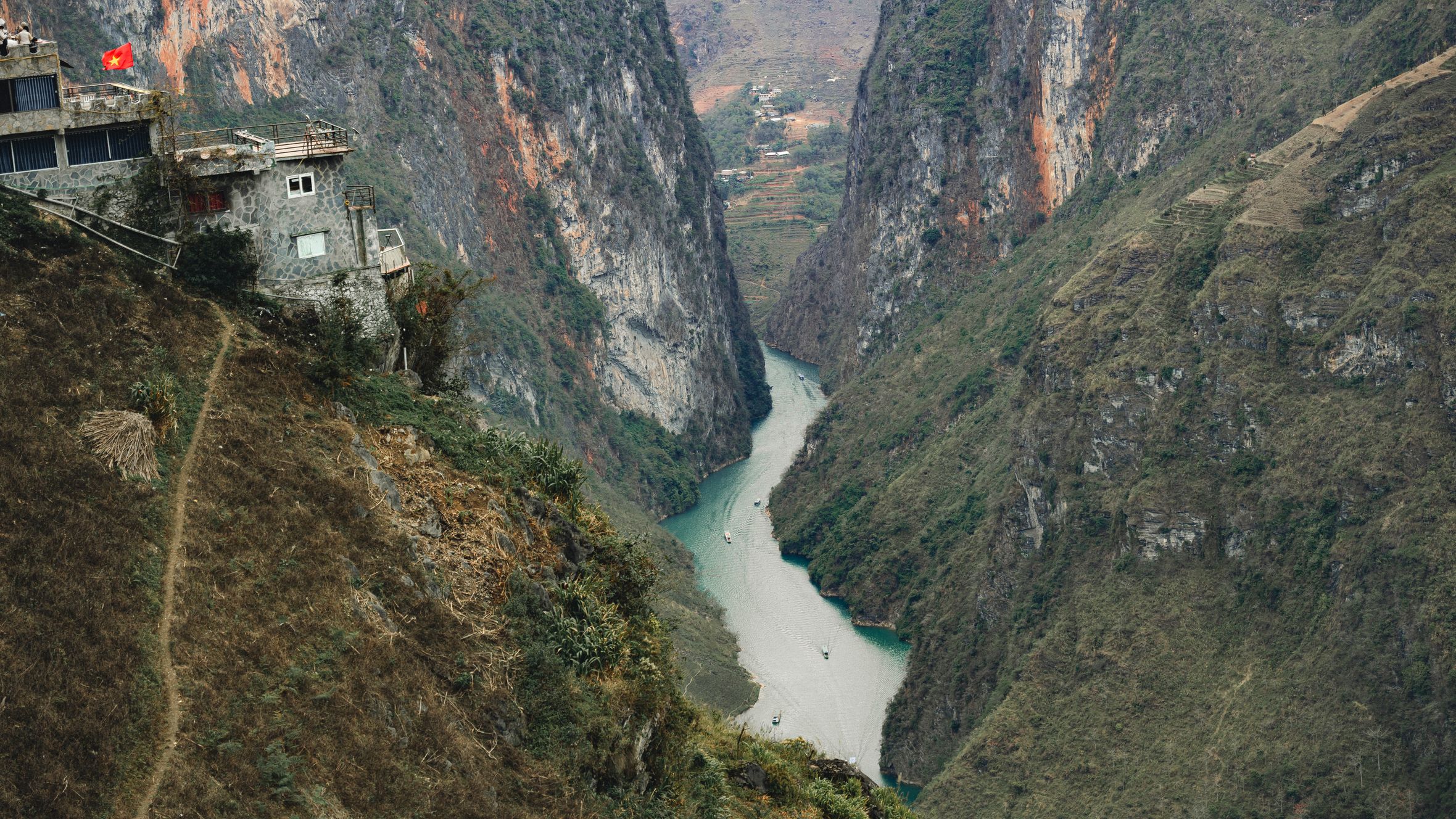
Hon Kem Da Dung is a narrow limestone gorge carved by the Thu Bon River, roughly 70 km southwest of downtown Da Nang. Until recently it sat within Quang Nam province, but following the 2025 administrative merger it now falls under Da Nang's expanded boundaries. Either way, the gorge itself hasn't changed — towering karst walls, dark-green water, and a stretch of river that feels genuinely removed from the coast.
What it is
The name translates loosely to "Zinc Rock and Coconut Rock," referring to the two massive cliff faces that pinch the Thu Bon River into a tight corridor near the border of Dong Giang and Nam Giang districts. The gorge runs for several kilometers, with rock walls rising 50–100 meters on both sides. During the French colonial period, surveyors noted it as one of the more dramatic geological features in Quang Nam. It has never been heavily developed for tourism, which is both its appeal and its inconvenience.
The Thu Bon River — the same waterway that winds through Hoi An further downstream — is narrower and faster here. In the dry months, the water runs surprisingly clear. Local Co Tu ethnic minority communities live in villages scattered along the upper reaches, and boat access through the gorge has been a transport route for generations.
Why travelers go
Hon Kem Da Dung attracts a specific kind of visitor: someone who has already done Da Nang (다낭 / 岘港 / ダナン)'s beaches, already crossed the Golden Bridge, and wants something that feels less curated. The gorge offers a half-day or full-day trip into terrain that most tourists in central Vietnam never see. You won't find ticket booths or souvenir shops. You will find limestone, river, forest, and quiet.
Photographers come for the light inside the gorge — morning sun hits the cliff walls at sharp angles, especially between 7:00 and 9:00 AM. Kayakers and small-boat enthusiasts come for the river itself. And some people come simply because it's one of the few places within Da Nang's orbit where you can sit by moving water without hearing a motorbike.
Best time to visit
The sweet spot is February through June. River levels are manageable, rain is infrequent, and the water is at its clearest. July and August are hotter but still workable if you start early. Avoid October through December — the Thu Bon floods regularly during the monsoon season, and the gorge becomes inaccessible and dangerous. Locals will flatly refuse to take boats through during high water, and they're right to.
How to get there from Da Nang
From central Da Nang, head southwest on the Ho Chi Minh (호치민 / 胡志明 / ホーチミン) Highway (QL14G) toward Dong Giang district. The drive takes roughly 2–2.5 hours by motorbike or private car, covering about 70 km. The road is paved the entire way but gets winding after Ai Nghia town. If you're renting a motorbike in Da Nang, budget around 150,000–200,000 VND per day for a semi-automatic.
Alternatively, you can arrange a car and driver through your hotel or a local tour operator in Da Nang for approximately 1,200,000–1,500,000 VND round-trip. There is no direct public bus to the gorge itself, though buses run to Dong Giang town — from there you'd need a local "xe om" (motorbike taxi) for the final stretch, around 50,000–80,000 VND.
Once at the river access point, you'll need to hire a local boat. Small wooden boats operated by villagers typically cost 200,000–400,000 VND for a 1–2 hour trip through the gorge, depending on distance and negotiation. Agree on the route and price before boarding.

Photo by Menderes Kahraman on Pexels
What to do
Take the boat through the gorge
This is the main event. The boat ride between the cliff walls is the reason you came. Sit low, watch the rock, and let the boatman navigate. The narrowest section — where the walls feel close enough to touch from both sides — is about halfway through. Bring a dry bag for your phone.
Swim in the river
In the dry season, there are calm pools at several points along the gorge where the boatman can stop. The water is cool and deep enough to swim. Ask your boatman to point out the safest spots — currents can be deceptive even when the surface looks still.
Visit a Co Tu village
Several Co Tu communities live along the upper Thu Bon. Some welcome visitors informally — you can see traditional longhouses ("guol") and local weaving. This isn't a staged cultural show; be respectful, ask before photographing, and consider buying something directly from weavers if textiles are on display. Prices are modest — small woven pieces start around 50,000 VND.
Hike the surrounding forest
Trails of varying quality lead into the hills above the gorge. There's no marked trail system, so hiring a local guide from one of the nearby villages is smart — expect to pay around 200,000–300,000 VND for a half-day. The forest here is secondary growth but dense, with good birding in the early morning.
Photograph the gorge at dawn
If you're staying overnight nearby, get on the water before 8:00 AM. The light inside the gorge shifts fast as the sun rises above the cliff line, and the first hour produces the best contrast between shadow and lit rock.
Where to eat nearby
Don't expect restaurants at the gorge. Pack food from Da Nang or stop in Ai Nghia town on the way. In Ai Nghia, look for "mi quang" — the turmeric-yellow noodle dish that's a central Vietnamese staple. A bowl runs 25,000–35,000 VND at market stalls. "Banh xeo" — the crispy rice-flour crepe filled with shrimp and pork — is another reliable option at roadside shops along the route.
If you're coming back through Da Nang in the evening, the city has no shortage of options. A bowl of "bun cha" or a plate of "com tam" near the Han River is a solid way to close the day.
Where to stay
There are no hotels at the gorge. Your options:
- Da Nang (most common): Return to the city. Budget rooms start around 300,000 VND/night; mid-range hotels near My Khe Beach run 600,000–1,200,000 VND.
- Dong Giang town: A handful of basic guesthouses, 200,000–350,000 VND/night. Don't expect English-speaking staff or hot water in all rooms.
- Homestay with a local family: Occasionally possible in Co Tu villages near the gorge. Ask your boatman or guide. Expect very basic conditions and bring a sleeping bag liner. Contribution of 150,000–200,000 VND per person is standard.

Photo by Ian Gabaraev on Pexels
Practical tips locals would tell you
- Bring cash. There are no ATMs at the gorge and none in most nearby villages. The last reliable ATM is in Ai Nghia.
- Wear shoes that can get wet. You'll step in and out of boats on muddy or rocky banks.
- Sunscreen and a hat matter. The boat ride feels cool, but reflected light off the water burns fast.
- Carry water. At least 1.5 liters per person. There's nowhere to buy drinks once you leave the main road.
- Tell someone your plan. Mobile signal drops in and out along the gorge. If you're traveling solo, let your hotel know your route.
Mistakes to avoid
- Going during monsoon season. The river floods hard from October to December. This isn't a "bring a rain jacket" situation — boats don't operate, and the access roads can wash out.
- Showing up without a plan for boats. There's no boat dock with a queue. You need to find a local boatman, which means either arranging in advance or asking around in the nearest village. A few Da Nang tour operators can set this up for you.
- Rushing it as a half-day trip. The drive alone eats 4–5 hours round-trip. If you want to actually enjoy the gorge, commit to a full day or stay overnight in Dong Giang.
- Expecting Hoi An-level infrastructure. This area is rural and undeveloped for tourism. That's the point — but plan accordingly.
Practical notes
Hon Kem Da Dung rewards travelers who plan ahead and keep expectations calibrated. It's not a polished attraction — it's a real gorge on a real river, accessed through small villages with no tourist infrastructure. Bring what you need, leave early, and give yourself time on the water.
Last updated · May 29, 2026 · independently researched, never sponsored.